
Water Desalination Equipment Market Set to Reach $84.83 Billion by 2036
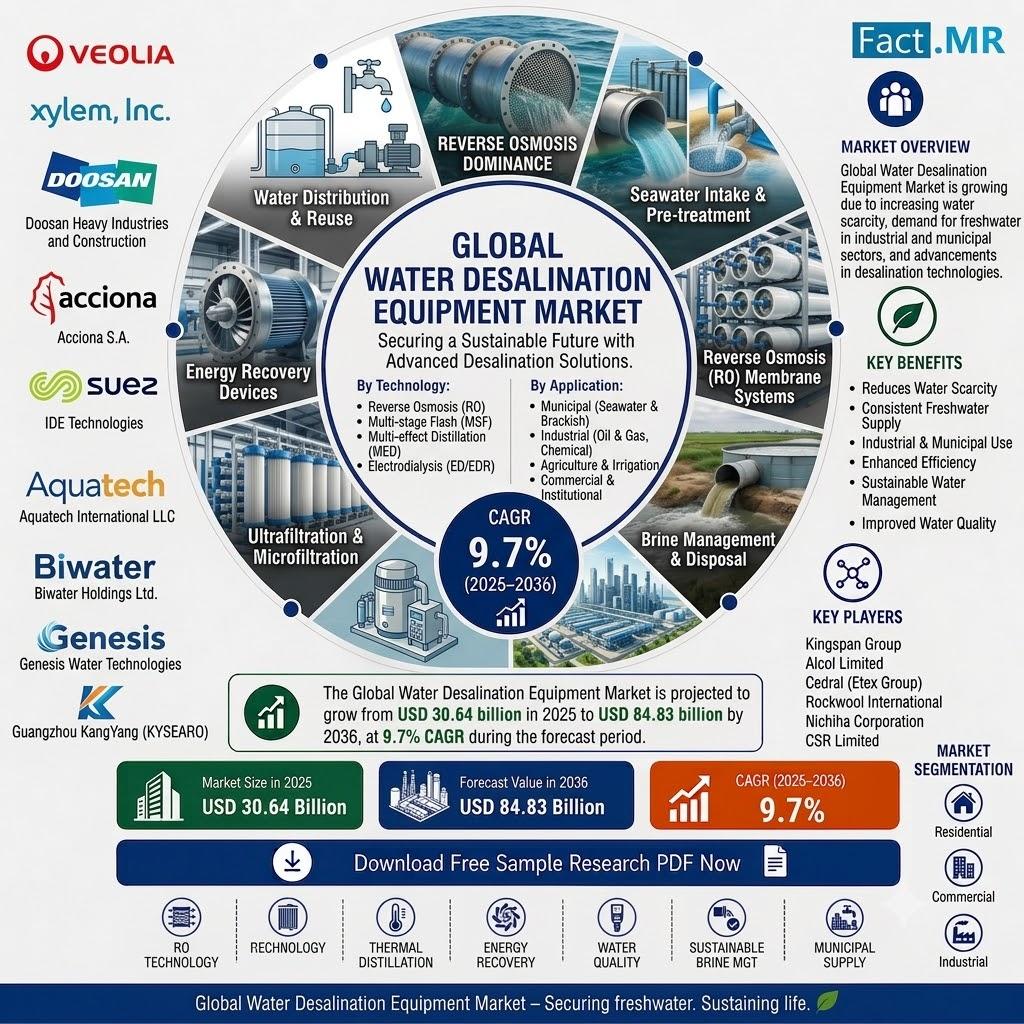
The global Water Desalination Equipment Market is projected to reach USD 84.83 billion by 2036, rising from USD 33.61 billion in 2026 at a 9.7% CAGR, according to Fact.MR. The market was valued at USD 30.64 billion in 2025 and is expected to create an absolute dollar opportunity of USD 51.22 billion between 2026 and 2036. Demand is expanding as freshwater scarcity intensifies across the Middle East, North Africa, South Asia, and water-stressed coastal regions.
The market is also changing beyond municipal water supply. Industrial requirements from power generation, petrochemical processing, semiconductor fabrication, and data center cooling are expanding the addressable equipment base, while declining reverse osmosis membrane costs and improved energy recovery systems are strengthening project economics.
Get detailed market forecasts, competitive benchmarking, and pricing trends: https://www.factmr.com/connectus/sample?flag=S&rep_id=11609
Reverse Osmosis Leads as Desalination Demand Expands
Water Desalination Equipment Market demand is increasingly centered on reverse osmosis (RO), which accounts for the largest technology share. Advanced RO configurations can operate below 3 kWh per cubic meter, supported by improvements in membrane performance, energy recovery devices, and pretreatment systems.
Water desalination equipment includes machinery, membrane systems, high-pressure pumps, energy recovery devices, pretreatment systems, and thermal evaporation units used to convert seawater or brackish water into potable or process-grade water.
Fact.MR is a market research and consulting firm that provides industry intelligence, market forecasts, and strategic analysis across global markets.
Municipal water supply remains the dominant application segment. Large projects typically require integrated packages covering membranes, pumps, energy recovery, pretreatment, and post-treatment systems.
The equipment aftermarket also provides recurring demand. Membrane replacement and related servicing can continue throughout the 20- to 30-year operating life of desalination facilities.
Solar-Powered RO Creates New Equipment Opportunities
Solar-powered reverse osmosis is emerging as a key product trend in the market. Fact.MR analysis indicates that combining photovoltaic power with RO can bring desalinated water costs below USD 0.50 per cubic meter in regions with high solar irradiance.
The Hassyan desalination plant in the UAE illustrates the scale of this development. Veolia, through its SIDEM subsidiary, is executing a USD 320 million technology contract for the first phase of the facility, which has a planned capacity of 818,000 cubic meters per day. Operations are scheduled to commence in 2026.
The combination of renewable electricity and membrane-based desalination also addresses exposure to fossil fuel price volatility. Battery storage and continued photovoltaic cost reductions could support wider deployment of solar-powered RO configurations in suitable markets.
Saudi Arabia and India Register High Growth Rates
Saudi Arabia is projected to record the fastest country-level growth at 10.4% through 2036. Vision 2030 water infrastructure programs and IKTVA local content requirements are supporting equipment procurement and domestic manufacturing development.
India follows at 10.2%. NITI Aayog desalination infrastructure planning, Jal Jeevan Mission water supply targets, coastal city requirements, and industrial water consumption are expanding the country's equipment demand.
China is projected to grow at 10.1%, supported by coastal megacity water programs and industrial requirements from semiconductor and petrochemical facilities. Brazil is expected to expand at 9.3%, while the United States is projected to register 9.1% growth.
The Middle East continues to hold the largest installed desalination capacity globally. Asia Pacific, meanwhile, represents the fastest-growing regional market, with India and China supporting equipment demand through municipal and industrial applications.
Large Projects Support Long-Term Procurement
Government-funded desalination programs are generating multi-year procurement pipelines across Saudi Arabia, the UAE, Israel, and India. These projects require equipment packages covering the core systems needed for large-scale water production.
Capital requirements remain a constraint. Mega-scale desalination projects can require USD 1 billion to USD 4 billion, creating lengthy development periods and financing complexity.
Brine disposal is another consideration. Environmental concerns and tighter discharge regulations can add pretreatment and brine management costs to project budgets.
Thermal desalination also remains exposed to energy prices, particularly where renewable energy integration is limited.
Industrial Water Demand Broadens the Market
The growth opportunity increasingly extends beyond municipal drinking water. Data centers require cooling water, while semiconductor facilities require high-purity water for manufacturing processes.
Petrochemical and power generation facilities also contribute to industrial demand. These applications can require higher equipment specifications, creating opportunities for suppliers with specialized technology portfolios.
Modular and containerized systems represent another application opportunity. These units can support remote communities, disaster relief operations, and temporary industrial water requirements where conventional infrastructure may take longer to deploy.
Shambhu Nath Jha, Principal Consultant at Fact.MR, said, “The water desalination equipment market is entering a structurally different growth phase where capacity additions are no longer driven solely by arid region necessity. Coastal megacities in India, China, and Southeast Asia are now specifying desalination as a planned component of urban water infrastructure rather than an emergency backup.”
Jha added, “Solar powered RO configurations are improving project economics in high irradiance regions, while industrial water demand from data centers and semiconductor fabrication is creating a high value application segment that justifies premium equipment specifications.”
Competitive Landscape
Key companies operating in the Water Desalination Equipment Market include Veolia, Xylem Inc., Doosan Heavy Industries and Construction, Acciona S.A., SUEZ, IDE Technologies, Aquatech International LLC, Biwater Holdings Ltd., Genesis Water Technologies, and Guangzhou KangYang (KYSEARO).
Veolia holds a significant role in large-scale project execution through its SIDEM subsidiary and integrated desalination capabilities. Acciona S.A., IDE Technologies, and SUEZ participate in major project execution, technology supply, and long-term operations and maintenance activities.
Xylem Inc., Doosan Heavy Industries and Construction, Aquatech International LLC, Biwater Holdings Ltd., Genesis Water Technologies, and Guangzhou KangYang (KYSEARO) compete across equipment technologies, project sizes, and geographic markets.
SUEZ and Meridiam signed a 30-year concession contract with Jordan in January 2025 for the Aqaba to Amman desalination and conveyance project. The project has a planned capacity of 851,000 cubic meters per day and EUR 4 billion in total project funding.
To View Top Reports
https://social.mytamam.com/blogs/40084/Global-Stem-Cell-Therapy-Market-to-Reach-USD-27-4
https://net-pals.com/blogs/35117/Stem-Cell-Therapy-Market-Set-to-Reach-USD-27-4
https://uddokta64.com/blogs/7980/Global-Stem-Cell-Therapy-Market-Set-to-Hit-USD-27
https://acmingle.com/blogs/20113/Stem-Cell-Therapy-Market-to-Hit-USD-27-4-Billion
About Fact.MR
Fact.MR is a market research and consulting firm providing syndicated and custom research across global industries. Its research combines secondary research, primary interviews, demand-side modelling, and forecast analysis.
For the Water Desalination Equipment Market study, Fact.MR draws on 140+ secondary sources, benchmarks 50+ company product portfolios, and covers 30+ countries. Primary validation includes 30+ interviews with equipment manufacturers, EPC contractors, utility operators, and water authorities.

 English
 Arabic
 French
 Portuguese
 Deutsch
 Turkish
 Dutch
Dutch
 Italiano
 Russian
 Romaian
 Portuguese (Brazil)
 Greek
Greek
