
A Complete Guide to Trading Signals: How They Work and Why They Matter
Markets rarely wait for anyone. Prices shift while you sleep, work, or eat lunch. Because of that, traders look for tools that watch the market when they simply cannot. Trading signals fill exactly that gap.
Still, plenty of confusion surrounds them. Some traders treat signals as guaranteed profits. Others dismiss them as guesswork. Both views miss the point entirely.
This guide to trading signals explains the full picture in plain language. You will learn what a signal really is, where it comes from, and how experienced traders judge its quality. By the end, you will also recognise the mistakes that quietly drain trading accounts.
What Are Trading Signals?
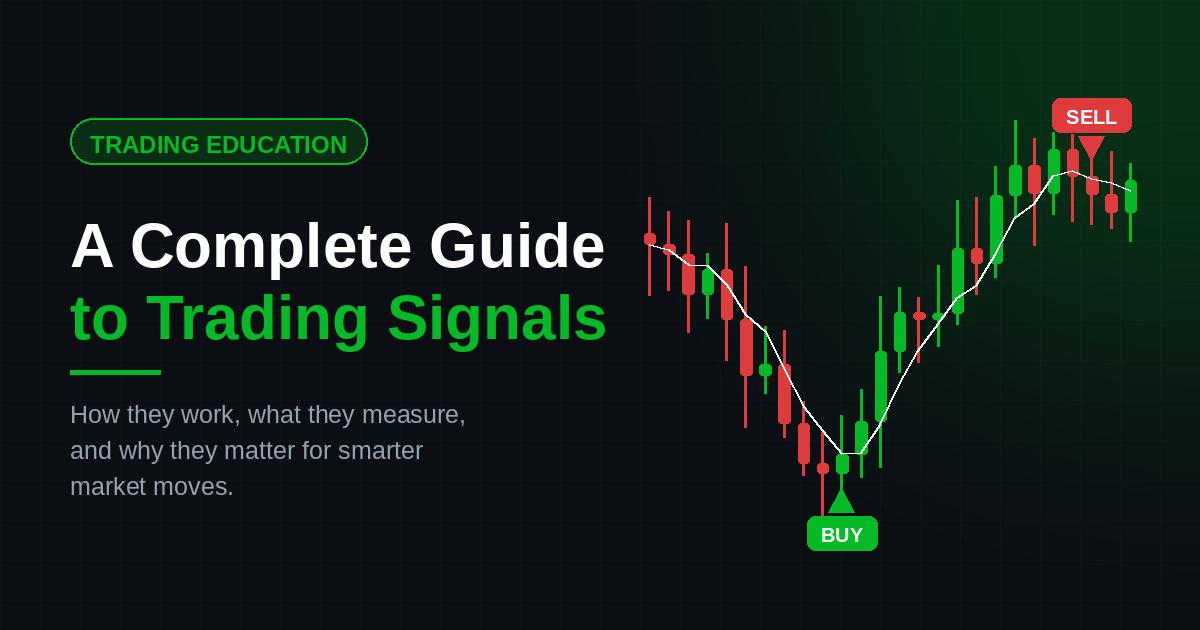
A trading signal is a suggested action in a market. It tells you what to trade, which direction to take, and when to act. Some signals appear as a marker on a chart. Others arrive as a short message on your phone.
Think of a signal as a research shortcut. Someone, or something, has already studied the price data. The signal simply reports the conclusion in a format you can act on.
However, a signal is not a promise. It is an idea supported by rules and past evidence. Therefore, the final decision always stays with you.
How Trading Signals Work
Every alert follows the same basic path, no matter how simple or advanced the system appears. Understanding how trading signals work removes most of the mystery around them.
Step one: data collection
The system reads live market information. Price, volume, volatility, and time all feed into the process. Cleaner data produces cleaner results.
Step two: rule testing
Next, the system compares that data against a fixed set of conditions. A rule might involve a moving average crossover, a break above resistance, or a sudden jump in volume.
Step three: confirmation
Strong systems wait for more than one condition to line up. As a result, random market noise gets filtered out before an alert ever appears.
Step four: delivery
Finally, the signal reaches you. It names the asset, the direction, the entry price, and the exit levels.
Modern platforms repeat this loop every few seconds. Speed genuinely matters here, because a late alert often loses its edge.
The Four Main Types of Trading Signals
Not all alerts share the same logic. In fact, they draw on very different sources of information.
Technical signals
These come directly from price charts. Indicators such as RSI, MACD, and moving averages drive the logic. Because they react quickly, technical signals suit short-term traders.
Fundamental signals
These follow economic data and company performance. Interest rate decisions, earnings reports, and inflation figures all create them. Fundamentals move slowly, so these alerts fit longer holding periods.
Sentiment signals
These measure crowd behaviour instead of price. Positioning data, options flow, and news tone reveal how traders feel. When sentiment reaches an extreme, contrarian opportunities often appear.
Algorithmic signals
These combine several methods inside one automated model. Software scans thousands of charts at once. Consequently, the coverage stretches far beyond any manual review.
Most traders blend two or more types. For example, a trader might use fundamentals for direction and technicals for timing.
Manual Signals Versus Automated Signals
Beyond the four categories above, one more distinction shapes your experience: who produces the alert.
Manual signals come from human analysts. A trader studies the charts, weighs the news, and shares a considered view. Human judgement handles unusual events well, such as surprise announcements or thin holiday markets. On the other hand, humans sleep, get tired, and occasionally act on feeling rather than rules.
Automated signals come from software. Code applies identical logic every single time, without fatigue or mood swings. Backtesting also becomes straightforward, because the rules never change. However, software struggles when conditions fall outside anything it has seen before.
Neither approach wins outright. Many traders therefore use automation for scanning and human judgement for the final call. That mix captures the strengths of both sides.
What a Strong Signal Must Contain
A vague alert helps nobody. Before acting, check that the signal gives you five clear pieces of information:
- Asset — the exact market, pair, or stock
- Direction — buy or sell
- Entry — the price level to open the trade
- Stop loss — the point where the idea has failed
- Take profit — a realistic target for the move
If any piece is missing, you cannot measure your risk properly. Above all, the stop loss carries the most weight. It defines your maximum loss before emotion enters the picture.
Good providers also explain the reasoning. A short note such as "breakout above the weekly range" teaches far more than a bare instruction.
Why Trading Signals Matter
Time comes first. Full chart analysis across several markets takes hours each day. Signals compress that workload into a single alert.
Discipline comes second. Emotion pushes traders to chase rallies and freeze during dips. A rule-based alert reduces that hesitation, because the conditions were agreed in advance.
Coverage comes third. One person can watch five charts properly. Software can watch five hundred without blinking. Therefore, opportunities that you would never spot manually still reach your screen.
Learning comes fourth, and many traders overlook it completely. Every alert shows the logic behind a decision. Over time, you start recognising those same patterns yourself. In short, signals inform and teach at the same time.
Who Actually Uses Trading Signals?
The audience is wider than most people assume. Beginners form the obvious group. New traders lack the screen time to read charts confidently, so a structured alert gives them a starting framework.
Part-time traders form the second group. Many hold full-time jobs and cannot monitor markets during the day. For them, an alert acts as a practical substitute for constant attention.
Experienced traders use them as well, though differently. Rather than following alerts blindly, they treat each one as a prompt to check a chart they had overlooked. In this sense, a signal works like a second pair of eyes.
Even fund managers rely on automated scans. Their systems flag unusual volume or volatility across huge lists of instruments. Because of that, no worthwhile move slips past unnoticed.
Any honest guide to trading signals should add one caveat here. These tools support a trading plan; they never replace one. Traders without risk rules simply lose money faster with alerts than without them.
How to Judge the Top Trading Signals
Quality varies enormously between providers. Fortunately, a handful of checks separate the top trading signals from the noise.
Look at the sample size. Ten winning trades prove nothing at all. Several hundred trades tell a far more honest story about performance.
Check the risk-to-reward ratio. A system with a 45% win rate can still perform well, provided the winners outsize the losers.
Review the maximum drawdown. This figure shows the worst losing streak the system has produced. Ask yourself honestly whether you could sit through that stretch calmly.
Confirm the market conditions. Some systems only shine in trending markets. Others prefer quiet, sideways ranges. Matching the tool to the environment matters enormously.
Demand transparency. Reliable sources publish losses alongside wins. Hidden or vague results usually hide a problem.
Finally, test any new system on a demo account first. Paper trading costs nothing, yet it reveals plenty about the method and about your own reactions.
Common Mistakes When Using Trading Signals
Even accurate alerts fail in careless hands. These errors appear again and again among newer traders.
Ignoring position size ranks first. A perfect entry cannot rescue an oversized trade. Risking one or two percent per position keeps your account alive through inevitable losing runs.
Signal hopping follows closely behind. Traders abandon a system after two losses, then jump to another one. Yet no strategy wins every single week. Patience across a full market cycle reveals the truth.
Trading every alert causes trouble as well. Some ideas clash with your schedule, your risk limits, or your knowledge of that particular market. Selectivity always beats volume.
Skipping the exit plan is the quietest mistake of all. Many traders act on the entry and then forget the stop loss. Consequently, one bad position erases a month of steady progress.
Blind trust creates the final problem. When someone starts using trading signals without understanding the logic behind them, panic arrives at the first drawdown. Understanding builds the patience that results require.
Trading Signals for Smarter Market Moves
Alerts alone change very little. Routine turns them into results.
Start by choosing one or two markets you genuinely understand. Familiar charts help you judge whether an alert makes sense in context.
Next, set fixed risk rules before the trading week begins. Decide your maximum risk per trade and your maximum open positions. Written rules resist pressure far better than instinct does.
When an alert arrives, pause for thirty seconds. Ask whether the trade fits your plan, your risk limit, and your available time. If the answer is no, skip it without regret. Missing a trade costs nothing, while a rushed trade costs money.
Consider the wider context too. Check whether major economic news lands within the next hour, since announcements can flip a clean setup within seconds. A quick look at the daily chart also shows whether the alert works with the larger trend or against it.
Keep a simple journal too. Record the signal, your action, and the outcome each time. After fifty entries, clear patterns start to emerge. Because of that record, you improve much faster than guesswork allows.
Traders who rely on trading signals for smarter market moves treat every alert as one input among several. Position size, market context, and personal discipline complete the picture.
Realistic Expectations Beat Perfect Promises
No system wins every trade. Anyone promising certainty deserves immediate suspicion.
Losing trades are simply a cost of doing business. A solid method produces small, controlled losses and larger gains across a long series of positions. Judge performance over months rather than days, because short samples mislead constantly.
Fees matter as well. Spreads, commissions, and slippage quietly reduce returns. A strategy that looks profitable on paper can break even in reality once those costs land. Always account for them before committing serious capital.
Finally, remember that markets evolve. A method that worked brilliantly two years ago may struggle today. Regular review keeps your approach aligned with current conditions.
Final Thoughts
Trading signals are tools, not shortcuts to guaranteed profit. They save time, sharpen discipline, and widen your view of the market. Used carelessly, though, they encourage overtrading and false confidence.
The traders who benefit most share a few habits. They understand the logic behind each alert. They size positions sensibly. Moreover, they stick with a tested method long enough to see honest results.
Treat this guide to trading signals as a foundation rather than a finish line. Study the reasoning, test carefully, and build your own judgement alongside the technology. That combination, over time, produces far steadier outcomes than any single alert ever could. GainzAlgo shares educational resources on this topic for traders who want to understand the mechanics behind the charts.

 Arabic
 French
 Spanish
 Portuguese
 Deutsch
 Turkish
 Dutch
Dutch
 Italiano
 Russian
 Romaian
 Portuguese (Brazil)
 Greek
Greek
