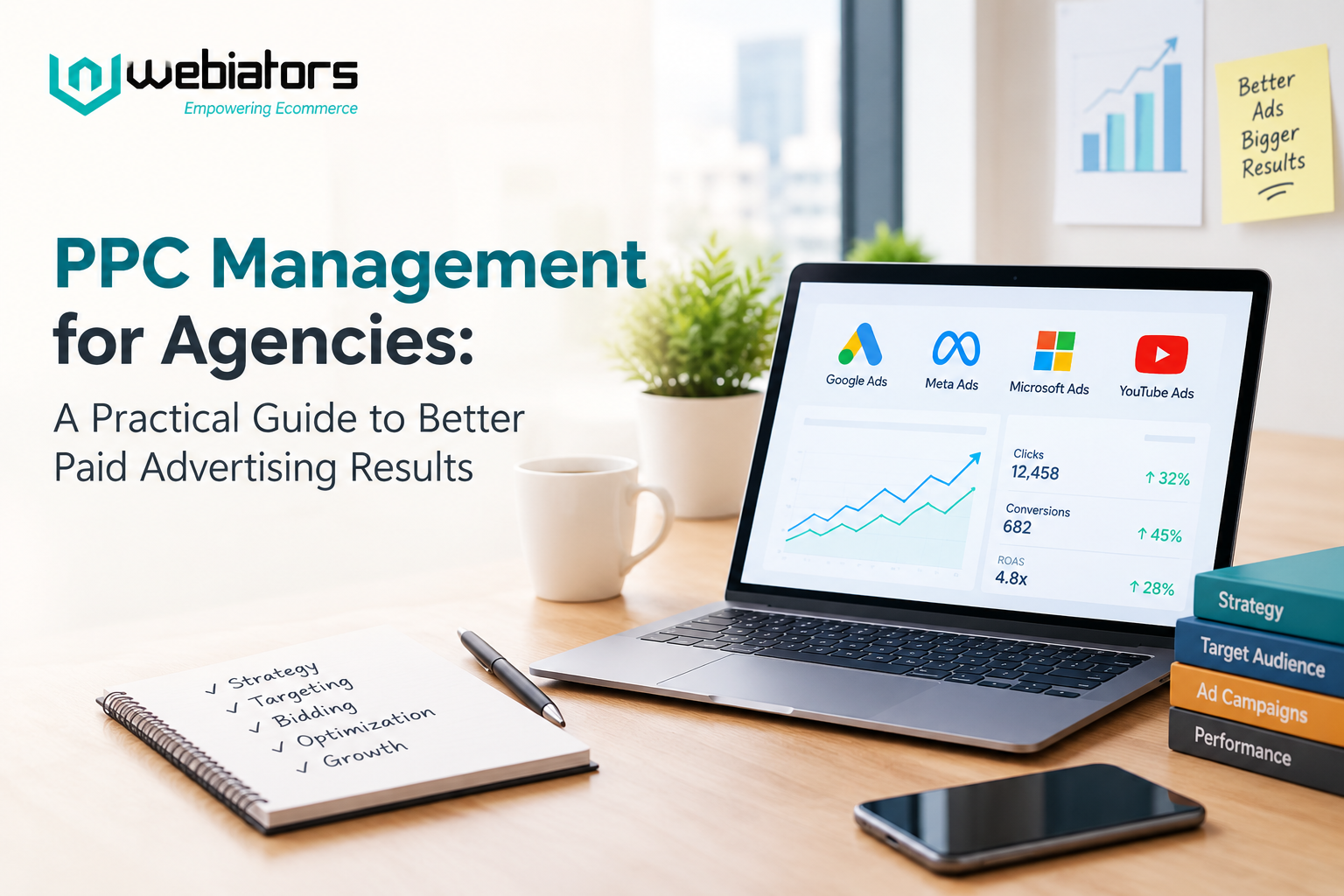
Digital marketing agencies are under constant pressure to deliver measurable results. Clients want more leads, sales, website traffic, and better returns from their advertising budgets. At the same time, agencies must manage multiple accounts, campaigns, platforms, audiences, and reporting requirements.
This is why a strong approach to PPC management for agencies is important. PPC advertising is not simply about creating ads and setting a daily budget. Successful campaigns require strategy, keyword research, audience targeting, creative testing, conversion tracking, optimisation, and regular performance analysis.
For agencies looking to grow their paid advertising services, a structured PPC strategy can help improve efficiency while delivering campaigns aligned with each client's business goals.
What Is PPC Management for Agencies?
PPC management for agencies involves planning, creating, monitoring, and optimising paid advertising campaigns for multiple clients. Depending on client requirements, agencies may manage search ads, display campaigns, shopping ads, remarketing campaigns, and paid social advertising.
The main objective is to turn advertising spend into measurable business outcomes.
A complete PPC management process can include:
- Campaign strategy and planning
- Keyword and competitor research
- Audience targeting
- Ad copy and creative development
- Budget allocation
- Bid management
- Conversion tracking
- Landing page recommendations
- Campaign optimisation
- Performance reporting
Every client has different objectives. An ecommerce brand may focus on purchases and return on ad spend, while a service-based business may prioritise leads, phone calls, or form submissions. This means agencies should avoid using exactly the same strategy for every account.
Why PPC Is Important for Modern Marketing Agencies
PPC advertising can help businesses reach potential customers at different stages of their buying journey. Search campaigns can target users actively looking for products or services, while social advertising can help businesses reach relevant audiences based on interests, behaviour, demographics, and other available targeting options.
For an agency, paid advertising can also become an important service for building long-term client relationships. When campaigns are managed properly, clients receive regular performance data and can better understand how their marketing budget is being used.
However, managing campaigns manually without a proper system can become difficult as an agency grows. A team handling ten or twenty client accounts needs clear processes for account setup, optimisation, communication, and reporting.
This is where professional PPC management for agencies can support scalable operations.
Start With Clear Campaign Goals
Marketing success starts with knowing what the campaign is expected to achieve.
Before launching ads, agencies should discuss key business goals with the client. Common PPC objectives include generating leads, increasing ecommerce sales, promoting specific services, driving app downloads, increasing registrations, or bringing qualified traffic to a website.
Once the objective is clear, agencies can choose relevant performance indicators.
For example, useful metrics may include:
- Cost per lead
- Conversion rate
- Cost per acquisition
- Return on ad spend
- Revenue generated
- Click-through rate
- Qualified traffic
A high number of clicks does not always mean a successful campaign. If visitors do not take meaningful action after arriving on the website, agencies need to investigate targeting, ad messaging, offers, and landing page experience.
Keyword Research Plays a Major Role
For search-based campaigns, keyword selection directly affects the type of traffic reaching a website.
Agencies should look beyond search volume alone. A keyword may receive a large number of searches but have little connection to the client's actual service or product. Search intent is equally important.
Commercial and transactional keywords can often indicate that a user is actively researching or preparing to take action. Informational keywords may work better for awareness-focused campaigns or content strategies.
Negative keyword management is also an important part of campaign optimisation. Excluding irrelevant searches can help reduce wasted spending and improve traffic relevance.
Regular search-term analysis can also reveal new keyword opportunities that agencies may not have identified during initial campaign research.
The Growing Role of Meta Ads Management
Paid advertising strategies are no longer limited to search engines. Social platforms offer agencies another way to reach potential customers.
Meta Ads management can involve creating campaigns, defining audiences, testing ad creatives, managing budgets, building retargeting strategies, and analysing conversions.
One advantage of paid social advertising is the ability to test different messages and creative formats. A business can experiment with videos, images, carousels, offers, product promotions, and lead-generation campaigns depending on available platform options.
For agencies, combining search and social campaigns can create a broader marketing approach.
Search ads can help capture existing demand from people actively looking for solutions. Meta advertising can support awareness, product discovery, audience engagement, and remarketing. The best channel mix depends on the client's industry, goals, budget, audience, and buying cycle.
Why Social Media Optimization Services Still Matter
Paid advertising works more effectively when it supports a wider digital marketing strategy.
Social Media Optimization Services focus on improving how a business presents itself across social platforms. This may include profile optimisation, content planning, brand consistency, audience engagement, and creating content around customer interests.
When businesses maintain active and relevant social profiles, paid campaigns can work alongside their organic presence. Potential customers who see an advertisement may also visit the brand's social profile before making a decision.
For this reason, agencies should consider how paid and organic marketing activities connect instead of managing every channel completely separately.
Conversion Tracking and Landing Pages Are Essential
Campaign decisions should be based on reliable data.
Before scaling advertising budgets, agencies need to confirm that important actions are tracked correctly. Depending on the business, conversions may include purchases, enquiries, phone calls, registrations, downloads, or submitted forms.
Without proper tracking, it becomes difficult to understand which campaigns are generating meaningful results.
The landing page also plays a major role. Even an excellent ad campaign can struggle if visitors arrive on a slow, confusing, or irrelevant page.
Agencies should review whether the page:
- Loads quickly
- Works properly on mobile devices
- Matches the advertisement
- Explains the offer clearly
- Includes a visible call to action
- Builds trust with relevant information
Improving the post-click experience can be just as important as improving the advertisement itself.
How Agencies Can Scale PPC Services
As client accounts increase, agencies need repeatable systems.
Campaign templates, documented processes, regular optimisation schedules, reporting formats, and quality checks can help teams manage accounts more efficiently. Automation may also support repetitive tasks, but important decisions should still be reviewed against campaign data and client goals.
White-label support can also be an option for agencies that want additional execution resources while maintaining their client relationships.
Webiators provides digital marketing support for businesses and agencies, including paid advertising strategies, PPC management for agencies, Meta Ads management, and Social Media Optimization Services.
Final Thoughts
Successful paid advertising requires continuous attention. Markets change, competitors update their campaigns, customer behaviour shifts, and advertising platforms regularly introduce new features.
For agencies, the goal should be to build a repeatable process while keeping every client's business objectives in focus.
Strong PPC management for agencies combines strategy, relevant targeting, creative testing, accurate conversion tracking, landing page improvements, and regular optimisation. By connecting PPC with Meta advertising and broader social media optimisation, agencies can create more coordinated marketing campaigns focused on measurable business outcomes.


 English
 Arabic
 Spanish
 Portuguese
 Deutsch
 Turkish
 Dutch
Dutch
 Italiano
 Russian
 Romaian
 Portuguese (Brazil)
 Greek
Greek
