
United States Digital Therapeutics Market Report: Growth & Future Outlook
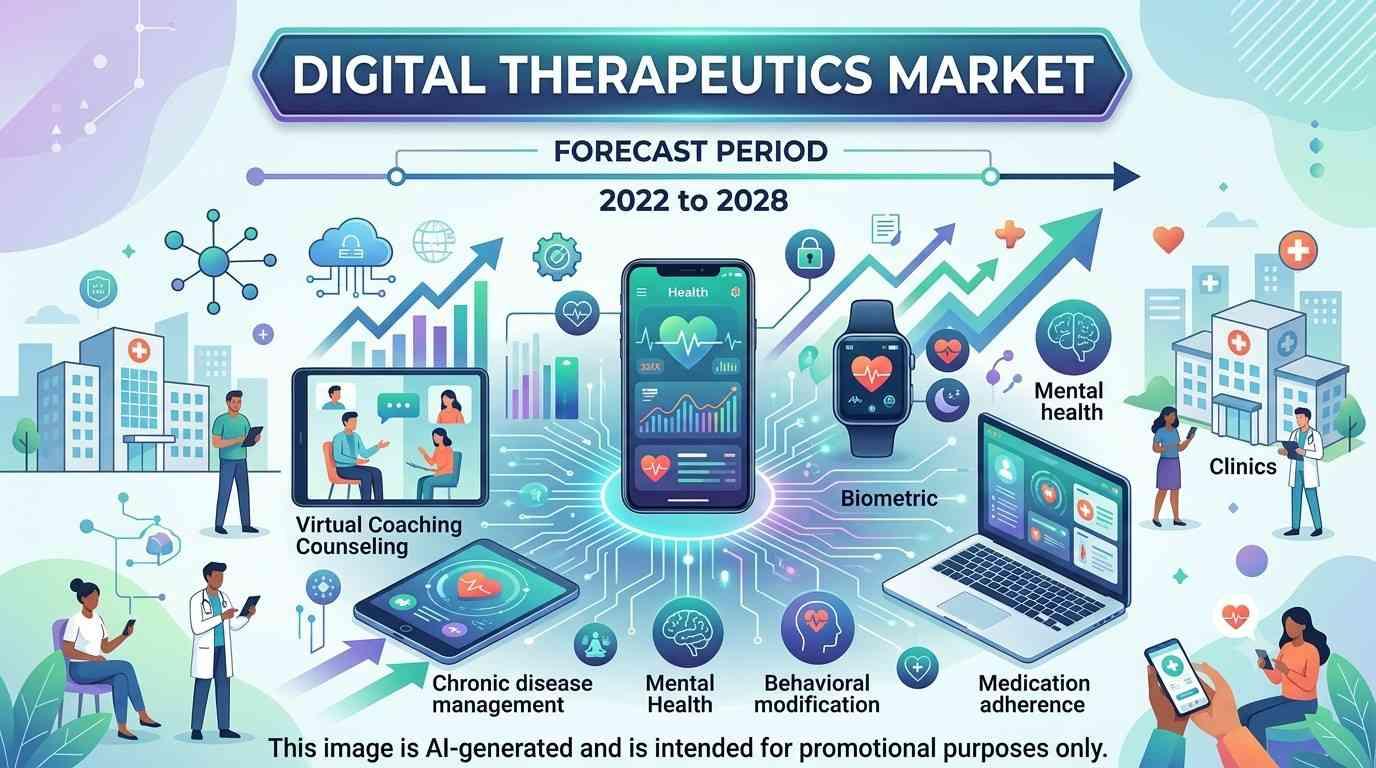
The Digital Therapeutics Market in the United States is expanding as healthcare providers, technology companies, and patients increasingly adopt software-based therapeutic solutions to support the prevention, management, and treatment of various health conditions. Growing emphasis on value-based care, remote patient engagement, personalized treatment, and digital health integration is contributing to market development.
The digital therapeutics market size was valued at US$ 4,226.94 million in 2021 and is projected to reach US$ 18,061.79 million by 2028; it is estimated to register a CAGR of 23.1% from 2022 to 2028.
What is driving the market?
Rising chronic disease prevalence, demand for cost-effective remote care, and expanding mobile/wearable infrastructure are the principal growth drivers. Healthcare systems and payers are increasingly seeking scalable digital solutions to manage conditions like diabetes, cardiovascular diseases, and mental health disorders without placing excessive burden on physical clinical capacity. Employers and insurers are adopting DTx tools to reduce claims and improve long-term outcomes.
The market is shifting beyond simple health-tracking apps toward clinically validated, prescription-grade interventions. Developers are integrating artificial intelligence for real-time adaptive feedback, continuous biometric tracking via wearables, and seamless EHR integration. Inconsistent reimbursement policies across regions, strict regulatory approval pathways, and data privacy/security requirements remain important constraints.
Which region leads?
North America leads the market, accounting for an estimated 38%–42% share in 2025, driven by mature healthcare IT infrastructure, high smartphone adoption, established coverage pathways, and strong investment in digital health start-ups. The United States remains the single largest national market.
Europe holds an estimated 26%–30% share, supported by structured reimbursement frameworks such as Germany's DiGA pathway and expanding digital care access across the EU. Asia Pacific is identified as the fastest-growing region, with a projected CAGR of 32%–36% through 2033. Growth in Asia Pacific is propelled by rapid digital transformation, expanding internet coverage, rising chronic disease burden, and government-backed health digitization in China, India, Japan, and South Korea.
Which segment leads?
By application, Diabetes Management is the leading therapeutic segment, accounting for an estimated 24%–28% of market revenue in 2025. Its position is supported by high global diabetes prevalence, demand for continuous glucose monitoring, and strong clinical efficacy of digital coaching and insulin management software. Central Nervous System (CNS) & Mental Health disorders represent another rapidly growing application area.
By offering, Software & Applications leads the market, capturing over 60% of revenue share due to high scalability, accessibility via mobile devices, low incremental distribution costs, and regular cloud-based functional updates.
Which companies are prominent?
The report identifies Omada Health, Inc., Teladoc Health, Inc. (Livongo), Welldoc, Inc., ResMed Inc. (Propeller Health), Noom, Inc., Akili Interactive Labs, Click Therapeutics, Inc., DarioHealth Corp., Big Health, and Biofourmis Inc. as prominent market participants.
These companies compete across cardiometabolic care, mental health interventions, respiratory management, behavioral health, and prescription digital therapeutics. Strategic differentiation increasingly depends on clinical trial data, regulatory approvals (e.g., FDA clearance, CE mark), payer reimbursement coverage, EHR interoperability, and strategic partnerships with pharmaceutical firms and health systems. The list reflects the competitive landscape rather than a revenue-ranked market-share table.
What is changing in 2026?
The market is shifting from standalone wellness tools toward integrated, reimbursement-ready healthcare solutions. Digital therapeutic tools increasingly feature generative AI, real-time behavioral nudging, multimodal biometric tracking, and direct EHR workflow integration for clinicians.
Regulatory and payer alignment has accelerated, with expanding prescription coverage pathways in North America and Western Europe reducing time-to-market for validated platforms. Procurement and enterprise adoption decisions are driven by real-world clinical evidence, longitudinal patient adherence metrics, cost-benefit claims data, and compliance with stringent patient privacy standards.
What are the major investment opportunities?
The strongest opportunities lie in AI-driven personalized therapeutics, cardiometabolic care, mental health software, and hybrid care models combining human coaching with digital delivery. Investment in continuous clinical validation, robust real-world evidence generation, and regulatory compliance infrastructure offers significant long-term returns.
Additional opportunities exist in interoperability middleware, remote patient monitoring (RPM) integration, sub-specialty areas like addiction recovery and post-surgical care, and localized platforms tailored to emerging markets across Asia Pacific and Latin America. Investors should prioritize solutions that demonstrate clear clinical efficacy, strong patient retention, seamless workflow integration, and explicit reimbursement pathways.
The Insight Partners provides comprehensive syndicated and tailored market research services in the healthcare, technology, and industrial domains. Renowned for delivering strategic intelligence and practical insights, the firm empowers businesses to remain competitive in ever-evolving global markets.
• Email: sales@theinsightpartners.com
• Website: theinsightpartners.com
• Phone: +1-646-491-9876

 English
 Arabic
 French
 Spanish
 Portuguese
 Deutsch
 Turkish
 Dutch
Dutch
 Italiano
 Romaian
 Portuguese (Brazil)
 Greek
Greek
