
United States Automotive Usage-Based Insurance Market Share, Trends & Outlook (2025–2031)
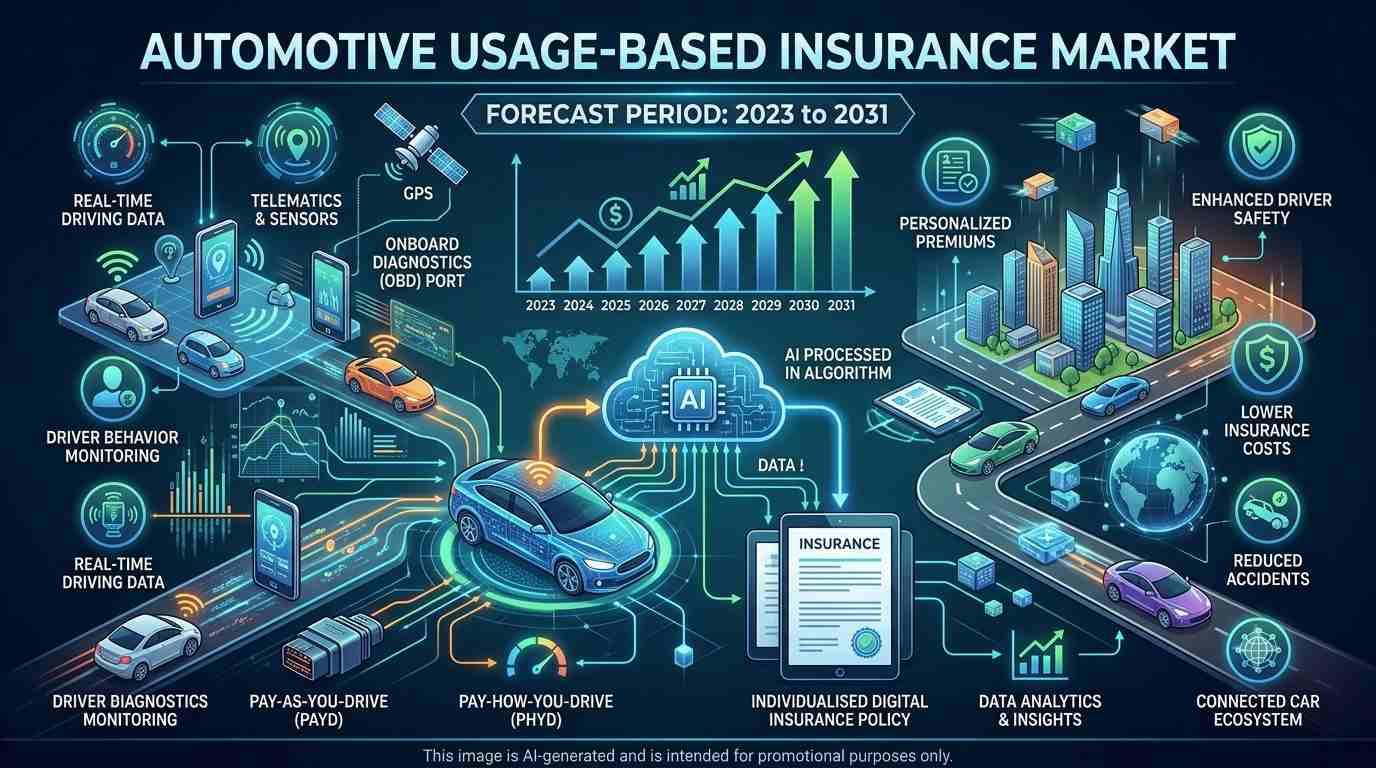
The United States Automotive Usage-Based Insurance Market is expanding as insurers increasingly adopt telematics, connected-car technologies, and data-driven risk assessment to develop more personalized motor insurance products. Usage-based insurance programs allow insurers to evaluate driving behavior through factors such as mileage, speed, braking patterns, acceleration, and time of vehicle use. Growing adoption of connected vehicles, smartphone-based telematics applications, and advanced vehicle data platforms is supporting market development across the US.
The automotive usage based insurance market size is projected to reach US$ 240.8 billion by 2031 from US$ 52.1 billion in 2023. The market is expected to register a CAGR of 21.1% in 2023–2031.
What is driving the market?
The widespread adoption of connected vehicle ecosystems, AI-powered underwriting, and consumer demand for cost-effective premiums are the principal growth drivers. Insurers are increasingly leveraging big data and machine learning to build risk models that process hard braking, acceleration profiles, distracted driving, and time-of-day patterns. Furthermore, regulatory support such as regional safety mandates for factory-fitted emergency telematics systems has accelerated the hardware prerequisites for mass UBI enrollment. Both individual consumers and commercial fleet operators are seeking insurance structures that lower fixed costs without compromising comprehensive coverage or claims efficiency.
The transition is moving beyond simple aftermarket hardware (like OBD dongles) toward seamless, software-driven enrollment. Suppliers are investing heavily in mobile telematics, smartphone integration, cloud-native data platforms, and direct OEM partnerships. Data privacy concerns, the fragmentation of telematics standards across mixed vehicle fleets, and the high initial costs of robust data infrastructure remain important constraints.
Which region leads?
North America leads the market, accounting for an estimated 44% share in 2025. Growth is supported by early consumer adoption of connected cars, highly advanced telematics infrastructure, and extensive collaborations between leading insurers and technology providers. The U.S. remains the dominant revenue contributor as top-tier insurance carriers scale AI-enabled, behavior-based pricing across personal auto insurance segments.
Europe holds the second-largest share, supported by stringent vehicular safety regulations, favorable telematics mandates, and growing OEM-embedded UBI partnerships. Asia Pacific is identified as the fastest-growing region, with significant expansion potential as rising passenger vehicle sales coincide with increasing smartphone penetration and a growing appetite for mobility-as-a-service models in developing economies.
Which segment leads?
By policy type, Pay-As-You-Drive (PAYD) is the leading segment, capturing an estimated 38% to 59% of the market share in 2025/2026. Its position is supported by its clear, mileage-based economic benefits for customers with short commutes and the straightforward nature of tracking distance. The segment is heavily favored by consumers looking for direct cost savings based on reduced driving time.
By vehicle type, Passenger Vehicles lead with an estimated 68%–72% share, reflecting massive consumer automotive applications and high enrollment in personal UBI programs. Within the technology/solution category, Smartphones and Embedded Systems are identified as high-growth segments. Embedded telematics is growing particularly fast, as major OEMs make data transmission hardware standard at the factory level, enabling frictionless insurance onboarding.
Which companies are prominent?
The report identifies The Progressive Corporation, Allstate Insurance Company, Cambridge Mobile Telematics (CMT), Octo Telematics, Liberty Mutual Insurance, Verisk Analytics, LexisNexis Risk Solutions, Geotab, and IMS as prominent market participants.
These companies compete across predictive analytics, mobile telematics platforms, embedded software solutions, and direct-to-consumer insurance products. Strategic differentiation increasingly depends on data accuracy, seamless OEM integration, multi-modal driving behavior scoring (combining smartphone, IoT, and dashcam data), automated claims adjudication, and the ability to deploy privacy-compliant UBI programs at commercial scale. The list reflects the competitive landscape rather than a revenue-ranked market-share table.
What is changing in 2026?
The market is shifting from physical retrofit devices (such as aftermarket black boxes) toward OEM-embedded telematics rollouts and factory-fit data systems that fundamentally reshape underwriting economics. Vehicle specifications increasingly include native telematics integration, allowing for hardware-free data transmission directly from the factory line. This removes the friction of aftermarket installation and provides insurers with richer, more stable telemetry to accurately price risk.
Insurers are accelerating the use of AI algorithms for real-time premium personalization, automated claims processing, and fraud detection. Commercial auto insurers are also expanding fleet pay-per-mile adoption, driven by gig economy and logistics fleets seeking usage-based pricing models rather than static annual assumptions. Procurement of telematics platforms is increasingly linked to proven reductions in claims frequency and seamless, front-end customer experiences.
What are the major investment opportunities?
The strongest opportunities lie in cloud-native telematics platforms, AI-driven risk modeling software, embedded OEM partnerships, and commercial fleet applications. Investment in data normalization layers, automated claims orchestration, fraud detection, and cybersecurity can significantly improve the usability and security of vehicle-generated data. Long-term partnerships between automakers and insurtech firms can help carriers secure direct data pipelines and reduce reliance on third-party hardware.
Additional opportunities include multi-modal driving behavior platforms that fuse smartphone sensor data with vehicle IoT, unlocking accurate crash detection and driver coaching. Solutions catering to the gig economy such as flexible, on-demand insurance for ride-share or delivery fleets also present strong recurring revenue potential where data capture and risk assessment operate economically at scale.
Europe and Asia Pacific offer attractive expansion potential through developing connected-car infrastructure and growing regulatory support for telematics. Investors should prioritize platforms that combine high underwriting accuracy, robust data privacy compliance, frictionless customer onboarding, and demonstrated compatibility with multiple OEM data protocols.
The Insight Partners provides comprehensive syndicated and tailored market research services in the healthcare, technology, and industrial domains. Renowned for delivering strategic intelligence and practical insights, the firm empowers businesses to remain competitive in ever-evolving global markets.
• Email: sales@theinsightpartners.com
• Website: theinsightpartners.com
• Phone: +1-646-491-9876

 English
 Arabic
 French
 Spanish
 Portuguese
 Deutsch
 Turkish
 Dutch
Dutch
 Russian
 Romaian
 Portuguese (Brazil)
 Greek
Greek
