
Medical Polyoxymethylene Market Poised to Reach USD 3.7 Billion by 2036
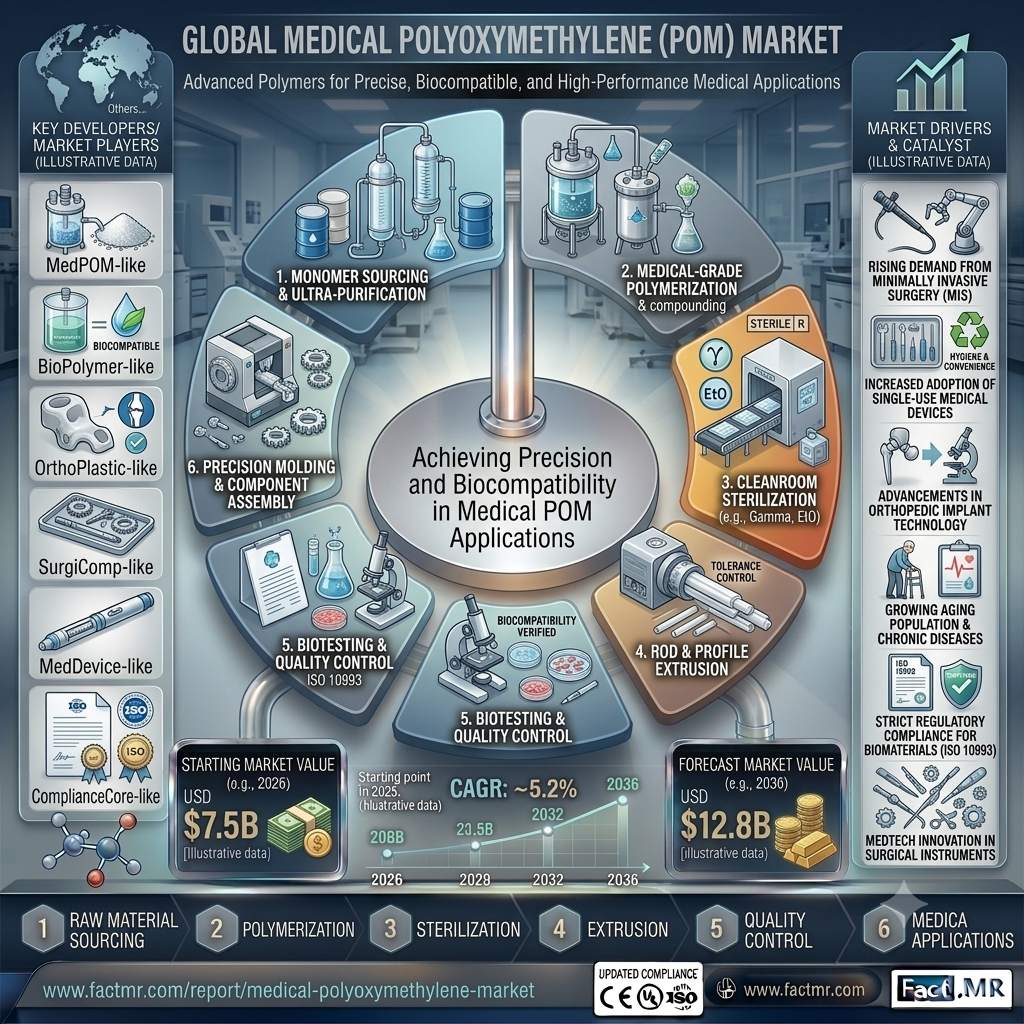
Rockville, MD., September 16, 2026 — The Medical Polyoxymethylene Market is projected to reach USD 3.7 billion by 2036, rising from USD 1.6 billion in 2026 at a CAGR of 8.6%, according to Fact.MR. The market was valued at USD 1.5 billion in 2025. Demand is shifting toward certified medical-grade POM as drug delivery, surgical, dialysis, and inhaler manufacturers face tighter requirements for biocompatibility and material traceability.
The shift is specification-led. Fact.MR states that copolymer POM holds 63% share in 2026, while insulin pens account for 30% of application share. Medical device manufacturers increasingly require USP Class VI and ISO 10993 documentation before qualifying POM for regulated applications.
Get detailed market forecasts, competitive benchmarking, and medical-grade polymer insights: https://www.factmr.com/connectus/sample?flag=S&rep_id=14793
Medical Polyoxymethylene Market Moves Toward Certified Copolymers
Fact block: Fact.MR is a market research company that analyzes medical POM demand across polymer types, medical applications, regions, certification requirements, and suppliers.
Medical polyoxymethylene is used in precision components for insulin pens, dialysis machines, surgical instruments, and inhalers. The material provides dimensional stability, chemical resistance, and low friction, making it suitable for components that require consistent performance during repeated operation.
Copolymer POM leads the market. Fact.MR puts its share at 63% in 2026, citing broader certification acceptance and stronger hydrolysis resistance than homopolymer grades. These characteristics support its use in medical components exposed to sterilization cycles and demanding operating environments.
Certification has become a direct procurement requirement. Fact.MR states that medical POM suppliers must meet USP Class VI and ISO 10993 standards, with full traceability documentation increasingly required by drug delivery OEMs. A formulation change can trigger full requalification for an approved device application.
One specific commercial detail stands out. Fact.MR reports that medical-grade POM typically commands a 25% to 40% price premium over standard grades. The premium reflects certification requirements and the qualification work needed for regulated medical device applications.
The European regulatory environment is reinforcing this shift. EU Medical Device Regulation 2017/745 requires biocompatibility evaluation for patient-contact materials, and Fact.MR identifies ISO 10993 documentation as increasingly important for surgical and inhaler component manufacturers.
Insulin Pens Lead Medical POM Applications
Insulin pens account for 30% of application share in 2026, according to Fact.MR. Rising diabetes-device production is increasing demand for precision polymer components used in cartridges, dose mechanisms, and related assemblies.
Dialysis machines, surgical instruments, and inhalers form other important application areas. POM is used where manufacturers require stable dimensions, chemical resistance, and controlled friction during device operation.
Fact.MR also identifies a specific inhaler market signal. The European Pharmaceutical Aerosol Group reported 18% growth in 2024, with medical-grade POM used in inhaler mechanisms that require precision and dimensional stability.
The qualification process creates another barrier. Fact.MR reports that changing an approved POM supplier can require complete requalification and may take 12 to 24 months. This encourages device manufacturers to maintain established supplier relationships once a material grade has been validated.
India Records the Fastest Country-Level Growth
Fact.MR projects India to grow at a 9.3% CAGR through 2036, followed by China at 8.8%, the United States at 8.3%, Germany at 7.5%, and Japan at 7.0%.
India's growth is linked to domestic medical device manufacturing and government-backed production incentives. The report identifies insulin pens, inhalers, and surgical components as areas benefiting from manufacturing localization under India's Production Linked Incentive scheme.
China remains the largest volume center for medical device production in the report's regional assessment. Its medical POM market is projected to expand at 8.8% CAGR, supported by insulin pen and surgical device manufacturing and procurement of certified materials through OEM supply chains.
The United States is projected to expand at an 8.3% CAGR. Fact.MR links demand to advanced drug delivery systems, surgical devices, FDA documentation requirements, and increasing attention to domestic medical-device supply chains.
Medical POM Suppliers Expand Certified Grades
The competitive landscape includes Celanese Corporation, Polyplastics Co., Ltd., BASF SE, DuPont, Mitsubishi Engineering-Plastics Corporation, SABIC, and Asahi Kasei Corporation. These suppliers compete through certified grades, technical support, OEM qualification, and application-specific material development.
Celanese Corporation expanded its Hostaform medical-grade copolymer POM portfolio in 2024, with new grades targeting insulin pen and inhaler components. Fact.MR identifies the development as supporting USP Class VI and ISO 10993 qualification requirements.
BASF SE introduced an updated Ultraform grade in 2025 targeting low-formaldehyde migration and EU MDR compliance. The development addresses requirements for medical components used in regulated European applications.
Polyplastics Co., Ltd. expanded its insulin pen OEM supply program in 2024, offering USP Class VI-certified grades with technical support. Mitsubishi Engineering-Plastics Corporation launched a dialysis-grade POM in 2025, targeting chemical resistance and steam sterilization requirements.
Shambhu Nath Jha, Principal Consultant at Fact.MR, said, “Biocompatibility certification is the primary qualification barrier.” He added that medical POM requires USP Class VI and ISO 10993 compliance, while full traceability documentation is essential for regulated device applications.
The market is expected to generate approximately USD 2.1 billion in incremental revenue between 2026 and 2036. Fact.MR identifies device production growth in Asia Pacific, surgical instrument localization, and expanding dialysis infrastructure as contributors, while certification timelines and formaldehyde migration requirements remain constraints.
Top Reports:
https://adamaamresearch.blogspot.com/2026/09/copper-market-projected-to-hit-usd.html
https://social.mytamam.com/blogs/39760/Copper-Market-to-Hit-USD-511-78-Billion-by-2036
https://zeuspage.org/blogs/54677/Copper-Market-Set-to-Reach-USD-511-78-Billion-by
https://kaamkaaziclub.com/read-blog/52208
About Fact.MR
Fact.MR is a market research and consulting company providing market intelligence, forecasts, competitive analysis, and industry research across global markets. Its medical polyoxymethylene research covers the 2026–2036 forecast period and evaluates demand by POM type, medical application, region, country, and certification requirements.

 English
 French
 Spanish
 Portuguese
 Deutsch
 Turkish
 Dutch
Dutch
 Italiano
 Russian
 Romaian
 Portuguese (Brazil)
 Greek
Greek
