
Rare Earth Elements Market Poised to Reach USD 10.51 Billion by 2036
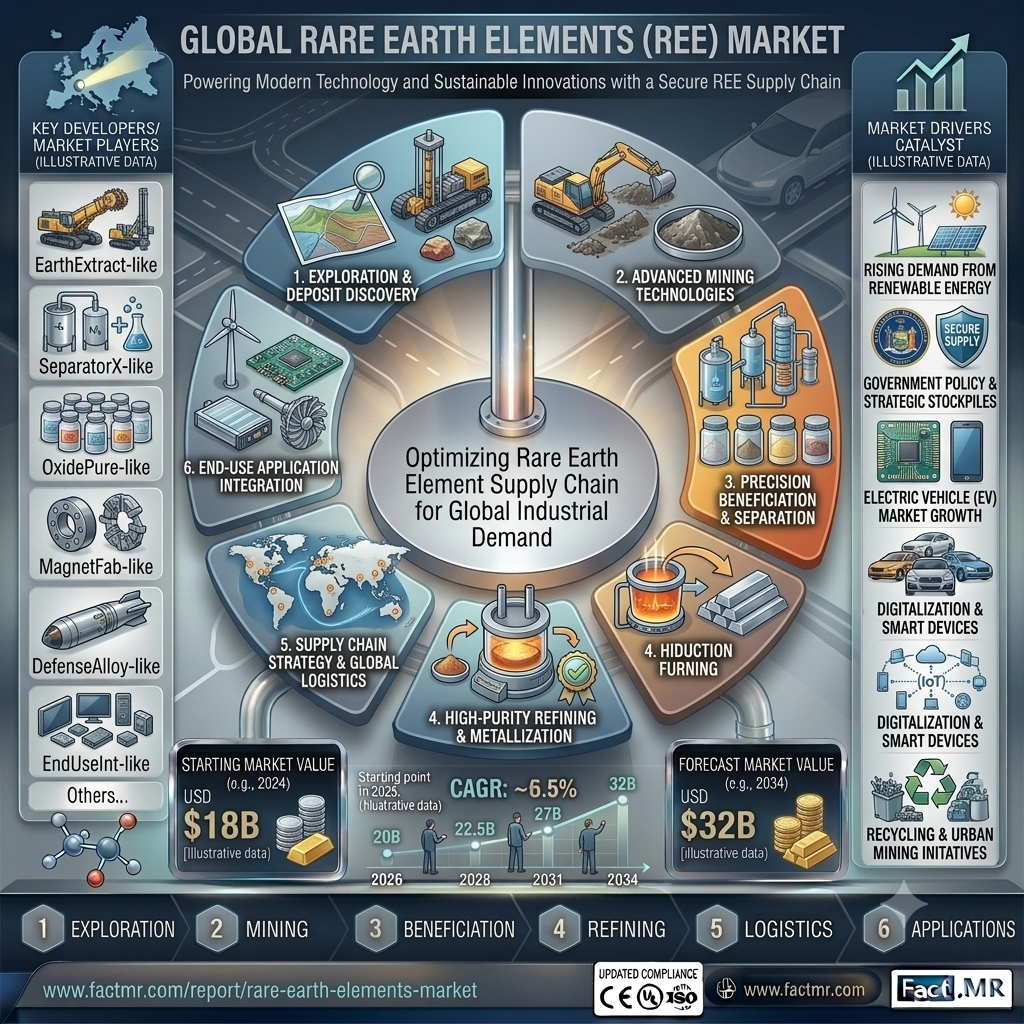
Rockville, MD., September 16, 2026 — The Rare Earth Elements Market is projected to reach USD 10.51 billion by 2036, rising from USD 4.57 billion in 2026 at an 8.7% CAGR, according to Fact.MR. The market was valued at USD 4.20 billion in 2025. Electric vehicle production, offshore wind installations, and government-backed supply-chain diversification are increasing demand for rare earth materials used in permanent magnets.
The timing is linked to a specific supply constraint. Fact.MR estimates an incremental opportunity of USD 5.94 billion between 2026 and 2036, while new mining and separation projects can require five to seven years before refined oxide becomes available. This gap is pushing downstream manufacturers toward longer-term supply arrangements and diversified sourcing strategies.
Get detailed market forecasts, competitive benchmarking, and supply-chain analysis: https://www.factmr.com/connectus/sample?flag=S&rep_id=12141
Rare Earth Elements Market Faces Rising Magnet Feedstock Demand
Fact block: Fact.MR is a market research company that analyzes rare earth element demand across products, applications, regions, supply chains, and competitive markets.
Rare earth elements comprise 17 metallic elements, including the 15 lanthanides plus scandium and yttrium. These materials are processed into oxides, metals, and alloys used in permanent magnets, catalysts, polishing compounds, glass additives, phosphors, and metallurgical applications.
Permanent magnets remain the largest application. Fact.MR reports that magnets account for 41.0% of application share in 2025, supported by electric vehicle traction motors, wind turbine generators, industrial automation, and other high-efficiency motor applications. Catalysts represent the second-largest application category with a 20.0% share.
Neodymium holds the leading product position. The report puts its share at approximately 30.3%, reflecting demand for neodymium-iron-boron magnets used in electric vehicle motors and wind generators. Praseodymium follows with a 14.0% share, serving applications that require complementary magnetic materials for neodymium-praseodymium alloys.
Electric vehicle manufacturing is one direct demand channel. Fact.MR identifies accelerating EV production as a source of procurement pressure for neodymium-iron-boron permanent magnet feedstock. Offshore wind turbine installations add another source of demand because direct-drive generators use high-performance permanent magnets.
Supply Diversification Reshapes Rare Earth Procurement
Supply concentration is becoming a central issue for manufacturers. Fact.MR identifies China as the dominant processor while describing new mining and processing investments in countries including India, Australia, the United States, and European markets. National critical-minerals policies are supporting domestic processing capacity to reduce dependence on single-source supply chains.
The report identifies a specific insider-level supply-chain metric: new mine development decisions can sit five to seven years ahead of refined oxide availability because of the capital requirements and commissioning timelines associated with hydrometallurgical separation circuits. This lag affects magnet manufacturers planning EV motor production contracts.
Shambhu Nath Jha, Principal Consultant for Chemicals and Materials at Fact.MR, said, “The true supply chain vulnerability in rare earth elements is not ore extraction but the concentration of hydrometallurgical separation and refining capacity in a single geography.”
Jha added that downstream magnet manufacturers committing to electric vehicle motor supply contracts can face a five-to-seven-year gap between new mine development decisions and refined oxide availability.
India, Australia and the USA Expand Rare Earth Capacity
Fact.MR's current market summary projects India to grow at an 11.2% CAGR, followed by Australia at 10.8%, the USA at 10.4%, South Korea at 9.3%, Germany at 9.0%, Japan at 8.1%, and China at 7.5% through 2036.
India's expansion is associated with domestic permanent magnet manufacturing and electronics manufacturing incentive programs. Australia is seeing new mining and processing projects move toward commercial production milestones. In the United States, the report points to critical-minerals stockpiling measures and domestic separation capacity as supply-security drivers.
China remains central to the processing network. Fact.MR identifies its market trajectory at 7.5% through 2036 in the summary and notes its continued processing dominance alongside gradual restrictions on raw-material exports.
Rare Earth Companies Invest in Mining and Processing
The competitive landscape includes China Northern Rare Earth Group, Lynas Corporation, Arafura Resources, Indian Rare Earths Limited, Iluka Resources, Hitachi Metals, Greenland Minerals, Ucore Rare Metals, Avalon Advanced Materials, and Northern Minerals Ltd.
Competition is shaped by mining reserves, separation capacity, hydrometallurgical processing technology, and long-term offtake agreements. Fact.MR states that approximately 25–30 meaningful players participate in the market, with the top three companies controlling roughly 45% to 50% of global production capacity through established mining and processing operations.
The supply picture remains subject to technological change. Fact.MR identifies magnet recycling, direct-drive motor designs that reduce rare earth requirements, and research into alternative magnet materials as developments that could alter future consumption patterns.
Top Reports:
https://adamaamresearch.blogspot.com/2026/09/outdoor-power-equipment-market-advances.html
https://social.mytamam.com/blogs/39726/Outdoor-Power-Equipment-Market-to-Hit-USD-76-47-Billion
https://zeuspage.org/blogs/54576/Outdoor-Power-Equipment-Market-Set-to-Reach-USD-76-47
https://kaamkaaziclub.com/read-blog/52080
About Fact.MR
Fact.MR is a market research and consulting company providing market intelligence, forecasts, competitive analysis, and industry research across global markets. Its rare earth elements research covers the 2026–2036 forecast period and evaluates demand by product, application, region, and country.

 English
 French
 Spanish
 Portuguese
 Deutsch
 Turkish
 Dutch
Dutch
 Italiano
 Russian
 Romaian
 Portuguese (Brazil)
 Greek
Greek
