
Global Market for Protein Beverage Stabilizers to Reach $5.2B by 2036
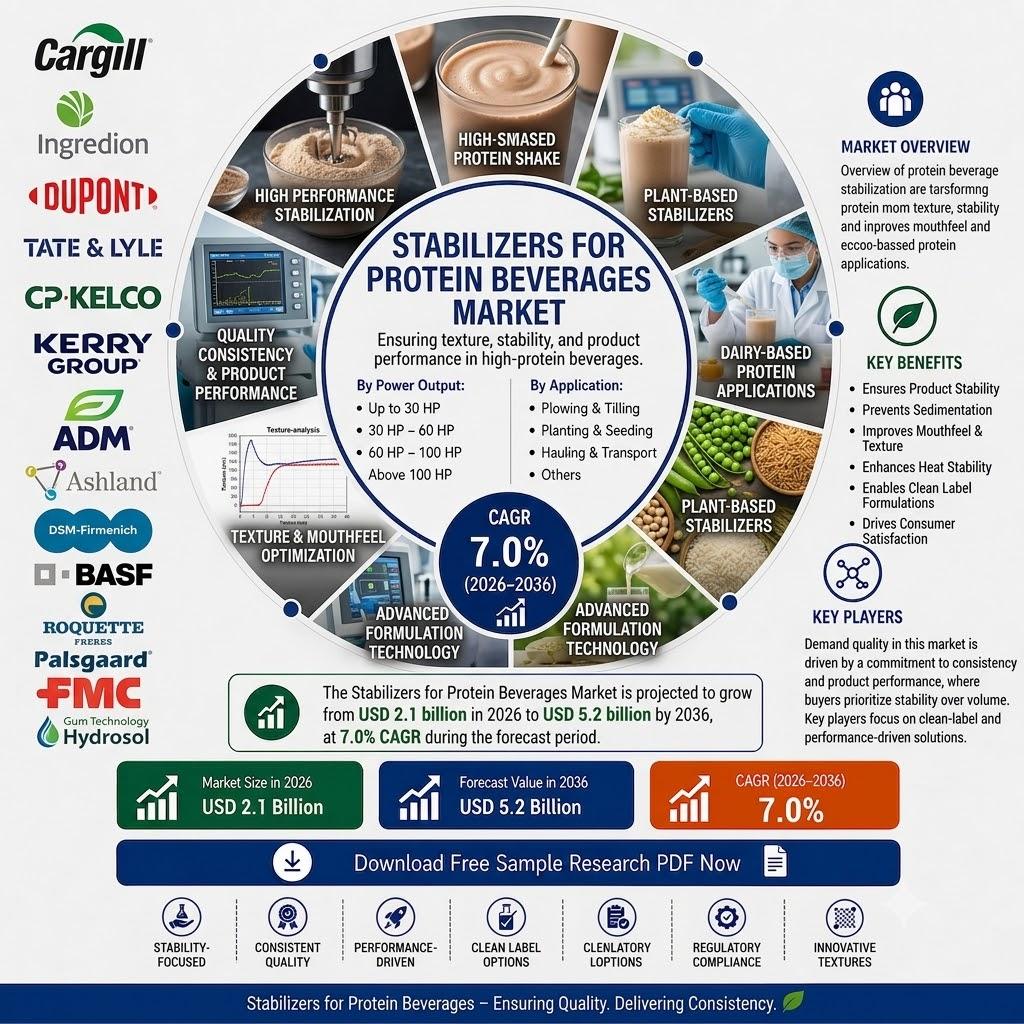
The global stabilizers for protein beverages market is projected to reach USD 5.2 billion by 2036, up from USD 2.1 billion in 2026 at a CAGR of 7.0%, according to Fact.MR. The market is set to add USD 3.1 billion in absolute opportunity during the forecast period as beverage manufacturers focus on suspension stability, consistent texture, shelf life, and protein dispersion.
The demand is not simply about producing more protein beverages. Manufacturers need formulations that remain stable from production through consumption. Ready-to-drink protein beverages account for 52% of end-use application share in 2026, making them the leading application segment.
Get detailed market forecasts, competitive benchmarking, and pricing trends: https://www.factmr.com/connectus/sample?flag=S&rep_id=13733
Stabilizers for Protein Beverages Market Benefits From RTD Formulations
Protein beverage manufacturers rely on stabilizers to maintain homogeneous texture and reduce phase separation during storage and distribution. These ingredients also support mouthfeel, protein suspension, and reduced sedimentation.
The market is projected to grow approximately 2.5 times in value between 2026 and 2036. That translates into USD 3.1 billion in additional market opportunity over the period.
Fact.MR is a market research company that provides market intelligence, forecasts, and industry analysis across global markets.
Hydrocolloids represent 46% of the market by stabilizer type. Their role in maintaining consistency and preventing separation makes them particularly relevant to ready-to-drink protein formulations.
Other stabilizer categories include emulsifiers, starches, gums and resins, and blended functional systems. These ingredients are used across dairy protein beverages, plant-based protein beverages, sports and performance nutrition drinks, and clinical and medical nutrition beverages.
"Consistency is becoming a formulation priority for protein beverage manufacturers," said Shambhu Nath Jha, Principal Consultant at Fact.MR. "The focus is on keeping the beverage stable, from the first pour to the last."
India Leads Country Growth at 8.2% CAGR
India is projected to record an 8.2% CAGR in the stabilizers for protein beverages market between 2026 and 2036. China follows with a 7.8% CAGR, while Brazil is forecast to grow at 7.0%.
The USA market is expected to expand at 6.6% CAGR. Germany follows at 6.1%.
India's projected growth reflects increasing demand for protein-enriched beverages, functional nutrition, and convenient ready-to-drink products. In China, rising interest in health and wellness beverages is supporting demand for ingredients that maintain texture and product stability.
The USA continues to see stabilizer demand across sports nutrition, health supplements, and functional beverages. Germany's market is associated with healthier beverage formulations, clean-label preferences, and fitness-oriented consumption.
These country figures provide a clear view of where formulation requirements are creating additional demand for stabilizing systems.
Product Performance Remains Central to Buyer Decisions
Protein beverage manufacturers face formulation challenges because stabilizer performance can vary with protein type, pH, and processing conditions. A stabilizer that performs well in one formulation may require adjustment in another.
Some stabilizer-protein interactions can create unwanted viscosity or gelation. Manufacturers may therefore conduct pilot trials before moving a formulation into commercial production.
Cost is another consideration. Premium or multifunctional stabilizers may face limitations in price-sensitive beverage categories, while differences in additive regulations and labeling requirements can affect supplier selection across markets.
At the same time, manufacturers are exploring multifunctional stabilizer systems that combine texture control with nutritional and sensory requirements.
Clean-label and naturally derived stabilizers are also gaining attention. Beverage producers are responding to demand for ingredient transparency and simpler formulations.
"Buyers are looking closely at documented stability data and compatibility with high protein loads," said Shambhu Nath Jha, Principal Consultant at Fact.MR. "It has to work in the plant, not just on paper."
Competitive Landscape Reflects Specialized Formulation Needs
The competitive landscape includes Cargill Incorporated, Ingredion Incorporated, DuPont Nutrition and Biosciences, Tate and Lyle PLC, CP Kelco, Kerry Group plc, Archer Daniels Midland Company (ADM), Ashland Global Holdings, DSM Firmenich, BASF SE, Roquette Freres, Palsgaard, FMC Corporation, Gum Technology Corporation, and Hydrosol GmbH.
Cargill Incorporated and Ingredion Incorporated compete with portfolios covering starches, fibers, and gum systems for dairy and plant-based protein applications. Tate and Lyle PLC and CP Kelco focus on hydrocolloid solutions for viscosity and texture management.
DuPont Nutrition and Biosciences and Kerry Group plc offer multifunctional ingredients. ADM and Roquette Freres focus on carbohydrate-derived stabilizing systems, while BASF SE and Ashland Global Holdings provide engineered solutions for high-protein formulations.
Palsgaard, FMC Corporation, Gum Technology Corporation, and Hydrosol GmbH participate with specialty emulsifiers and texturants.
Supplier selection is closely tied to documented stability performance, compatibility with protein loads, and production-line integration. For beverage manufacturers, consistency remains a practical purchasing requirement.
Market Outlook Through 2036
The stabilizers for protein beverages market is forecast to rise from USD 2.1 billion in 2026 to USD 5.2 billion by 2036. At a 7.0% CAGR, the market will generate USD 3.1 billion in additional opportunity.
The expansion is supported by demand for protein-enriched drinks and the growing use of ready-to-drink nutrition formats. Product stability remains central because manufacturers need beverages that maintain texture and suspension throughout their intended shelf life.
Fact.MR's analysis covers more than 40 countries, including the United States, Canada, Mexico, Brazil, Germany, the United Kingdom, France, Italy, Spain, China, Japan, South Korea, India, and Australia and New Zealand.
To View Top Reports
https://afgbfh.blogspot.com/2026/09/global-non-destructive-testing-market.html
About Fact.MR
Fact.MR is a market research and consulting firm providing syndicated and customized research across industries and regions. Its research covers market sizing, forecasts, competitive analysis, emerging trends, and strategic insights for businesses and decision-makers.

 English
 Arabic
 French
 Spanish
 Portuguese
 Deutsch
 Turkish
 Dutch
Dutch
 Italiano
 Romaian
 Portuguese (Brazil)
 Greek
Greek
