
Fuel Additives Market Demand From Modern Fuel Injection Systems
The fuel industry is facing an unusual contradiction. Fuels are expected to become cleaner, while engines are becoming more technologically demanding. Lower sulfur levels, alternative fuel blends, emissions targets, and more sophisticated injection systems are changing the chemistry of the fuel itself. At the same time, engines require excellent cleanliness, stability, lubrication, corrosion protection, and combustion performance.
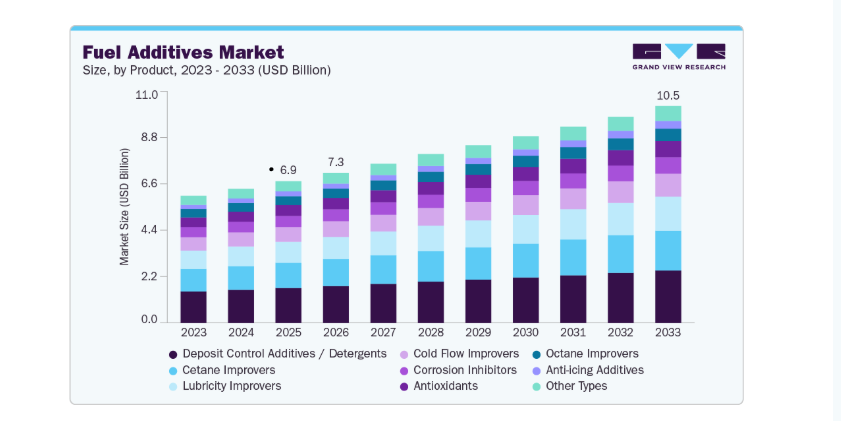
This tension is creating the next phase of the Fuel Additives Market. The global market reached USD 6.9 billion in 2025 and is projected to reach USD 10.5 billion by 2033, growing at a 5.4% CAGR from 2026 to 2033. Asia Pacific led the market with a 40.1% share in 2025.
When Cleaner Fuel Creates a New Chemistry Problem
Lower sulfur fuels are important for reducing emissions, but refining fuel to meet new specifications can change characteristics that previously contributed naturally to fuel performance. As fuel formulations evolve, additive packages can be used to restore or enhance specific properties.
That is why the market is increasingly operating through a balancing act:
Lower emissions → changing fuel composition → new performance gaps → targeted additives → compliant fuel
The additive is therefore not simply an extra ingredient. It can serve as the bridge between environmental requirements and the practical needs of engines and fuel systems.
Modern Engines Leave Less Room for Poor Fuel Quality
The rise of high-pressure fuel injection and turbocharged systems has made combustion systems more precise. With that precision comes greater sensitivity to deposits and changes in fuel behavior. A small amount of buildup in an injector can influence spray patterns. Changes in fuel stability can affect storage. Inadequate lubricity can contribute to component wear. Moisture can become a serious issue in aviation fuel at low temperatures.
Download a free sample report or claim your copy of this full market intelligence report
These challenges explain why the market contains such a wide range of additive chemistries.
Deposit control → cleaner fuel systems
Cetane improvement → better diesel ignition characteristics
Lubricity improvement → component protection
Antioxidants → greater fuel stability
Anti-icing chemistry → safer low-temperature fuel operation
The market's evolution is therefore closely tied to the increasingly specialized requirements of modern fuel systems.
The Diesel Market Shows Why Additives Remain Important
Diesel accounted for 42.2% of global fuel additives revenue in 2025, making it the largest application. Diesel is deeply connected to freight transportation, commercial vehicles, industrial machinery, marine applications, and power generation. These sectors often place strong emphasis on fuel reliability because poor engine performance can create significant operational and maintenance costs. Deposit-control additives help maintain injector cleanliness, while other additive types can improve cetane performance, lubricity, corrosion resistance, or cold-weather operability.
In heavy-duty applications, fuel quality is therefore connected directly with uptime:
Reliable fuel → stable combustion → protected components → fewer performance issues → better operating continuity
Aviation Takes the Market Into a More Specialized Direction
Aviation fuel introduces a different set of technical requirements. Aircraft operate through wide temperature ranges, and fuel-system performance can be influenced by moisture, thermal conditions, and storage characteristics.The aviation fuel segment is projected to grow at 6.3% CAGR, supported by increasing air traffic, fleet expansion, and demand for specialized fuel-performance solutions.
The development of sustainable aviation fuels adds another layer. As the industry introduces new fuel pathways, additive developers must determine how these fuels behave under storage, combustion, temperature, and compatibility conditions.
New aviation fuel → new chemical characteristics → formulation testing → specialized additives → operational compatibility
This makes aviation one of the most technically interesting growth areas within the market.
What Happens When the Fuel Itself Changes?
The transition toward biofuels, ethanol blends, and synthetic fuels is creating a broader innovation opportunity. Alternative fuels can bring advantages in emissions and sustainability, but they may also introduce concerns around oxidation stability, corrosion, water sensitivity, cold-flow behavior, and long-term storage. The additive industry therefore has to adapt alongside the fuel industry.
Instead of simply asking, “Which additive improves diesel?” the industry increasingly asks, “Which additive package allows this new fuel formulation to perform reliably inside an existing engine ecosystem?”
That shift is creating demand for more specialized and application-specific chemistry.
Anti-Icing Additives Show How Specialized the Market Can Become
The fastest-growing product category is expected to be anti-icing additives, projected to expand at approximately 6.3% CAGR. Their importance becomes particularly clear in aviation and cold-region transportation, where moisture contamination can create ice crystals and interfere with fuel flow.
In this case, additive demand is not primarily about improving fuel economy. It is about operational reliability.
Moisture exposure → low temperature → ice formation risk → anti-icing additive → uninterrupted fuel flow
This illustrates how the Fuel Additives Market has expanded into highly specialized performance problems.
Regulation Will Continue to Shape Product Development
Environmental regulation remains one of the strongest forces influencing product development. As governments establish stricter requirements for emissions and fuel quality, refiners and fuel suppliers need formulations that maintain performance while meeting those standards. In the U.S., certified detergent additives are required in gasoline. Globally, low-sulfur fuel rules and tighter vehicle emissions standards are encouraging greater use of advanced fuel-treatment technologies.
This regulatory environment favors suppliers capable of producing effective, multifunctional formulations that can work with changing fuel compositions.
Asia Pacific Is Where Consumption and Regulation Meet
Asia Pacific held 40.1% of the global market in 2025 and is expected to record the fastest regional growth at approximately 6.2% CAGR. The region combines rapidly expanding transportation activity with industrialization, automotive production, and increasing fuel consumption.
China remains the largest country market, while India and Southeast Asian economies are creating additional demand as vehicle ownership and commercial transportation expand. Stronger fuel-quality and emissions standards are reinforcing the need for more sophisticated formulations.
North America benefits from advanced refining and transportation infrastructure, while Europe is increasingly connecting fuel additives with biofuel development, fuel efficiency, and lower-emission mobility.
The Contradiction Is Actually the Opportunity
Cleaner fuels do not eliminate the need for chemistry. They often create new chemistry requirements.
Cleaner regulations → changing fuel formulations → more sophisticated engines → new performance challenges → more specialized additives
That is the central story of the Fuel Additives Market. As the transportation and energy sectors transition toward lower-emission fuels, additive manufacturers will increasingly be asked to make those fuels work better, last longer, remain stable, and perform safely under demanding operating conditions.
About us:
Grand View Research, a market research and consulting company, provides syndicated research reports, customized research reports, and consulting services. Grand View Research database is used by the world's renowned academic institutions and Fortune 500 companies to understand the global and regional business environment. Our database features thousands of statistics and in-depth analysis on 46 industries in 25 major countries worldwide.

 English
 Arabic
 French
 Spanish
 Portuguese
 Deutsch
 Turkish
 Dutch
Dutch
 Italiano
 Russian
 Portuguese (Brazil)
 Greek
Greek
