Why Surface Protection Matters in Packaging
A product does not have to break for shipping damage to occur. Scratched labels, rubbed printing, scuffed coatings, dented corners, and marked surfaces can all affect how an item looks when it reaches the customer. This is especially important for products where appearance is part of the overall presentation.
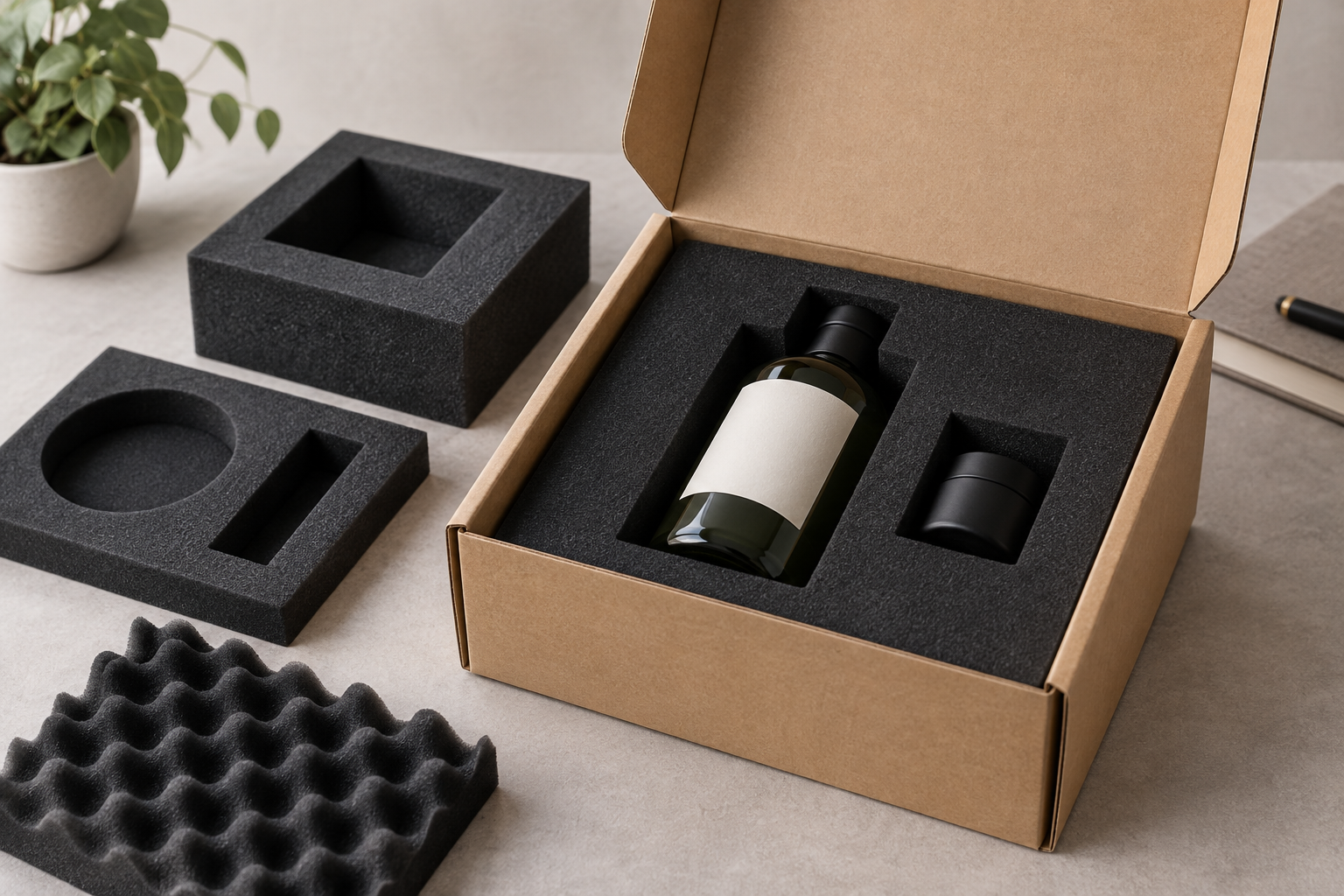
Different internal packaging structures can help limit surface contact during handling and transportation. Information about foam, cardboard, corrugated, molded pulp, and other insert materials can be found through Inserts Hub, particularly when comparing how different structures hold products without allowing unnecessary contact with surrounding surfaces.
What Causes Surface Damage Inside a Box?
Surface damage often develops through repeated movement rather than a single major impact.
A bottle may rub against a cardboard wall throughout transportation. A cosmetic container can rotate against another product. A printed label may repeatedly contact loose packaging material.
Over time, these small movements can affect the finish even when the product itself remains structurally intact.
Common causes include:
- Product movement inside oversized boxes
- Direct contact between multiple items
- Rough internal packaging surfaces
- Excessive pressure from tight cavities
- Loose accessories rubbing against the main product
- Improper product orientation
- Abrasive filler materials
- Repeated vibration during transportation
Understanding the surface that needs protection is therefore an important part of insert selection.
Different Product Finishes Have Different Needs
Not all surfaces react to packaging in the same way.
A plain glass bottle may tolerate contact that could damage a printed paper label. A matte-coated cosmetic box can react differently from a polished metal component.
The packaging structure should take the actual finish into account.
Printed Labels
Labels can become scratched, creased, or partially lifted if they continuously rub against an insert.
This is particularly relevant for bottles and jars where the label extends around a curved surface.
The insert should ideally support the container at areas that do not place unnecessary pressure on the printed section.
Glossy and Polished Surfaces
High-gloss finishes can show small scratches more easily than textured materials.
Products with polished plastic, coated metal, lacquered surfaces, or glossy printing may require softer contact points.
Even minor rubbing can become visible under strong light.
Matte and Soft-Touch Finishes
Matte coatings can sometimes develop shiny rub marks after repeated friction.
Soft-touch surfaces may also attract marks or show pressure points.
The insert design should therefore reduce unnecessary movement rather than simply holding the item with maximum pressure.
The Difference Between Holding and Compressing
A good insert should control the product without creating excessive compression.
There is an important difference between a product being securely positioned and being squeezed tightly inside a cavity.
If an insert is too loose, the product may move.
If it is too tight, the packaging itself may damage coatings, labels, corners, or delicate components.
The goal is to provide support at appropriate points while maintaining practical clearance.
Choosing Contact Points
An insert does not always need to touch the entire product.
Strategically selected contact points can provide enough support while leaving sensitive areas free.
For example, a bottle can sometimes be supported around its base and shoulder instead of placing pressure directly across the label.
An electronic device may be held around stronger edges while keeping its display surface untouched.
Areas That May Need Clearance
Depending on the product, designers may need to leave additional space around:
- Printed labels
- Screens
- Buttons
- Decorative coatings
- Foil details
- Embossed areas
- Raised logos
- Soft-touch surfaces
- Pump mechanisms
- Fragile caps
- Polished edges
These details should be identified before the cavity or divider structure is finalized.
Foam Inserts and Sensitive Surfaces
Foam is commonly considered when cushioning and close-fitting support are required.
It can be cut around a product shape and used to create several controlled contact areas.
However, foam selection should not depend only on softness.
Density, surface texture, thickness, and cavity dimensions can all influence performance.
A product with a sensitive coating may need slightly more clearance than a rugged tool, even when both products have similar dimensions.
Avoid Overly Tight Foam Cavities
A cavity that grips a product too firmly may create friction every time the item is inserted or removed.
This may be undesirable for products with delicate printed or coated surfaces.
Sampling the real product inside the proposed foam cavity can help identify whether the fit is practical.
Cardboard Inserts and Printed Products
Cardboard inserts can provide simple positioning for lightweight items.
They are often used for cosmetics, retail goods, food products, personal care items, and small accessories.
For products with decorated surfaces, the position of folds and cut edges should be considered carefully.
A sharp edge repeatedly contacting a printed surface can potentially create marks.
Folded supports can sometimes be positioned around less sensitive sections of the product instead.
Corrugated Inserts for Stronger Separation
Corrugated board is useful when products require greater structural separation.
Dividers can prevent bottles, jars, or other products from touching each other during transit.
This is particularly helpful in multi-item shipping cartons.
Instead of allowing several products to repeatedly collide, each item receives its own compartment.
The divider should still be sized correctly. Excessively large cells may allow products to rotate and rub against the internal walls.
Molded Pulp and Formed Product Support
Molded pulp can create defined support points around containers, electronics, personal care products, and other consumer goods.
Its formed structure can help maintain consistent product positioning.
When surface appearance is important, the molded shape should be designed so that contact occurs at suitable areas.
A well-planned tray does not necessarily need to surround every part of the product.
Comparison of Insert Materials
| Insert Type |
Typical Use |
Surface Protection Consideration |
Main Benefit |
| Foam |
Fragile or sensitive products |
Avoid excessive cavity pressure |
Cushioning |
| Cardboard |
Lightweight retail products |
Position cut edges carefully |
Simple organization |
| Corrugated |
Bottles and heavier items |
Correct divider spacing matters |
Strong separation |
| Molded Pulp |
Formed product trays |
Choose stable contact areas |
Repeatable positioning |
The table is useful as a starting point, but the actual product should determine the final material choice.
Protecting Products With Multiple Components
Some packages include a primary product along with accessories.
Examples include a cosmetic container with an applicator, an electronic device with a cable, or a bottle with a measuring tool.
Small accessories should not be allowed to move freely around the main product.
Even a lightweight cable connector can repeatedly strike a polished or printed surface during shipping.
Dedicated compartments can help keep smaller components separated.
Consider the Direction of Product Movement
Movement is not limited to side-to-side motion.
Products may also move vertically when the box is lifted, dropped, turned, or stacked.
An insert that controls horizontal movement but leaves significant vertical clearance may still allow the product to repeatedly contact the top or bottom of the package.
The complete three-dimensional space around the item should therefore be reviewed.
Product Removal Is Part of the Design
Surface protection does not end when shipping is complete.
Customers also need to remove the product from the insert.
If the cavity is extremely tight, users may have to pull, twist, or scrape the product against the material.
This can damage delicate finishes during the unboxing process.
Finger notches, access areas, or additional clearance can make removal easier without allowing excessive movement during transit.
Why Physical Sampling Is Useful
Digital dimensions can indicate whether a product should fit, but they cannot fully show how different surfaces will interact.
A physical sample allows the packaging team to check:
- Whether labels rub against the insert
- Whether coatings develop marks
- How easily the product can be removed
- Whether contact points are correctly positioned
- Whether accessories stay separated
- Whether the product rotates during handling
- Whether cavity pressure is excessive
The actual production product should be used for testing whenever possible.
Evaluate the Complete Packaging System
An insert should not be evaluated separately from the outer box.
A correctly fitted insert can still move if the box around it is oversized. This movement may eventually transfer to the product.
Similarly, a tightly sized outer box cannot compensate for poorly positioned contact points inside the insert.
The product, insert, and outer packaging should be considered together.
Storage Conditions Can Also Affect Surface Protection
Packaging may remain in storage for days, weeks, or longer before the customer receives it.
During that time, stacked cartons can create continuous pressure.
Temperature and humidity may also affect certain materials, labels, adhesives, or coatings.
For products intended for longer storage periods, the insert should support the item without creating concentrated pressure on sensitive areas.
Questions to Ask Before Finalizing an Insert
Before approving the packaging structure, consider the following questions:
- Which surfaces are most visible to the customer?
- Does the insert contact any printed labels?
- Can the product rotate inside the cavity?
- Are polished areas touching rough materials?
- Can accessories reach the main product?
- Is the fit unnecessarily tight?
- Can the product be removed without scraping?
- Is vertical movement controlled?
- Does the insert move inside the outer box?
- Has the real product been tested in a physical sample?
These questions can help reveal surface-related issues that basic dimensional checks may miss.
A More Practical Approach to Surface Protection
Surface protection begins with understanding where the product can safely be supported.
The goal is not necessarily to add more packaging material. In many cases, better positioning and carefully selected contact points can be more useful than filling every available space.
Material choice, cavity dimensions, product orientation, accessory placement, and ease of removal should all be considered together.
By treating labels, coatings, printed finishes, and polished surfaces as part of the packaging requirement, an insert can help maintain both the physical condition and visual appearance of a product throughout storage, transportation, and unpacking.


 English
 Arabic
 French
 Spanish
 Deutsch
 Turkish
 Dutch
Dutch
 Italiano
 Russian
 Romaian
 Portuguese (Brazil)
 Greek
Greek
