
managed soc services in india: Reliable Healthcare Security for Indian Businesses
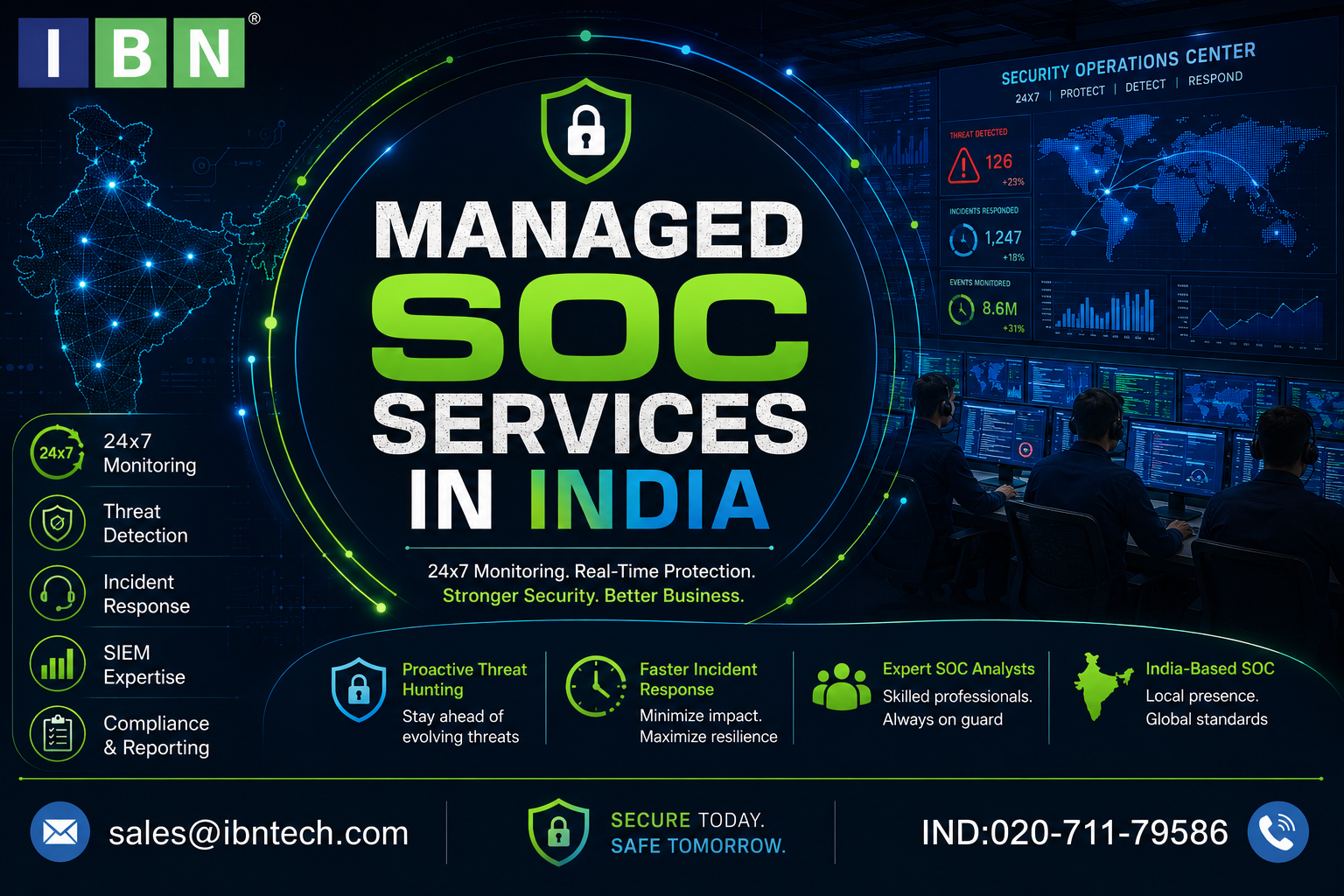
When managed soc services in india Become Essential for Healthcare Security
Healthcare organizations are managing increasingly connected digital environments. Patient-facing applications, electronic records, cloud platforms, employee endpoints, networks, and other technologies all contribute to a broader attack surface.
At the same time, healthcare teams cannot afford prolonged disruption to critical digital operations. Security incidents can affect data protection, system availability, business continuity, and organizational trust.
This is why managed soc services in india are becoming an important consideration for healthcare organizations seeking stronger security monitoring. A managed SOC can provide continuous observation of security events, alert analysis, threat detection, and escalation support while complementing existing internal security resources.
Why Healthcare Organizations Need Continuous Security Visibility
Healthcare environments generate security events throughout the day and night. Login attempts, endpoint alerts, network activity, application events, and other signals can create a large volume of information for security teams to assess.
Monitoring only during standard working hours leaves a potential visibility gap outside those hours. Even when an internal team operates continuously, maintaining adequate staffing and specialist expertise can be challenging.
A managed SOC provides a dedicated operational layer for security monitoring. Instead of waiting for suspicious activity to become an obvious incident, analysts can continuously review security signals and investigate events that warrant attention.
Evaluating soc service providers for Healthcare Operations
Healthcare organizations should evaluate soc service providers according to their actual operational requirements rather than simply choosing the provider with the longest list of features.
Important considerations include:
- Continuous security monitoring capabilities
- SIEM integration and event analysis
- Threat detection and alert investigation
- Defined incident escalation processes
- Security reporting and visibility
- Integration with existing IT and security infrastructure
- Analyst expertise and operational processes
- Ability to support changing security requirements
- Clear division of responsibilities
The evaluation should also consider how the SOC will work with internal IT, security, compliance, and leadership teams.
Why DIY Security Monitoring Can Become Difficult
Managing security monitoring internally can provide significant control, but it also creates operational responsibilities.
Organizations need suitable security technologies, trained personnel, monitoring procedures, alert-handling workflows, escalation rules, and ongoing process improvements.
Healthcare security teams may already be responsible for multiple priorities. Adding continuous alert monitoring can increase workload and make it difficult to dedicate sufficient attention to every security event.
Another challenge is consistency. Security monitoring needs to continue during nights, weekends, holidays, and periods when internal staffing is limited.
A managed SOC can supplement the internal team by handling defined monitoring and investigation responsibilities while internal personnel retain control over strategic security decisions.
Comparing Healthcare SOC Operating Models
Healthcare organizations generally have three broad approaches to security operations.
Internal SOC: The organization manages monitoring, analysts, technology, and processes itself. This offers direct control but requires significant internal resources.
Managed SOC: An external security operations team provides defined monitoring and security services. This can extend security capabilities without requiring every function to be built internally.
Hybrid SOC: Internal and external teams share responsibilities. This can be useful when an organization wants to retain internal oversight while obtaining additional monitoring or specialist support.
There is no universal model for every healthcare organization. The appropriate structure depends on the organization's technology environment, security maturity, internal resources, and monitoring objectives.
Key Benefits of a Managed SOC for Healthcare
A well-designed managed SOC can strengthen healthcare security operations in several practical areas.
Round-the-clock monitoring: Security events can be observed continuously rather than only during office hours.
Centralized visibility: Relevant events from supported systems can be brought into a structured monitoring environment.
Alert investigation: Security analysts can examine suspicious events and determine whether further action is required.
Threat detection: Continuous analysis can help identify patterns associated with potentially malicious activity.
Incident escalation: Significant events can be escalated to designated internal stakeholders according to agreed procedures.
Additional expertise: Internal teams can gain operational support from security professionals focused on monitoring and analysis.
The value comes from combining technology with consistent security processes and human investigation.
Healthcare Use Case: Monitoring a Multi-System Environment
Consider a healthcare organization using cloud applications, employee endpoints, network infrastructure, patient-facing systems, and centralized business applications.
An isolated security alert may not provide enough information to determine whether an event is serious. For example, an unusual login attempt could appear harmless on its own. When combined with suspicious endpoint or network activity, however, the overall pattern may warrant investigation.
A managed SOC can help correlate relevant security signals and provide analysts with a broader operational view. This allows potential threats to be assessed using multiple indicators rather than relying on individual alerts.
Practical Checklist for Healthcare SOC Adoption
Healthcare security leaders should review the following areas before implementing or expanding managed SOC capabilities:
- Critical systems requiring continuous monitoring
- Security events that should trigger investigation
- Required monitoring coverage and operating hours
- SIEM and security-tool integration requirements
- Alert prioritization procedures
- Incident escalation responsibilities
- Internal versus external team responsibilities
- Required security and management reports
- Data protection and access requirements
- Processes for reviewing SOC performance
Clear service boundaries are particularly important when the managed SOC works alongside an internal IT or cybersecurity team.
Compliance and Security Governance
Security monitoring should form part of a broader information security and risk-management program.
Healthcare organizations processing personal information should consider applicable requirements under India's Digital Personal Data Protection framework based on their specific circumstances. Organizations may also use recognized information security frameworks such as ISO 27001 to structure security governance and controls.
A SOC does not replace governance or compliance processes. Instead, monitoring and incident-handling capabilities can support broader security objectives by improving visibility into potential threats and providing structured operational processes.
Strengthening Healthcare Security Through Managed Monitoring
Healthcare cybersecurity requires more than deploying security technologies. Organizations need consistent monitoring, skilled analysis, defined escalation procedures, and clear accountability.
managed soc services in india can help healthcare organizations strengthen these areas by extending internal capabilities with continuous security monitoring and operational expertise. By comparing SOC models carefully and selecting capabilities that match their environment, healthcare organizations can create a more resilient and responsive security operation.
Contact Us:
IND- 02067680404
IBN Technologies Ltd.
E-mail: - sales@ibntech.com

 English
 Arabic
 French
 Spanish
 Portuguese
 Deutsch
 Dutch
Dutch
 Italiano
 Russian
 Romaian
 Portuguese (Brazil)
 Greek
Greek
