
Buying a Bigger Washer Extractor for Future Growth? This Sizing Mistake Can Cost You
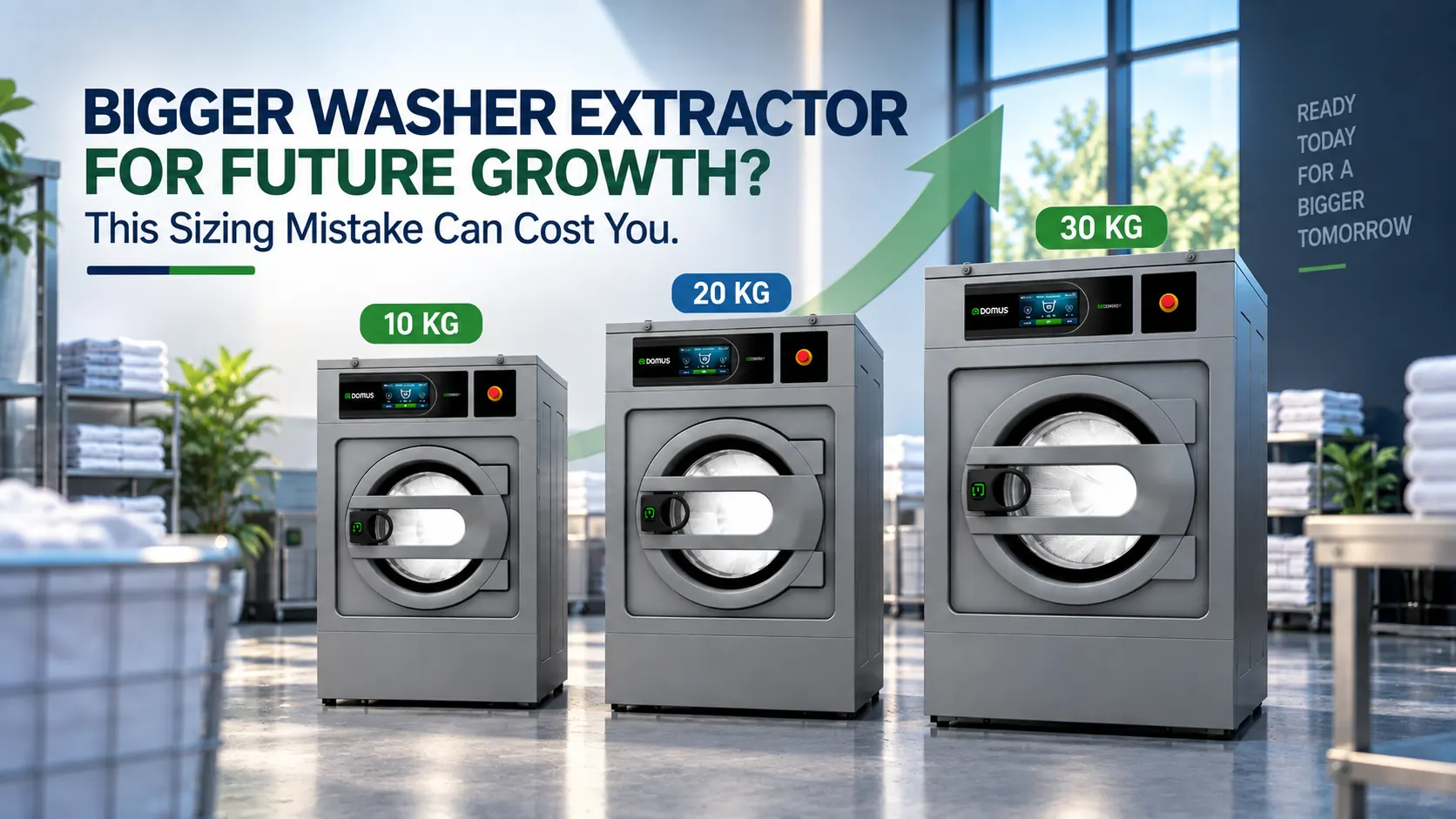
Your laundry is growing, so buying a bigger washer extractor now may seem like the safest way to prepare for future orders. But purchasing capacity you cannot use efficiently can increase your investment without solving today's operational needs. The better approach is to size equipment around current volume, realistic growth, load mix, operating hours and the complete laundry workflow.
Why Is Buying the Biggest Washer Extractor Not Always the Best Growth Strategy?
When planning laundry business expansion, it is natural to think bigger equipment means better preparation for growth.
But the largest industrial washer extractor your budget or space allows is not automatically the best investment.
Suppose your laundry currently processes mostly small customer-specific loads. A much larger machine may have enough capacity for future business, but today you may struggle to create suitable full loads without mixing items that should remain separate.
That can result in frequent partial loads and unused capacity.
Before selecting a larger machine, consider:
-
Current daily laundry volume
-
Average practical load size
-
Number of loads per shift
-
Textile and customer mix
-
Peak-day volume
-
Available operating hours
-
Confirmed or realistically expected new business
-
Washing, drying and finishing capacity
There is an important difference between having spare capacity and buying excessive capacity.
Some additional capacity can support future growth. But purchasing a significantly oversized commercial washer extractor machine based only on hoped-for orders may tie up capital that could have been required elsewhere in the operation.
The objective should be:
Current Requirement + Realistic Growth Allowance = Planned Capacity
Not:
Largest Machine Available = Best Future-Proof Investment
What Happens When Your Washer Extractor Is Too Large for Your Daily Laundry Volume?
An oversized washer extractor machine does not necessarily mean it will always be inefficient. The problem occurs when your normal load structure cannot make practical use of the available capacity.
Imagine a laundry receiving linen from several smaller customers.
You may have enough total KG across the day to justify significant washing capacity, but those items cannot necessarily be combined into one large load. Different customers, colors, textile types, soil levels or required programs may need separate processing.
A large machine could therefore spend much of the day handling loads well below the capacity you originally purchased it for.
Potential problems include:
Frequent partial loads
If suitable laundry is not available to form practical loads, part of the machine's available capacity may remain unused.
Difficult load segregation
A bigger drum does not remove the need to separate textiles according to process requirements.
Higher initial investment
A larger industrial washing machine may involve a higher equipment investment as well as different installation and site requirements.
Capacity in the wrong place
Spending heavily on washing capacity may not improve overall output if drying or finishing is already the real bottleneck.
This is why equipment utilization matters.
Instead of asking only, “How many KG can this machine hold?”, ask:
“How many suitable loads can my business realistically build and process every day?”
That question gives you a much clearer view of practical laundry machine capacity.
How Do You Calculate the Washer Extractor Capacity Your Business Actually Needs?
Start with data from your operation rather than the capacity printed on a brochure.
Record your average and peak daily laundry volume, practical load sizes, textile categories and available production hours.
A useful starting formula is:
Required Daily Loads = Expected Daily Laundry KG ÷ Practical Average Load
Suppose your expected volume is 480 KG per day and your practical average load is 24 KG:
480 ÷ 24 = 20 loads per day
This is an illustrative calculation, not a machine recommendation.
You then need to determine whether those loads can be completed within your available operating hours using the programs required by your laundry.
Most importantly, calculate current and future volume separately.
For example:
Current Daily Volume = Existing Customer Demand
Future Daily Requirement = Current Volume + Confirmed/Realistically Expected Additional Volume
Avoid choosing an industrial washer extractor machine around an undefined statement such as, “We might double our business next year.”
Instead, examine where that additional volume could actually come from. A confirmed hotel contract is very different from a general expectation of future growth.
Also examine peak demand.
A laundry averaging 400 KG per day but regularly reaching 600 KG on specific days has a different capacity requirement from a business consistently processing 400 KG.
A better planning sequence is:
Daily KG → Customer Mix → Textile Mix → Practical Loads → Loads Per Day → Operating Hours → Future Volume → Required Capacity
Internal link placeholder: Commercial Washing Machine Capacity Guide
One Bigger Washer Extractor or Two Smaller Machines—Which Is Better for Expansion?
This is often a more important question than simply choosing the next machine size.
One larger heavy-duty washer extractor may suit a business processing substantial volumes of compatible textiles in large batches.
Multiple smaller machines can provide different operational advantages.
One larger machine may suit you when:
-
Large compatible loads are common
-
Batch sizes consistently justify the capacity
-
Available floor space is limited
-
Your workflow supports larger loads
-
Downstream equipment can handle the output
Two smaller machines may suit you when:
-
Customer loads need separation
-
You process different textile categories
-
Small and medium loads are common
-
Different programs need to run simultaneously
-
Peak periods require parallel washing
-
Operational flexibility is important
Multiple machines can also reduce dependence on a single washing unit, although they require appropriate space, utilities, installation and workflow planning.
A high spin washer extractor should also be evaluated for extraction performance, not simply KG capacity. Extraction can influence the amount of residual moisture sent to the drying section.
Therefore, compare equipment configurations based on:
Load Flexibility + Practical Throughput + Operating Hours + Site Requirements + Future Volume
rather than KG capacity alone.
What Should You Check Before Investing in a Bigger Washer Extractor?
Once you have identified a genuine capacity requirement, evaluate the complete project before comparing washer extractor price.
1. Daily and peak KG
Know both your normal processing requirement and the volume experienced during busy periods.
2. Practical load mix
Understand how many large, medium and small loads you actually process.
3. Textile categories
Hotel linen, towels, uniforms and other textiles may require different programs and load planning.
4. Operating hours
A machine's capacity is only useful if your required loads can be processed within the available shift.
5. Extraction performance
Review G-factor and extraction specifications for the actual machine being considered. Higher extraction can potentially reduce residual moisture, but actual results depend on equipment, program, textile and operating conditions.
6. Site and utility requirements
Check dimensions, floor or foundation requirements where applicable, water, drainage, electrical requirements and other utilities specified by the manufacturer.
7. Dryer and finishing capacity
A larger washer can increase upstream output.
If your dryers cannot handle additional wet laundry, you may simply move the bottleneck from washing to drying.
Your workflow should remain balanced:
Washing → Extraction → Drying → Finishing → Packing
8. Total laundry equipment investment
When comparing washer extractor price in India, consider more than the purchase price.
Use:
Total Investment = Machine + Installation + Site Preparation + Utility Requirements + Supporting Equipment
A cheaper machine can still involve different installation requirements, while a larger machine may require changes elsewhere in your facility.
How Orgaearth Can Help
Choosing the right commercial laundry equipment starts with understanding the business requirement before selecting machine capacity.
OrgaEarth can help commercial laundry businesses evaluate current daily volume, practical load sizes, customer and textile mix, operating hours, available space, utilities and expected future demand when considering a washer extractor.
The objective is not simply to recommend more KG. It is to help plan a washing setup that fits the actual workflow while leaving practical room for future expansion.
Frequently Asked Questions
What washer extractor capacity does my laundry business need?
Calculate daily KG, practical average load size, required loads per day, operating hours, textile mix and peak demand. Then include realistic future volume before selecting capacity.
Is buying a bigger washer extractor better for future growth?
Not always. Extra capacity can support expansion, but excessive capacity may remain underutilized if your daily volume and load mix cannot make practical use of it.
Can I run small loads in a large commercial washer extractor?
Machine capabilities and suitable loading practices vary by model and program. For capacity planning, focus on the practical loads your operation regularly processes and follow the manufacturer's operating specifications.
Should I buy one large washer extractor or two smaller machines?
One large machine can suit high-volume compatible loads, while multiple machines can provide flexibility for customer segregation, different textiles and simultaneous processing. Compare both configurations against your actual workload.
What affects the washer extractor price in India?
Pricing can vary based on capacity, configuration, extraction performance, features, manufacturer, and other specifications. Installation, utilities, site preparation, and supporting requirements should also be included when calculating total investment.
Contact Us
Orgaearth Laundry Solutions
Plot no. 774, Udyog Vihar, Phase 5, Gurugram, Haryana, India-122016
Email: marketing@orgaearth.com
Contact No.- +91 7042912777

 English
 Arabic
 French
 Spanish
 Portuguese
 Deutsch
 Turkish
 Italiano
 Russian
 Romaian
 Portuguese (Brazil)
 Greek
Greek
