
Automation Testing Market Size, Growth, Trends Forecast to 2034
The Automation Testing Market is evolving with the integration of artificial intelligence and machine learning, enabling intelligent test generation, predictive analytics, automated test execution, and self-healing capabilities.
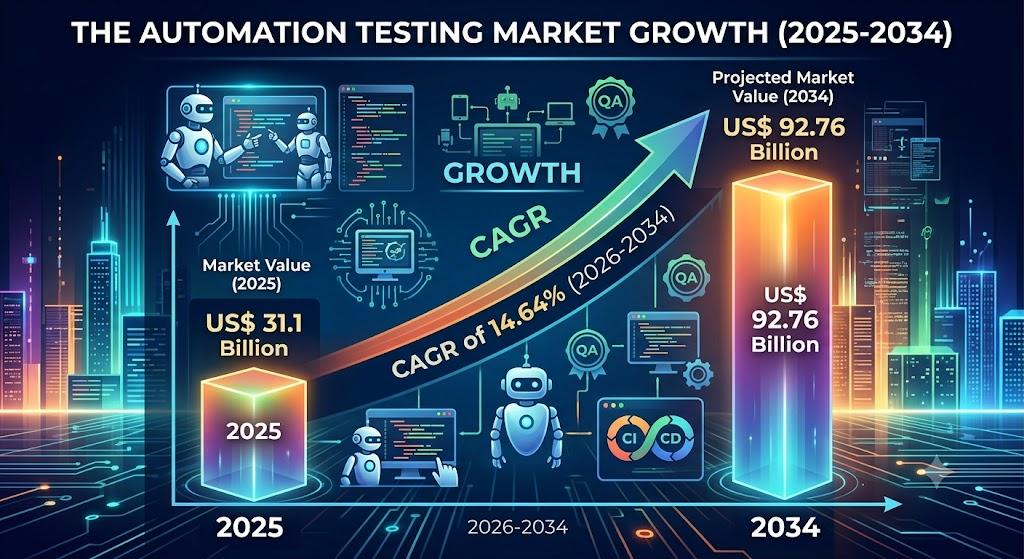
According to The Insight Partners, The automation testing market was valued at US$ 31.1 Billion in 2025 and is projected to reach US$ 92.76 Billion by 2034, growing at a CAGR of 14.64% during 2026–2034. Enterprises are increasing automated validation across web, mobile, cloud, embedded, and enterprise applications as software release cycles shorten and quality risks become more expensive to manage.
Get Sample PDF@ https://www.theinsightpartners.com/sample/TIPRE00007499
Key Factors Driving the Automation Testing Market
One of the major factors driving the Automation Testing Market is the growing adoption of DevOps and continuous delivery methodologies. Organizations are releasing software updates more frequently, making conventional manual regression testing increasingly time-consuming. Automation allows development and testing teams to execute repetitive tests quickly and integrate quality checks directly into CI/CD pipelines.
Automation testing also helps enterprises improve software reliability while reducing defect leakage. Automated regression, integration, functional, performance, and API testing can provide rapid feedback during development and deployment. This allows developers to identify and resolve issues earlier, reducing rework and supporting faster software releases.
Another important driver is the growing complexity of applications. Modern software environments often include cloud infrastructure, APIs, microservices, mobile applications, databases, and third-party integrations. Testing these interconnected components manually can be difficult and resource-intensive. Automation provides scalable testing capabilities across different environments, devices, browsers, and operating systems.
The increasing cost of software failures is also encouraging enterprises to invest in automated quality assurance. Organizations in banking, healthcare, retail, telecommunications, manufacturing, and other sectors depend heavily on digital applications. Software defects, downtime, or security vulnerabilities can result in financial losses, compliance issues, and reputational damage.
AI and Machine Learning Transforming Test Automation
Artificial intelligence and machine learning are emerging as important technologies in the evolution of automated testing. AI-enabled testing platforms can assist with test case generation, test prioritization, defect prediction, test maintenance, and analysis of test results.
AI can identify application changes and help adjust test scripts when user interfaces or application workflows change. This capability addresses one of the major challenges associated with automation testing: maintaining large numbers of test cases over time.
Machine learning can also analyze historical testing data to identify high-risk areas and prioritize testing activities. As organizations seek greater efficiency from their quality engineering teams, AI-assisted automation is expected to become increasingly integrated into testing platforms and enterprise development environments.
The growing application of AI and machine learning in testing therefore represents a significant opportunity for technology vendors and service providers.
Shift-Left Testing and CI/CD Integration
The shift toward shift-left testing is another important trend shaping the market. Instead of testing applications primarily after development is completed, organizations are moving quality assurance activities earlier into the software development lifecycle.
Automated testing enables developers to conduct validation during coding and integration stages. Static testing can identify code quality and security issues before software execution, while dynamic testing evaluates application behavior during execution.
Integration with CI/CD pipelines allows automated tests to run whenever new code is committed or deployed. This approach provides development teams with immediate feedback and supports continuous software improvement.
As Agile and DevOps practices become more widespread, demand for automation testing tools that integrate seamlessly with development, deployment, monitoring, and project-management environments is expected to increase.
Automation Testing Market Segmentation
The Automation Testing Market can be analyzed by offering, testing type, services type, organization size, and end user.
By offering, the Automation Testing Market is divided into testing type and services. Services represent a significant portion of the market as enterprises increasingly seek consulting, implementation, managed testing, framework development, and maintenance support.
By testing type, the Automation Testing Market includes static testing and dynamic testing. Static testing evaluates code and software artifacts without executing the program, while dynamic testing validates software behavior during execution. Dynamic testing is particularly important for functional, regression, performance, and integration testing.
By services type, the Automation Testing Market includes managed services and professional services. Managed services provide recurring testing, maintenance, reporting, and execution capabilities. Professional services assist enterprises with assessment, tool selection, framework development, migration, and integration.
By organization size, the Automation Testing Market covers small and medium-sized enterprises and large enterprises. Large enterprises remain important adopters because of their complex software environments and extensive release pipelines. Meanwhile, SMEs are increasingly adopting cloud-based and low-code automation solutions because these technologies reduce infrastructure and skill requirements.
Regional Outlook
North America represents a major market for automation testing due to mature DevOps practices, cloud adoption, enterprise modernization, and demand for continuous software validation. The United States is a particularly important contributor, supported by digital banking, e-commerce, cloud platforms, and software-driven business operations.
Europe is also witnessing increasing adoption, particularly in financial services, automotive, manufacturing, retail, telecommunications, and public-sector digitalization. Organizations across the region place strong emphasis on software quality, security, data protection, and regulatory compliance.
Asia Pacific is expected to experience strong growth during the forecast period. India is benefiting from its large IT services and software development ecosystem, while China, Japan, South Korea, and Australia are increasing investments in cloud technologies, enterprise modernization, mobile applications, and embedded software. The region's growing digital economy and expanding technology services industry are creating substantial opportunities for automation testing providers.
Key Players in the Automation Testing Market
Major companies analyzed in the Automation Testing Market include:
- Amazon Web Services, Inc.
- Datalogic S.p.A.
- Fujitsu Limited
- Honeywell International Inc.
- Ingenico
- KUKA AG
- NCR Corporation
- Pricer AB
- Toshiba Global Commerce Solutions Inc.
- Zebra Technologies Corp.
These companies participate in different parts of the ecosystem, including cloud infrastructure, enterprise software, industrial automation, retail technology, payment solutions, and software-enabled testing environments.
Emerging Trends and Opportunities
A major emerging trend is the integration of AI into test automation platforms. Intelligent test generation, predictive analytics, automated test prioritization, and self-healing test scripts can improve testing efficiency and reduce maintenance requirements.
End-to-end automation is another significant opportunity. Enterprises are increasingly looking beyond isolated automated tests and seeking integrated solutions that connect test planning, execution, data management, reporting, deployment, and monitoring.
Managed quality engineering services are also expected to gain traction as organizations face shortages of skilled testing professionals. Service providers can help enterprises establish automation frameworks, integrate tools into DevOps environments, and continuously maintain testing processes.
The expansion of cloud-based testing represents another growth opportunity. Cloud platforms allow organizations to provision testing environments quickly and execute tests across multiple configurations without maintaining extensive physical infrastructure.
Future Outlook
The Automation Testing Market is expected to remain on a strong growth trajectory through 2034 as software development becomes increasingly automated, distributed, and continuous. AI-assisted quality engineering, DevOps adoption, cloud testing, shift-left methodologies, and end-to-end automation are likely to remain central to market development.
About The Insight Partners
The Insight Partners delivers market intelligence and consulting services to help clients make informed decisions. The firm covers industries such as Aerospace and Defense, Automotive and Transportation, Semiconductor and Electronics, Biotechnology, Healthcare IT, Manufacturing, Medical Devices, Technology, Media, and Chemicals and Materials.
Contact Us
Email: sales@theinsightpartners.com
Website: www.theinsightpartners.com
Phone: +1-646-491-9876
Also Available in :

 English
 Arabic
 French
 Portuguese
 Deutsch
 Turkish
 Dutch
Dutch
 Italiano
 Russian
 Romaian
 Portuguese (Brazil)
 Greek
Greek
