
Neonatal Jaundice Management Market: Global Phototherapy, Bilirubin Monitoring and Growth Outlook
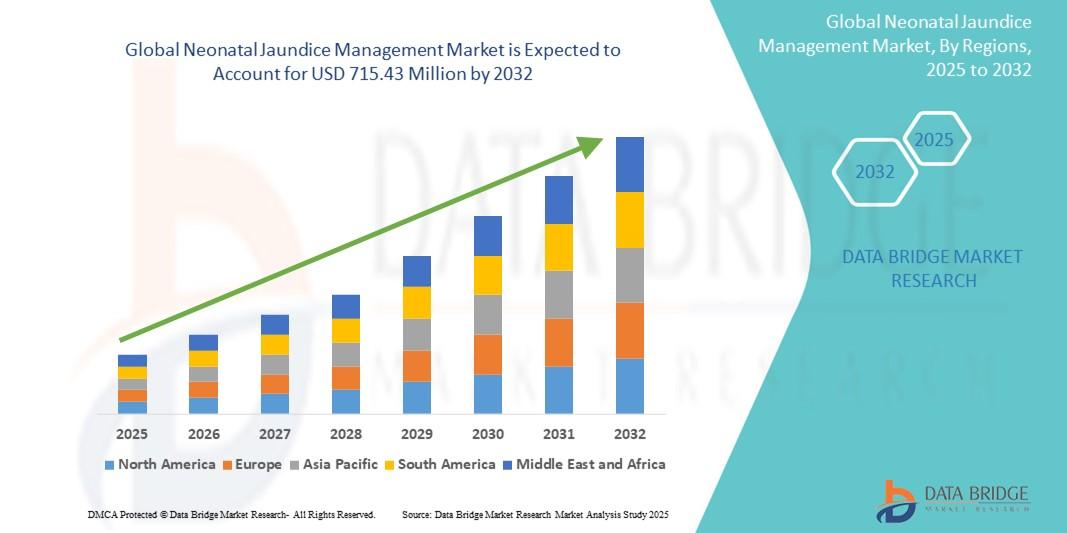
According to the latest report published by Data Bridge Market Research, the Neonatal Jaundice Management Market
CAGR Value
The global neonatal jaundice management market size was valued at USD 425.85 million in 2024 and is expected to reach USD 715.43 million by 2032, at a CAGR of 6.70% during the forecast period
Market research analysis and data in this Neonatal Jaundice Management Market document promisingly lend a hand to businesses for the strategy planning related to production, product launches, costing, inventory, purchasing and marketing. With a systematic problem analysis, model building and fact-finding, Neonatal Jaundice Management Market research report assists businesses in decision-making and managing marketing of goods and services. Analysis and estimations of important industry trends, market drivers, market restraints, market size, market share and sales volume are mentioned in the report. Some of the competitor strategies covered are new product launches, expansions, agreements, partnerships, joint ventures, acquisitions, and others that help to amplify their footprints in the market.
Stay informed with our latest keyword market research covering strategies, innovations, and forecasts. Download full report: https://www.databridgemarketresearch.com/reports/global-neonatal-jaundice-management-market
Neonatal Jaundice Management Market Segmentation and Market Companies
Segments
- Based on treatment type, the neonatal jaundice management market can be segmented into light therapy, exchange transfusion, intravenous immunoglobulin (IVIG) therapy, phototherapy, and others. Light therapy is a commonly used treatment for neonatal jaundice in which the infant is exposed to special blue lights that help break down the bilirubin in their blood. Exchange transfusion involves replacing the infant's blood with donor blood to reduce bilirubin levels. IVIG therapy is administered in cases where the jaundice is due to immune-related factors. Phototherapy is a non-invasive treatment that involves exposing the infant's skin to light to breakdown bilirubin.
- By end user, the market is categorized into hospitals, clinics, and others. Hospitals are the primary facility for the diagnosis and treatment of neonatal jaundice due to the availability of specialized equipment and healthcare professionals. Clinics also play a significant role in the management of neonatal jaundice by providing outpatient services and follow-up care for infants with jaundice.
- On the basis of geography, the global neonatal jaundice management market can be segmented into North America, Europe, Asia Pacific, Latin America, and Middle East & Africa. North America holds a significant share in the market due to the presence of well-established healthcare infrastructure and the high prevalence of neonatal jaundice cases. Europe follows closely behind, with increasing awareness about neonatal healthcare driving market growth. The Asia Pacific region is expected to witness rapid growth in the market due to improving healthcare facilities and rising investments in neonatal care.
Market Players
- Some of the key players in the global neonatal jaundice management market include Koninklijke Philips N.V., Drägerwerk AG & Co. KGaA, GE Healthcare, Natus Medical Incorporated, Nice Neotech Medical Systems Pvt. Ltd., Atom Medical Corporation, General Electric Company, NovoNordisk A/S, and BabyBloom Healthcare BV. These companies are actively involved in product development, strategic collaborations, and mergers to enhance their market presence and cater to the growing demand for neonatal jaundice management solutions.
Neonatal jaundice management is a critical aspect of infant healthcare, with a range of treatment options available to address this condition. The market segmentation based on treatment type reflects the diverse approaches utilized by healthcare providers to manage neonatal jaundice effectively. Light therapy, exchange transfusion, IVIG therapy, and phototherapy offer distinct methodologies for reducing bilirubin levels in infants, highlighting the importance of tailored treatment strategies based on individual patient needs. The emphasis on non-invasive options such as phototherapy underscores the shift towards gentler interventions that prioritize infant well-being. As advancements continue to be made in treatment modalities, the landscape of neonatal jaundice management is evolving to offer more effective and patient-friendly solutions.
In terms of end users, the division into hospitals, clinics, and other healthcare facilities underscores the varied settings where neonatal jaundice management takes place. Hospitals serve as central hubs for the diagnosis and treatment of this condition, equipped with specialized resources and personnel to deliver comprehensive care. Clinics play a complementary role in providing ongoing support and follow-up services, ensuring continuity of care beyond the hospital setting. This segmentation highlights the collaborative nature of neonatal healthcare delivery, where different facilities work together to optimize patient outcomes and promote long-term health for infants affected by jaundice.
Geographically, the global neonatal jaundice management market demonstrates distinct regional trends that influence market dynamics and growth opportunities. North America's strong market presence is attributed to its advanced healthcare infrastructure and the high incidence of neonatal jaundice cases in the region. Europe's focus on neonatal healthcare awareness is driving market growth, reflecting a growing emphasis on early intervention and prevention strategies. The Asia Pacific region, characterized by improving healthcare facilities and increased investments in neonatal care, presents significant growth potential for the market. These geographic insights underscore the importance of tailoring market strategies to regional needs and trends to maximize growth and expansion opportunities in the neonatal jaundice management sector.
Key players in the global neonatal jaundice management market are actively engaged in initiatives to enhance their market position and meet the evolving demands of healthcare providers and patients. Through product development, strategic partnerships, and mergers, companies such as Koninklijke Philips N.V., GE Healthcare, and Natus Medical Incorporated are advancing the field of neonatal jaundice management by introducing innovative solutions and expanding their reach in key markets. This competitive landscape underscores the dynamic nature of the market, where ongoing innovation and collaboration are driving progress and shaping the future of neonatal healthcare worldwide.Neonatal jaundice management is a critical aspect of infant healthcare, with a range of treatment options available to address this condition. The market segmentation based on treatment type reflects the diverse approaches utilized by healthcare providers to manage neonatal jaundice effectively. Light therapy, exchange transfusion, IVIG therapy, and phototherapy offer distinct methodologies for reducing bilirubin levels in infants, highlighting the importance of tailored treatment strategies based on individual patient needs. The emphasis on non-invasive options such as phototherapy underscores the shift towards gentler interventions that prioritize infant well-being. As advancements continue to be made in treatment modalities, the landscape of neonatal jaundice management is evolving to offer more effective and patient-friendly solutions.
In terms of end users, the division into hospitals, clinics, and other healthcare facilities underscores the varied settings where neonatal jaundice management takes place. Hospitals serve as central hubs for the diagnosis and treatment of this condition, equipped with specialized resources and personnel to deliver comprehensive care. Clinics play a complementary role in providing ongoing support and follow-up services, ensuring continuity of care beyond the hospital setting. This segmentation highlights the collaborative nature of neonatal healthcare delivery, where different facilities work together to optimize patient outcomes and promote long-term health for infants affected by jaundice.
Geographically, the global neonatal jaundice management market demonstrates distinct regional trends that influence market dynamics and growth opportunities. North America's strong market presence is attributed to its advanced healthcare infrastructure and the high incidence of neonatal jaundice cases in the region. Europe's focus on neonatal healthcare awareness is driving market growth, reflecting a growing emphasis on early intervention and prevention strategies. The Asia Pacific region, characterized by improving healthcare facilities and increased investments in neonatal care, presents significant growth potential for the market. These geographic insights underscore the importance of tailoring market strategies to regional needs and trends to maximize growth and expansion opportunities in the neonatal jaundice management sector.
Key players in the global neonatal jaundice management market are actively engaged in initiatives to enhance their market position and meet the evolving demands of healthcare providers and patients. Through product development, strategic partnerships, and mergers, companies such as Koninklijke Philips N.V., GE Healthcare, and Natus Medical Incorporated are advancing the field of neonatal jaundice management by introducing innovative solutions and expanding their reach in key markets. This competitive landscape underscores the dynamic nature of the market, where ongoing innovation and collaboration are driving progress and shaping the future of neonatal healthcare worldwide.
Frequently Asked Questions About This Report
What was the valuation of the pet food application segment in 2025?
What is the expected exit strategy for Neonatal Jaundice Management Market start-ups?
How is the Neonatal Jaundice Management Market adapting to Low-Growth scenarios?
Which technology has the highest ROI in the Neonatal Jaundice Management Market?
What is the impact of API Integration on Neonatal Jaundice Management Market transparency?
How are key players expanding their regional footprint in the Neonatal Jaundice Management Market?
What is the role of third-party logistics (3PL) in the Neonatal Jaundice Management Market?
What are the primary factors driving the growth of the Neonatal Jaundice Management Market?
What is the valuation of Neonatal Jaundice Management Market in the Renewable Energy market?
Which region is expected to lose market share by 2033?
Which year is expected to witness the highest growth spike in the Neonatal Jaundice Management Market?
What is the projected market size of cloud-based Neonatal Jaundice Management Market solutions in 2025?
Browse More Reports:
Global Primary Mediastinal Large B-cell Lymphoma Treatment Market
Global Ocular Pain Oral Treatment Market
Global Acute Abdomen Trauma Treatment Market
Global Blow-Fill-Seal Market
Global Dental Composite Materials Market
Global Flavouring Agents Market
Global Lymphedema Tarda Treatment Market
Global Molecular Point of Care Testing (using NAAT) Market
Global Retail Point of Sale Market
Global Sertraline Market
Global Swab Market
Global Aircraft Lighting Market
Global Breather Membrane Used in Building Envelope Market
Global Flame Retardant for Electronic, Electrical and Appliances Market
Global Fragile X Syndrome (FXS) Treatment Market
Contact Us:
Data Bridge Market Research
US: +1 614 591 3140
UK: +44 845 154 9652
APAC : +653 1251 976
Email:- corporatesales@databridgemarketresearch.com"

 English
 Arabic
 French
 Spanish
 Portuguese
 Deutsch
 Turkish
 Dutch
Dutch
 Russian
 Romaian
 Portuguese (Brazil)
 Greek
Greek
