
Nutrition Analysis Software Market: Industry Trends and Growth Analysis by 2034
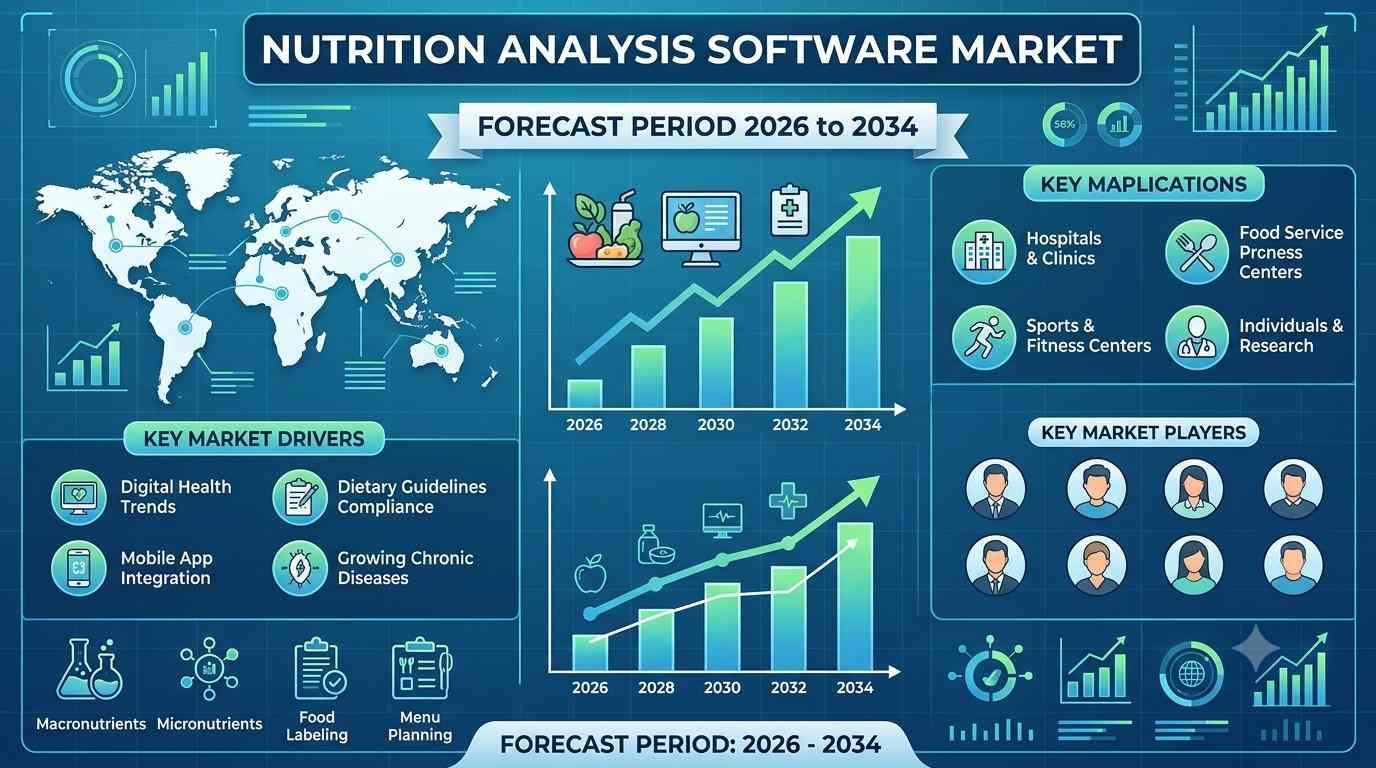
The global nutrition analysis software market is experiencing rapid expansion as demand rises for precise, digital-first dietary tracking and automated food labeling solutions. Driven by growing consumer awareness surrounding health, preventative wellness, and specialized nutrition, organizations across the healthcare, food service, and food manufacturing sectors are adopting digital platforms to evaluate recipe formulations, track micronutrients, and maintain compliance with international food standard regulations.
The global nutrition analysis software market size is projected to reach US$ 3.3 billion by 2034 from US$ 1.21 billion in 2025. The market is anticipated to register a CAGR of 11.85% during the forecast period 2026-2034.
What is driving the market?
Rising health consciousness, regulatory food labeling compliance, and the demand for personalized dietary management are the principal growth drivers. Food manufacturers and commercial food services are increasingly required to provide accurate nutrient panels, allergen disclosures, and front-of-pack labeling compliant with regional food standards (e.g., FDA, EFSA). Concurrently, healthcare practitioners, hospitals, and wellness platforms seek software that reduces manual calculations, tracks 50–150+ micronutrient/macronutrient parameters, and integrates with electronic health records (EHR).
The market is moving beyond basic calorie calculation toward real-time, data-driven nutrient analytics. Software providers are investing in AI-driven meal planning engines, dynamic recipe optimization, automatic barcode database syncing, and metabolic tracking. Fragmented global ingredient databases, variable data quality across user-generated food libraries, and high implementation costs for small-scale foodservice businesses remain important constraints.
Which region leads?
North America leads the market, accounting for an estimated 38%–42% share in 2025, supported by early adoption of digital health tools, stringent FDA labeling mandates, high healthcare expenditure, and a mature ecosystem of health tech platforms.
Asia Pacific represents the fastest-growing region with a projected CAGR of 11.5%–12.8%. Growth is propelled by rapid smartphone penetration, urbanization, rising consumer focus on preventive healthcare, and expanding food and beverage manufacturing capacity across China, India, and Southeast Asia. Europe holds a significant market share of 22%–26%, driven by strict regulatory labeling frameworks and corporate wellness initiatives.
Which segment leads?
By component, the Software segment is the leading revenue generator, accounting for approximately 70% of market value in 2025. Its position is supported by widespread adoption of Software-as-a-Service (SaaS) deployment, cloud-enabled accessibility, continuous database updates, and scalable subscriptions for independent practitioners and enterprise users alike. The software segment is forecast to maintain a high CAGR through 2033.
By end-use, Hospitals & Healthcare Systems leads with an estimated 40%–44% share in 2025, driven by the need for standardized nutritional care plans, therapeutic diet management, and regulatory compliance in clinical environments. Among software functionalities, Recipe & Nutrient Calculation forms the largest base, while AI-Powered Meal Planning & Personalized Recommendations is identified as the fastest-growing functional segment.
Which companies are prominent?
The report identifies Nutritionist Pro (Axxya Systems), ESHA Research (Genesis R&D), Cronometer, MyFitnessPal, Nutritics, Food Processor, MealMetrics, Libib, Computrition, and Nutrium as prominent market participants.
These platforms compete across clinical dietary assessment, commercial food labeling, corporate wellness integration, and consumer health tracking. Strategic differentiation increasingly depends on food database depth, micronutrient tracking precision, EHR and wearable API integration, regulatory compliance automation, and user interface simplicity. The list reflects the report's competitive landscape rather than a revenue-ranked market-share table.
What is changing in 2026?
The market is shifting from static nutrient lookup tables toward intelligent, AI-driven, and interoperable nutrition management ecosystems. Software updates in 2026 emphasize automated meal-image recognition, deep integration with IoT health wearables, dynamic allergen detection, and continuous metabolic data syncing.
Regulatory bodies have tightened front-of-pack nutritional labeling policies, requiring packaging software to automatically calculate revised nutrient scoring systems and print-ready digital labels. Consequently, enterprise procurement is increasingly prioritizing software solutions with verified food databases (e.g., USDA FoodData Central, McCance and Widdowson) and robust data security standards (HIPAA/GDPR compliance).
What are the major investment opportunities?
The strongest opportunities lie in AI-integrated personalized nutrition engines, clinical healthcare software integration, continuous glucose/wearable tracking synchronization, and compliance platforms for the food manufacturing industry. Investment in specialized omics-based software (linking DNA, blood biomarkers, or microbiome data with dietary planning) offers significant long-term growth potential.
Additional opportunities exist in localized food database expansion for emerging markets, cloud-based B2B SaaS solutions for cloud kitchens and quick-service restaurants (QSRs), and white-label nutrition modules for corporate wellness providers. Strategic investors should prioritize software vendors that demonstrate high database accuracy, seamless API connectivity, strict regulatory readiness, and scalable cloud infrastructure.
The Insight Partners provides comprehensive syndicated and tailored market research services in the healthcare, technology, and industrial domains. Renowned for delivering strategic intelligence and practical insights, the firm empowers businesses to remain competitive in ever-evolving global markets.
• Email: sales@theinsightpartners.com
• Website: theinsightpartners.com
• Phone: +1-646-491-9876

 English
 Arabic
 French
 Spanish
 Portuguese
 Deutsch
 Dutch
Dutch
 Italiano
 Russian
 Romaian
 Portuguese (Brazil)
 Greek
Greek
