
Pouches Market Growth Supported by E-Commerce Packaging Needs
The packaging industry is undergoing a quiet but significant shift. Products that were once almost automatically packed in bottles, cans, cartons, or rigid containers are increasingly moving toward flexible formats that use less material, weigh less, and offer greater convenience. The pouches market is at the center of this transition, supported by growing packaged food consumption, changing lifestyles, e-commerce, and the search for more efficient packaging systems.
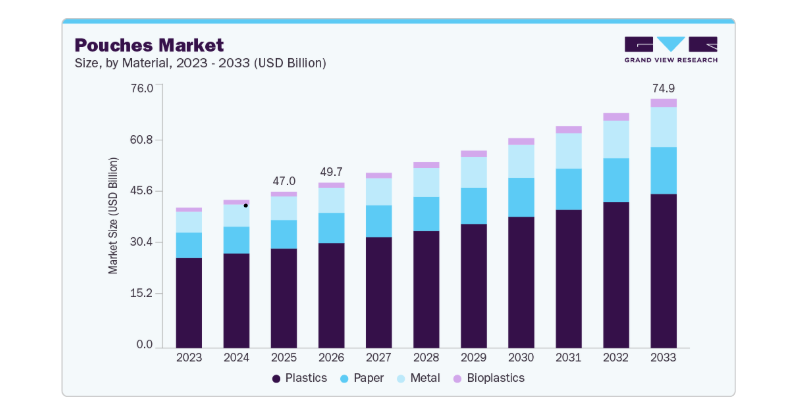
The global Pouches Market was valued at USD 47.0 billion in 2025 and is projected to grow from USD 49.7 billion in 2026 to USD 74.9 billion by 2033, representing a 6.0% CAGR from 2026 to 2033. Asia Pacific accounted for more than 39.4% of global revenue in 2025, making it the leading regional market.
Key Highlights
- 2025 Market Size: USD 47.0 Billion
- 2026 Market Estimate: USD 49.7 Billion
- 2033 Market Projection: USD 74.9 Billion
- CAGR (2026–2033): 6.0%
- Fastest-Growing Material: Bioplastics
- Fastest-Growing Product: Stand-up pouches
- Fastest-Growing End Use: Healthcare
Why Pouches Are Taking More Shelf Space
The strongest advantage of a pouch is that it can perform several packaging functions without carrying the weight and volume associated with many rigid formats.
A pouch can be:
Lightweight → portable → resealable → flexible → space-efficient → easier to transport
This combination matters to both manufacturers and consumers. For manufacturers, lower material consumption and transportation weight can improve supply chain economics. For consumers, the same package may be easier to carry, open, store, pour, and reuse.
That is why the demand story extends across sauces, snacks, ready-to-eat foods, beverages, pet food, personal care products, household products, and healthcare applications.
Food and Beverage Remain the Main Demand Engine
Food and beverages represented 54.9% of the market in 2025, making this sector the largest contributor to pouch consumption.
The reason is closely connected to changing lifestyles. Urban consumers increasingly prefer convenient products that fit into faster daily routines. Single-serve packs, ready-to-eat products, liquid foods, snacks, sauces, and beverages all benefit from flexible packaging.
The trend can be viewed as a simple progression:
Busy lifestyles → demand for convenience → growth in packaged foods → more flexible packaging → higher pouch consumption
E-commerce adds another layer. Packaging used for online distribution needs to balance durability with low transportation weight, making pouches attractive for several consumer categories.
Download a free sample report or claim your copy of this full market intelligence report
Plastic Dominates, but the Material Mix Is Not Standing Still
Plastic remained the leading material, accounting for 63.7% of revenue in 2025. Its popularity comes from durability, moisture resistance, barrier performance, impact resistance, and cost efficiency.
However, the material landscape is changing. Manufacturers are increasingly exploring recyclable structures, mono-material packaging, downgauged films, and bio-based options.
Bioplastics are projected to grow at the fastest rate among materials. Their appeal comes from the opportunity to reduce reliance on conventional fossil-based plastics while retaining useful packaging characteristics.
The market is therefore moving toward:
Conventional plastic → optimized structures → recyclable solutions → bio-based alternatives
The challenge is to achieve sustainability without sacrificing shelf life, mechanical strength, sealing performance, or production efficiency.
The Shape of the Pouch Matters
Flat pouches led the product category with a 63.7% revenue share in 2025. Their low material consumption, scalability, and compatibility with high-speed filling systems make them particularly useful for high-volume packaging.
Stand-up pouches tell a different story. They are expected to record the fastest growth because they combine shelf visibility with convenience. Their upright structure creates additional branding space, while resealable and dispensing features improve the consumer experience.
This has created two distinct product strategies:
Flat pouch → efficient, compact, scalable
Stand-up pouch → visible, convenient, increasingly premium
Closures Are Becoming a Competitive Feature
The closure is no longer an afterthought.
Zipper closures accounted for 41.0% of market revenue in 2025, supported by resealability and product freshness. The consumer journey becomes simple:
Open → use → close → store → use again
Spout closures are gaining momentum because they provide controlled dispensing and are particularly useful for beverages, sauces, baby food, dairy alternatives, and liquid homecare products.
As a result, manufacturers are competing not only on pouch material and printing but also on the functionality built into the package.
Sustainability Is Redesigning the Pouch
The environmental pressure on packaging is increasing. Consumers, retailers, regulators, and brands are all paying greater attention to recyclability and material efficiency.
This is encouraging the development of mono-material structures that can simplify recycling while maintaining the functional properties required during filling, sterilization, transportation, and storage.
Recent industry activity demonstrates the direction. Innovations such as recyclable polypropylene and recycle-ready pouch structures are being developed to reduce material complexity and packaging-related emissions.
For manufacturers, sustainability is becoming less of a marketing feature and more of a product-development requirement.
Healthcare Opens a Higher-Value Opportunity
Food remains the largest end-use segment, but healthcare is emerging as an important high-growth opportunity.
Pouches can provide secure packaging for medicines, supplements, diagnostic kits, and medical devices where protection, hygiene, tamper evidence, and convenience are critical.
This makes healthcare different from mass-market packaging. It requires stronger material performance, specialized structures, and compliance with strict standards.
Basic packaging → functional packaging → specialized packaging → regulated packaging
That progression gives pouch producers opportunities to enter higher-value applications.
Asia Pacific Keeps the Market Moving
Asia Pacific held 39.4% of global revenue in 2025, supported by large consumer populations, packaged food demand, manufacturing activity, retail expansion, and increasing preference for affordable and convenient packaging.
China remains the leading country market in the region, supported by its large manufacturing ecosystem and strong packaged-food industry. India is another important growth market, with Grand View Research projecting the country's pouches market to reach approximately USD 6.93 billion by 2033, growing at a 7.6% CAGR.
Europe is increasingly focused on recyclable and mono-material solutions, while North America continues to benefit from convenience-oriented consumption across food, beverages, pet care, and homecare.
Key Companies
The competitive landscape includes
Amcor pl
Mondi
Sealed Air
Constantia Flexibles
Coveris
Competition is increasingly influenced by material innovation, sustainable structures, printing quality, barrier performance, specialized closures, production scale, and the ability to develop application-specific packaging solutions.
Final Outlook
The pouch is evolving from a simple flexible package into a multifunctional packaging platform.
Less weight + lower logistics burden + more convenience + stronger functionality + improved sustainability
That combination gives the pouches market a broad base for growth through 2033 as brands search for packaging that performs better across both the supply chain and the consumer experience.
About us:
Grand View Research, a market research and consulting company, provides syndicated research reports, customized research reports, and consulting services. Grand View Research database is used by the world's renowned academic institutions and Fortune 500 companies to understand the global and regional business environment. Our database features thousands of statistics and in-depth analysis on 46 industries in 25 major countries worldwide.

 Arabic
 French
 Spanish
 Portuguese
 Deutsch
 Turkish
 Dutch
Dutch
 Italiano
 Russian
 Romaian
 Portuguese (Brazil)
 Greek
Greek
