
Electrical Steel Market Advances Through High-Efficiency Steel Grades
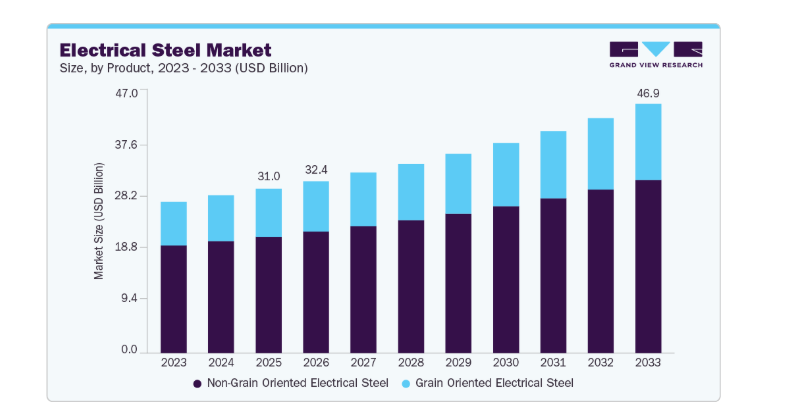
The electrical steel market is becoming increasingly important as electricity networks, electric mobility, industrial automation, and energy-efficient equipment expand worldwide. The global Electrical Steel Market was valued at USD 31.0 billion in 2025 and is projected to reach USD 47.0 billion by 2033, advancing at a 5.5% CAGR from 2026 to 2033. Asia Pacific led the industry with a 66.0% revenue share in 2025, highlighting the region’s strong manufacturing base and rapidly expanding electrification ecosystem.
Key Highlights
2025 Market Size: USD 31.0 Billion | 2026 Estimate: USD 32.4 Billion | 2033 Projection: USD 47.0 Billion | CAGR: 5.5% | Leading Product: Non-Grain Oriented Electrical Steel | Leading Application: Transformers | Largest Region: Asia Pacific
Why Electrical Steel Matters More Than Ever
Electrical steel sits inside many of the systems that make electrification practical. Transformers depend on it to improve magnetic efficiency, while motors and generators use it to reduce energy losses during operation. As power consumption increases and industries replace older equipment with energy-efficient alternatives, demand is moving toward grades that deliver improved electromagnetic performance.
The connection with electric mobility is particularly significant. EV motors require highly efficient magnetic cores to support performance and minimize energy losses. Global electric car sales surpassed 17 million units in 2024, reinforcing the long-term expansion of electric mobility and creating additional demand for high-performance electrical steel.
Download a free sample report or claim your copy of this full market intelligence report
The market’s growth can be viewed through a straightforward chain:
Grid expansion → More transformers → Greater electrical steel consumption
Industrial automation → More energy-efficient motors → Rising non-grain oriented steel demand
EV adoption → Advanced traction motors → Greater demand for premium electrical steel grades
Renewable integration → Grid modernization → Higher transformer and transmission equipment requirements
This interconnected demand structure gives the industry exposure to several major electrification trends rather than relying on a single end-use sector.
Product Landscape: Why Non-Grain Oriented Steel Leads
Non-grain oriented electrical steel held the largest market share in 2025. Its broad magnetic performance makes it suitable for motors, generators, compressors, HVAC equipment, appliances, and electric mobility applications. The continued expansion of rotating electrical machines supports its strong position.
At the same time, grain oriented electrical steel represents an important growth opportunity. Its magnetic properties make it particularly valuable for transformer cores, where energy efficiency and lower core losses are increasingly important. Rising investment in transmission networks and replacement of aging grid equipment are supporting this segment.
Transformers Remain the Core Demand Center
Transformers represented the leading application segment in 2025. Electricity generation is increasingly being accompanied by investments in transmission, distribution, substations, and grid resilience. Modernizing these networks requires efficient transformer systems, making electrical steel a critical material within power infrastructure.
The opportunity extends beyond traditional grids. Renewable generation, distributed energy systems, and electrification are reshaping power flows, increasing the requirement for flexible and efficient electrical equipment.
EVs Open a Second Growth Engine
Electric vehicles are changing the demand profile of the electrical steel market. An EV motor requires carefully engineered magnetic materials to deliver efficient power conversion, compact motor designs, and lower operating losses. As automakers increase EV production, material suppliers are under pressure to deliver thinner and higher-efficiency grades.
This creates a value progression:
Higher EV production → More traction motors → Greater demand for efficient magnetic cores → More premium electrical steel consumption
Motors are also expected to be the fastest-growing application segment, supported by demand from industrial equipment, appliances, commercial systems, and electric mobility.
Regional Pulse
Asia Pacific dominates the global market, supported by large-scale manufacturing in China, India, Japan, Vietnam, and Indonesia. The region’s electrical steel demand is closely linked with motor production, transformer manufacturing, appliances, industrial equipment, and infrastructure investment.
North America is benefiting from grid modernization and increasing requirements for efficient electrical equipment. The U.S. electrical steel market is projected to grow at a 6.2% CAGR through 2033, reaching about USD 4.53 billion, reflecting continued infrastructure and industrial demand.
India represents another strong growth opportunity. Its electrical steel market is projected to reach USD 2.56 billion by 2033, expanding at a 7.2% CAGR, with grain oriented steel identified as the fastest-growing product segment.
Key Companies
The competitive landscape includes Nippon Steel Corporation, POSCO, Voestalpine AG, ArcelorMittal, JFE Steel Corporation, Baosteel, Shougang Group, Thyssenkrupp Steel Europe, Tata Steel, and China Steel Corporation. These companies are positioned across product development, capacity expansion, technology advancement, and regional supply strategies.
Looking Ahead
The electrical steel market is evolving alongside the electrification economy. The strongest opportunities are emerging where grid modernization, electric mobility, industrial efficiency, and clean-energy deployment overlap. As equipment manufacturers demand lower losses and higher efficiency, electrical steel is moving from being a specialized material to a strategic component of the global energy transition.
About us:
Grand View Research, a market research and consulting company, provides syndicated research reports, customized research reports, and consulting services. Grand View Research database is used by the world's renowned academic institutions and Fortune 500 companies to understand the global and regional business environment. Our database features thousands of statistics and in-depth analysis on 46 industries in 25 major countries worldwide.

 English
 Arabic
 French
 Portuguese
 Deutsch
 Turkish
 Dutch
Dutch
 Italiano
 Russian
 Romaian
 Portuguese (Brazil)
 Greek
Greek
