
Hydraulic Workover Unit Market to Reach USD 13.89 Billion by 2036 as Buyers Prioritize Advanced Workover Systems
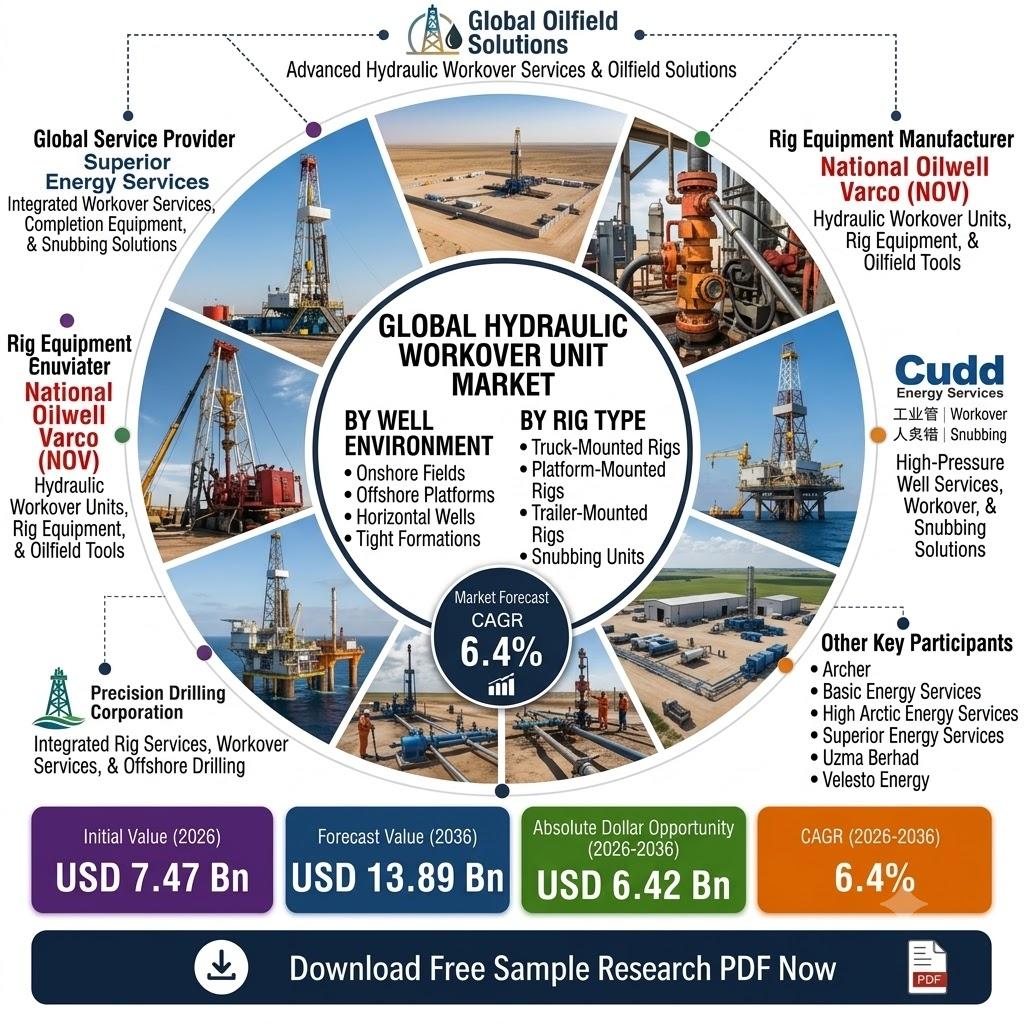
Rockville, Md., September 10, 2026 — The global hydraulic workover unit market is estimated at USD 7.47 billion in 2026 and is projected to reach USD 13.89 billion by 2036, expanding at a 6.4% CAGR during the forecast period. The market is expected to create an absolute dollar opportunity of USD 6.42 billion between 2026 and 2036.
Demand for hydraulic workover units is being shaped by requirements for workover and snubbing configurations across trailer-mounted and skid-mounted systems. Equipment modernization, replacement activity, expanding capacity, and changing technology requirements are influencing purchasing decisions across onshore and offshore operations.
Get detailed market forecasts, competitive benchmarking, and pricing trends: https://www.factmr.com/connectus/sample?flag=S&rep_id=12544
Workover Remains the Leading Service Segment
Workover is estimated to account for 62% of the service segment in 2026, maintaining its position as the dominant service type. Its established demand base, operational relevance, and broad suitability across core applications support continued procurement.
Snubbing represents the other major service category. Its role is gaining attention as buyers evaluate systems based on operational flexibility, lifecycle costs, pressure-control requirements, and changing well-intervention needs.
The market is segmented into Workover and Snubbing under service, with further classification by installation, application, capacity, operation mode, and region.
Trailer-Mounted Systems Lead Installation Demand
Trailer-mounted hydraulic workover units are estimated to represent 58% of the installation segment in 2026. Their established market presence and deployment flexibility support demand across applications requiring mobility and rapid positioning.
Skid-mounted systems remain important where fixed-site installation, stability, and specific operating requirements influence procurement decisions.
The installation landscape is increasingly being shaped by buyer priorities around deployment requirements, operating efficiency, maintenance, and total cost of ownership.
Onshore Applications Account for 76% Share
Onshore applications are estimated to hold 76% of the application segment in 2026, making them the dominant application category. Demand is supported by established onshore operations and continuing requirements for well maintenance and workover activities.
Offshore applications represent a smaller but important opportunity, particularly where complex intervention requirements and higher equipment specifications create demand for specialized systems.
Technology Is Changing Equipment Procurement
Hydraulic workover unit buyers are increasingly evaluating equipment beyond its initial purchase price. Lifecycle cost, energy efficiency, operational flexibility, monitoring capabilities, and aftermarket support are becoming important considerations in equipment selection.
The integration of remote monitoring, IoT-based controls, predictive maintenance, and advanced automation is influencing equipment specifications. These capabilities can support data-driven maintenance planning and performance monitoring while helping operators respond to increasingly demanding operational requirements.
The shift toward higher-specification systems is particularly relevant as replacement cycles and modernization programs create opportunities for suppliers with broader technical portfolios and stronger service capabilities.
United States Leads Country-Level Growth
The U.S. hydraulic workover unit market is projected to expand at a 7.1% CAGR through 2036, making it the fastest-growing country among the markets highlighted by Fact.MR.
Replacement demand across the installed base, equipment upgrades, and aftermarket service activity are supporting market expansion. The U.S. market is also benefiting from ongoing modernization requirements across established onshore and offshore operations.
India follows with a projected 6.9% CAGR, supported by infrastructure investment, capacity expansion, domestic manufacturing activity, and demand for workover systems.
Saudi Arabia is projected to grow at 6.8% CAGR, while China is expected to expand at 6.4% CAGR. Brazil and Canada are forecast to register CAGRs of 5.9% and 5.6%, respectively.
Market Competition Centers on Technology and Service
The competitive landscape includes global energy-service companies and specialized providers. Key participants include Halliburton, National Oilwell Varco, Cudd Energy Services, Archer, Precision Drilling Corporation, High Arctic Energy Services, Basic Energy Services, Superior Energy Services, Velesto Energy, and Uzma Berhad.
Competition is increasingly influenced by product capability, service infrastructure, technical expertise, geographic reach, and aftermarket support. Suppliers able to combine equipment performance with monitoring, maintenance, and service capabilities can strengthen their position as buyers place greater emphasis on lifecycle economics.
Analyst Perspective
Shambhu Nath Jha, Principal Consultant at Fact.MR, states:
“The hydraulic workover unit market is moving beyond volume-driven growth toward value-led expansion. Buyers are increasingly specifying products based on lifecycle cost, energy efficiency, and integration capability rather than upfront price alone. This shift is favoring suppliers with stronger technical portfolios and aftermarket service networks.”
Outlook for Hydraulic Workover Unit Suppliers
The market outlook points toward continued demand for workover equipment as operators modernize installed assets and evaluate higher-specification systems. Opportunities are also emerging through adjacent applications, connected monitoring services, predictive maintenance, and expansion across Asia Pacific and Latin America.
For manufacturers and service providers, the competitive opportunity extends beyond equipment sales. Product differentiation through automation, monitoring, lifecycle support, and regional service networks is expected to become increasingly important as procurement decisions become more focused on long-term operating value.
Top Trending Reports:
https://www.openpr.com/news/4539462/age-related-macular-degeneration-market-to-reach-usd-26-9
https://www.openpr.com/news/4541628/mercury-analyzer-market-to-reach-usd-483-6-million-by-2036-as
https://www.openpr.com/news/4541667/energy-retrofit-systems-market-to-reach-us-377-2-million-by-2036
About Fact.MR
Fact.MR is a global market research and consulting firm specializing in market intelligence, industry analysis, and strategic research across multiple sectors. Its research combines secondary research, primary interviews, market modelling, and validation to assess market size, competitive dynamics, demand trends, and future opportunities.
About the Hydraulic Workover Unit Market Report
The Fact.MR Hydraulic Workover Unit Market report covers market analysis and forecasts from 2026 to 2036, including segmentation by service, installation, application, capacity, operation mode, and region. The report evaluates market size, growth trends, country-level opportunities, competitive positioning, and key factors influencing demand.

 English
 Arabic
 French
 Spanish
 Portuguese
 Turkish
 Dutch
Dutch
 Italiano
 Russian
 Romaian
 Portuguese (Brazil)
 Greek
Greek
