
Wound Care Market Outlook for Remote Wound Monitoring
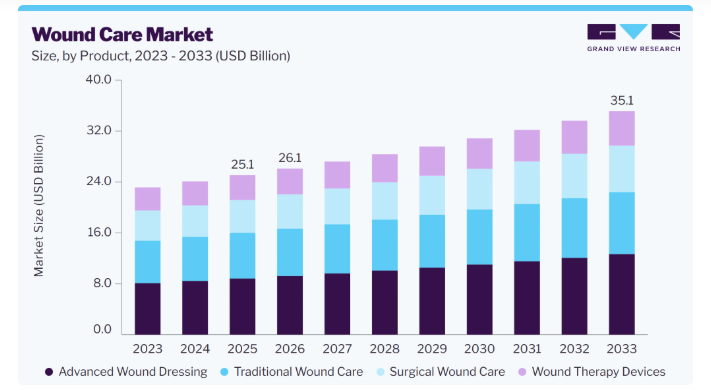
The wound care market is evolving around a fundamental healthcare challenge: wounds that do not heal quickly can become prolonged clinical and economic burdens. Chronic conditions such as diabetic foot ulcers, pressure injuries, and venous leg ulcers are increasing demand for advanced dressings, negative pressure wound therapy, biologics, and digitally enabled monitoring. The global Wound Care Market was valued at USD 25.1 billion in 2025 and is projected to reach USD 35.1 billion by 2033, expanding at a 4.3% CAGR from 2026 to 2033. North America dominated the market with a 46.9% revenue share in 2025, while Asia Pacific is expected to record the fastest growth.
Key Highlights
USD 25.1 billion was the market value in 2025, rising to USD 26.1 billion in 2026 and an estimated USD 35.1 billion by 2033. Chronic wounds represented 59.8% of application revenue in 2025, advanced wound dressings led the product landscape, and institutional sales remained the dominant distribution channel. North America led regionally, while Asia Pacific represents the strongest expansion opportunity.
The Wound Care Journey Is Becoming More Technology-Intensive
A wound rarely represents just one treatment decision.
The management journey can be viewed across several stages:
Stage 1 | Identifying the problem
The first challenge is determining wound type, severity, infection risk, tissue condition, and healing potential.
For chronic wounds, early assessment is particularly important because delayed healing can increase the complexity and duration of treatment.
Download a free sample report or claim your copy of this full market intelligence report
Stage 2 | Selecting the right intervention
The market now offers considerably more than conventional gauze and basic bandages.
Advanced wound dressings
Antimicrobial solutions
Negative pressure wound therapy
Biologics
Skin substitutes
Specialized surgical wound products
The growing burden of diabetic ulcers, pressure injuries, and venous leg ulcers is expanding the need for these solutions.
Stage 3 | Monitoring progress
Treatment does not end after a dressing is applied.
Clinicians increasingly need to monitor:
Wound size
Exudate
Tissue condition
Infection indicators
Healing progression
This is creating opportunities for digital wound assessment, telehealth, imaging, remote monitoring, and AI-assisted analysis.
Stage 4 | Preventing recurrence
A successful wound-care strategy also considers what happens after healing.
For chronic conditions, recurrence prevention can involve ongoing monitoring, patient education, pressure management, offloading, compression, and disease management.
This makes wound care a continuing clinical process rather than a one-time product purchase.
Chronic Wounds Are the Market's Core Demand Base
The chronic wounds segment held 59.8% of market revenue in 2025.
Its dominance is closely linked to diabetes, obesity, vascular disease, aging, and prolonged healing cycles.
The growing global diabetes population is particularly important because diabetic foot ulcers can require repeated intervention and long-term wound management.
This creates recurring demand for dressings, wound therapy systems, regenerative products, and clinician-directed care.
Advanced Dressings Are Changing Standard Practice
Advanced wound dressings represented the leading product category in 2025.
Unlike conventional wound coverings, advanced products can be designed around specific healing requirements.
They include:
- Foam dressings
- Hydrocolloids
- Hydrogels
- Alginate dressings
- Collagen dressings
- Antimicrobial dressings
- Other specialized moist wound dressings
The category continues to benefit from demand for improved moisture management, infection control, exudate handling, and healing support.
NPWT Is Creating a Different Growth Layer
Negative pressure wound therapy is becoming increasingly important in complex wound management.
The technology uses controlled negative pressure to help manage exudate and support the healing environment.
Its market opportunity is expanding across surgical and chronic wounds, while portable and single-use systems are helping extend NPWT beyond traditional inpatient settings.
The growing emphasis on shorter hospital stays and decentralized care can further increase the importance of portable wound therapy.
Healthcare Is Moving Wound Management Beyond Hospitals
Hospitals remain the leading end-use environment, but wound management is gradually becoming more distributed.
Home healthcare
Growing aging populations, chronic disease prevalence, shorter inpatient stays, and expanding home-care services are creating demand for products that can be safely used outside hospitals.
Outpatient care
Specialized wound centers and clinics can provide ongoing treatment without requiring full hospitalization.
Digital care
Remote assessment and connected monitoring can help clinicians follow wound progression between physical visits.
This shift is particularly important for chronic wounds, where treatment can continue for long periods.
Regional Market Pulse
North America
North America accounted for 46.9% of global revenue in 2025, supported by established healthcare infrastructure, advanced product adoption, a large chronic-wound patient population, and strong manufacturer presence. The U.S. remains the dominant country in the region.
Asia Pacific
Asia Pacific is projected to post the fastest CAGR through 2033. Large patient populations, increasing healthcare expenditure, aging demographics, and rising demand for advanced wound products are creating strong expansion opportunities across China, India, Japan, and Southeast Asia.
Europe
Europe continues to address chronic wound burden through structured care pathways, advanced therapies, and growing attention to community-based wound management.
Middle East & Africa
Growing healthcare investment, diabetes prevalence, and improving access to modern wound treatment are expanding market potential.
Reimbursement Is Becoming a Competitive Filter
The market is also experiencing greater scrutiny around the cost and evidence supporting advanced therapies.
Changes in reimbursement policies, particularly for expensive wound products and tissue-based therapies, are increasing the importance of:
Clinical evidence
Medical necessity
Documentation
Patient selection
Cost-effectiveness
This environment favors companies that can demonstrate measurable clinical and economic value.
Key Companies
- Smith+Nephew
- Convatec Group PLC
- Mölnlycke Health Care AB
- Baxter
Where the Market Is Going
The future wound care market is moving toward earlier intervention, advanced materials, personalized treatment, remote monitoring, and decentralized care.
The most valuable innovations will be those that do more than cover a wound. They will help clinicians understand it, treat it efficiently, monitor its progression, and reduce the likelihood of complications.
That shift is turning wound care from a product-centered market into a broader healing-management ecosystem.
About us:
Grand View Research, a market research and consulting company, provides syndicated research reports, customized research reports, and consulting services. Grand View Research database is used by the world's renowned academic institutions and Fortune 500 companies to understand the global and regional business environment. Our database features thousands of statistics and in-depth analysis on 46 industries in 25 major countries worldwide.
USD 23.0B 2025 market
USD 28.1B 2026 estimate
USD 119.6B 2033 projection
23.0% CAGR
54.6% smart stadium share
15.5% soccer share
45.8% sports leagues share
The Market From the Inside Out
- The Athlete Layer
Technology starts at the athlete.
Wearables, smart apparel, GPS trackers, biometric sensors, smartwatches, and sensor-enabled equipment are helping capture real-time information about physical performance.
What gets measured?
Heart rate
Speed
Distance
Movement
Workload
Energy use
Recovery
This information allows coaches and performance teams to build a more detailed understanding of athlete condition.
- The Training Layer
Data becomes useful when it changes training.
AI-powered systems can analyze historical and real-time information to help teams adjust workloads and identify performance patterns.
Instead of giving every athlete the same training structure, technology supports increasingly personalized approaches.
Training can become more targeted through
- Workload analysis
- Player movement tracking
- Biomechanical assessment
- Recovery monitoring
- Injury-risk analysis
- Performance comparisons
The result is a shift from experience-only coaching toward technology-assisted decision-making.
Download a free sample report or claim your copy of this full market intelligence report
- The Strategy Layer
Performance data is also influencing game strategy.
Video analytics, computer vision, and machine learning can evaluate player positioning, tactical structures, opponent behavior, and historical patterns.
This changes the coaching process.
Observation becomes measurement.
Measurement becomes analysis.
Analysis becomes strategy.
Technology is therefore becoming part of competitive preparation rather than a post-match reporting tool.
- The Venue Layer
The smart stadium segment represented 54.6% of revenue in 2025.
Stadiums are becoming connected ecosystems where digital infrastructure can influence both operations and fan experience.
Smart stadium functions include
Mobile services
Real-time statistics
Digital signage
Personalized promotions
In-seat ordering
Seat upgrades
Interactive content
IoT infrastructure also provides stadium operators with information that can help improve operational planning and understand audience behavior.
- The Fan Layer
The sports experience increasingly extends beyond the physical venue.
AR can provide live overlays and player statistics.
VR can allow immersive viewing and simulated experiences.
Mobile applications can provide:
Live updates
Personalized content
Interactive statistics
Digital offers
Venue services
This creates a more individualized relationship between sports organizations and their audiences.
- The Data Layer
As technology adoption expands, the volume of sports data is increasing rapidly.
A single organization may generate information through:
Wearables
Cameras
Ticketing systems
Mobile applications
Stadium sensors
Broadcast systems
Social platforms
Cloud computing provides the infrastructure needed to manage these large and diverse data streams.
- The Intelligence Layer
AI and machine learning sit above the data.
This is where the sports technology market becomes increasingly sophisticated.
AI can help identify patterns related to:
Player performance
Injury risk
Tactical behavior
Fan preferences
Content engagement
Talent development
The analytics & statistics segment is projected to record a CAGR of over 29%, demonstrating the growing importance of this intelligence layer.
- The Commercial Layer
Sports technology is also becoming a revenue-generation tool.
Connected systems can help sports organizations understand fans and personalize their interactions.
Potential commercial applications include:
Targeted promotions
Digital sponsorship
Personalized offers
Fan subscriptions
Enhanced ticketing
Data-based advertising
This makes technology relevant not only to coaches and athletes but also to the business side of sports.
Soccer Creates the Largest Sports Technology Footprint
The soccer segment represented 15.5% of market revenue in 2025.
The sport's widespread use of wearable tracking, performance analytics, video systems, and connected coaching tools creates a strong technology ecosystem.
Soccer is also an important environment for player development, where longitudinal data can support decisions around workload, fitness, scouting, and tactical performance.
Basketball Is Building Momentum
Basketball is expected to experience the fastest growth among sports categories during the cited forecast period.
Advanced tracking systems can evaluate:
Shot efficiency
Player movement
Defensive positioning
Possession patterns
Matchups
Workload
These capabilities are increasingly influencing coaching and player evaluation.
Sports Leagues Have the Broadest Technology Requirements
With 45.8% revenue share in 2025, sports leagues represented the largest end-use category.
Unlike individual teams, leagues must address multiple technology needs simultaneously.
Competition
Broadcasting
Fan engagement
Venue operations
Data management
Commercialization
This makes leagues important customers for integrated sports technology platforms.
Regional Technology Map
Europe: Europe held the largest global share at 30.1%, supported by established leagues, large fan bases, sophisticated stadium infrastructure, and strong adoption of sports analytics.
North America: The region benefits from professional sports ecosystems, advanced digital platforms, wearable adoption, analytics, broadcasting technologies, and fan monetization models.
Asia Pacific: Asia Pacific is expected to grow fastest, supported by rising sports investments, smart infrastructure, esports, digital fan engagement, and expanding professional competitions.
Latin America: Digital sports engagement and professional league development are creating opportunities for analytics and connected technologies.
Middle East & Africa: Large investments in sports infrastructure and major sporting events are supporting adoption of smart venue and digital fan technologies.
What Could Slow the Digital Shift?
Technology adoption remains uneven.
Smaller teams may face high implementation costs, while organizations operating older systems may encounter interoperability challenges.
The market must also address:
Cybersecurity
Data ownership
Privacy
Skills
Integration
These challenges are becoming more important as sports organizations collect increasingly sensitive performance and audience data.
Key Companies
- Apple Inc.
- Catapult Group
- ChyronHego Corporation
- Cisco Systems, Inc.
The Sports Technology Ecosystem of Tomorrow
The sports technology market is heading toward an environment in which every major layer is connected.
Athlete data informs training.
Training data informs strategy.
Strategy data feeds content.
Fan data informs engagement.
Stadium data improves operations.
AI connects the entire system.
That is the real transformation behind the market’s projected rise to USD 119.6 billion by 2033.
About us:
Grand View Research, a market research and consulting company, provides syndicated research reports, customized research reports, and consulting services. Grand View Research database is used by the world's renowned academic institutions and Fortune 500 companies to understand the global and regional business environment. Our database features thousands of statistics and in-depth analysis on 46 industries in 25 major countries worldwide.

 English
 French
 Spanish
 Portuguese
 Deutsch
 Turkish
 Dutch
Dutch
 Italiano
 Russian
 Romaian
 Portuguese (Brazil)
 Greek
Greek
