
How a Handyman Clone App Can Help You Build a Profitable and Scalable Service Business in 2026
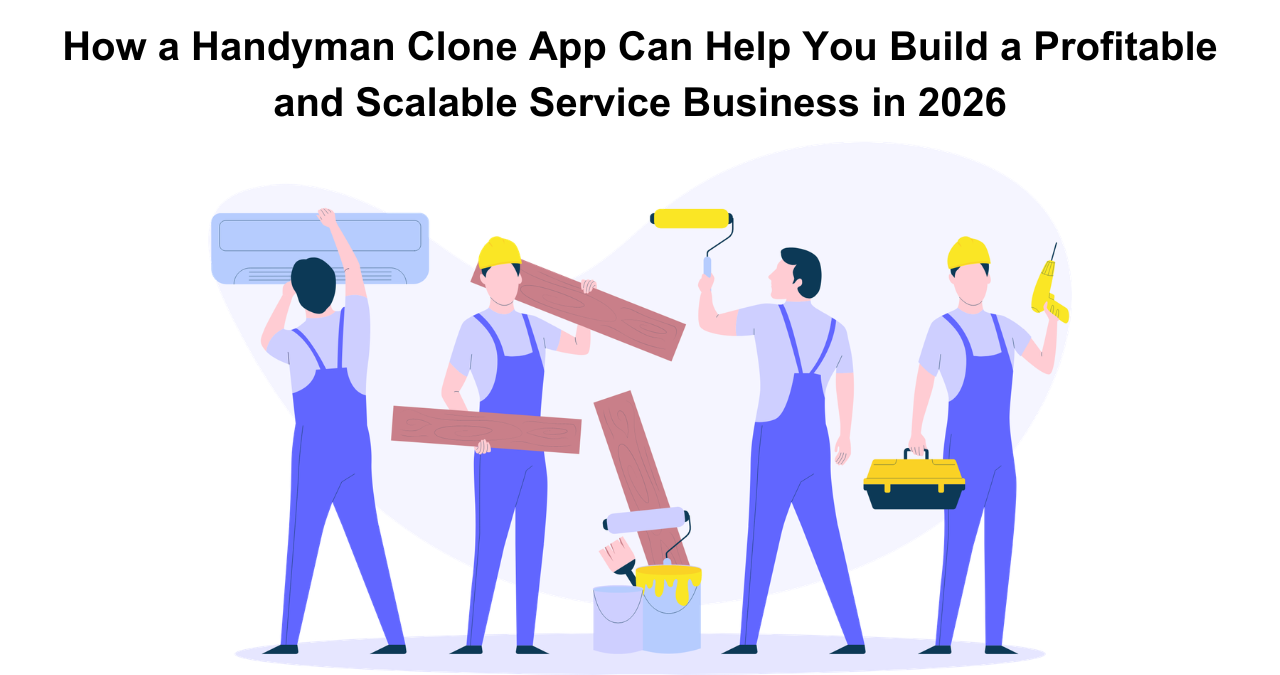
The demand for convenient home services is growing across cities and markets worldwide. Customers no longer want to spend hours searching for reliable professionals, calling multiple service providers, or waiting days for a simple repair. They increasingly expect the same convenience they get from ride-hailing and food delivery platforms: choose a service, request it digitally, track progress, and complete the job with minimal effort.
This shift has created a strong opportunity for entrepreneurs and startups to build digital home-service marketplaces. A Handyman Clone App can provide the foundation for launching such a business without having to create an entirely new service marketplace concept from the ground up.
The model is inspired by successful on-demand platforms while allowing entrepreneurs to build their own brand, define their service categories, select their target market, and create a business model suited to local demand.
From plumbing and electrical work to appliance repair, cleaning, painting, carpentry, and general maintenance, an on-demand platform can bring customers and skilled professionals together through one convenient service.
For entrepreneurs entering the home-services industry in 2026, the real opportunity is not simply creating another booking application. It is building a reliable marketplace that solves three important problems: customers need trusted professionals, service providers need consistent leads, and businesses need an efficient way to manage growing demand.
What Is a Handyman Clone App?
A Handyman Clone App is a ready-made on-demand service platform inspired by established marketplace models. It allows an entrepreneur to launch a branded digital platform where customers can discover and request home services while professionals can receive and manage service requests.
The concept is similar to the way ride-hailing platforms connect riders with drivers. Instead of transportation, the platform connects customers with professionals who provide home maintenance services.
For example, a customer may need:
- Plumbing repair
- Electrical maintenance
- Furniture assembly
- Painting
- Carpentry
- Appliance repair
- Air-conditioning service
- Cleaning
- Gardening
- Home improvement
- General property maintenance
Rather than searching independently for each professional, customers can use one platform to find an appropriate service provider.
This is why the Handyman App Like Uber concept has gained attention among entrepreneurs. It combines the convenience of an on-demand marketplace with the recurring demand associated with residential and commercial maintenance.
The important point is that a clone does not mean copying another company's brand or identity. It means using a proven business concept as a starting point and adapting it to create an independent business.
Why the Handyman Services Market Is Attractive in 2026
Home maintenance is not a one-time requirement. Homes, offices, rental properties, commercial buildings, and other spaces require regular repairs and maintenance.
This creates an advantage for entrepreneurs compared with businesses that depend entirely on occasional purchases.
A customer who books a plumber today may later require electrical work, appliance repair, cleaning, painting, or another service. If the platform delivers a good experience, that customer can return whenever another requirement appears.
At the same time, professionals need a consistent source of customers. Independent technicians often depend heavily on referrals, local advertising, social media, or classified listings. An on-demand marketplace can give them another channel for generating business.
The combination of recurring demand and fragmented service providers creates a strong foundation for a marketplace model.
Changing Customer Expectations
Customers are becoming more comfortable with digital service booking. They expect businesses to provide:
- Convenient service discovery
- Quick booking
- Professional profiles
- Service availability
- Clear communication
- Appointment updates
- Digital notifications
- Reviews and ratings
- Multiple payment options
- Reliable customer support
These expectations are not limited to major cities. Entrepreneurs can adapt the model to suburban markets, smaller cities, regional markets, or specialized commercial service segments.
How a Handyman App Like Uber Works
The basic concept behind a Handyman App Like Uber is straightforward.
A customer opens the application, selects the required service, provides relevant details, chooses a preferred appointment or service option, and submits a request.
The platform then helps connect the request with an appropriate professional.
The professional can review the request and decide whether to accept it. Once the service is confirmed, the customer receives relevant updates throughout the process.
After completion, the customer can provide feedback and rate the service.
This creates a marketplace cycle:
Customer demand → Service request → Professional matching → Service completion → Review → Repeat booking
The simplicity of this model is one reason the concept works across different markets.
Business Opportunities With an Uber for Home Services Model
An Uber for Home Services platform does not have to focus only on individual household repairs.
Entrepreneurs can create specialized marketplaces around different customer segments.
Residential Home Services
This is the most obvious market. Customers can book professionals for routine repairs and maintenance.
Common categories include plumbing, electrical work, cleaning, painting, carpentry, appliance repair, and general home maintenance.
Property Management Services
Property managers often need reliable professionals for apartments, rental properties, offices, and commercial spaces.
A specialized platform can help property managers request services repeatedly and manage multiple maintenance requirements through one marketplace.
Commercial Maintenance
Businesses regularly require maintenance services for offices, retail stores, restaurants, warehouses, and other commercial properties.
Entrepreneurs can develop an Uber for home services concept that also supports business customers, creating opportunities beyond residential bookings.
Specialized Services
Another strategy is to focus on a specific category.
For example, a platform could specialize in:
- Plumbing
- HVAC maintenance
- Electrical services
- Cleaning
- Appliance repair
- Senior home assistance
- Smart-home installation
- Property maintenance
Specialization can help a startup establish a clearer market position before expanding into additional categories.
Why Entrepreneurs Are Considering the Handyman App Like Uber Model
Building a service marketplace from scratch can involve considerable planning, testing, and market validation.
A ready-made business model gives entrepreneurs a starting point that has already been proven in related on-demand industries.
The Handyman App Like Uber approach allows entrepreneurs to focus more attention on business development rather than spending all their early effort defining the basic marketplace structure.
For a startup, this can be particularly useful because speed matters.
Entrepreneurs can validate demand, onboard professionals, build a customer base, collect feedback, and improve their service offering based on actual market behavior.
The goal should not be to launch quickly and stop there. The goal is to launch with a clear market strategy and continue improving the platform as demand grows.
Key Service Categories for an On-Demand Handyman Services App
A successful On-Demand Handyman Services App should make it easy for customers to identify the service they need.
A broad service marketplace could include categories such as:
Plumbing Services
Customers can request professionals for leaking pipes, blocked drains, faucet repairs, water-related problems, installations, and other plumbing requirements.
Search behavior such as “handyman plumber” also shows how customers may combine a general service term with a specific requirement.
Electrical Services
Electrical professionals can handle repairs, installations, switches, lighting, wiring-related requirements, and other maintenance needs.
Appliance Repair
Customers can request assistance for refrigerators, washing machines, ovens, air conditioners, and other household appliances.
Carpentry and Furniture Services
Furniture assembly, repairs, installations, shelving, doors, cabinets, and other carpentry requirements can be offered through the marketplace.
Painting Services
The platform can support small repair jobs as well as larger residential or commercial painting requirements.
Cleaning Services
Cleaning can become an important recurring category because customers may require services weekly, monthly, or for specific occasions.
General Home Maintenance
Some customers may not know exactly which professional they need. A general maintenance category can allow them to describe their requirement and receive assistance from an appropriate service provider.
Features That Make the Marketplace Useful
A successful service marketplace needs more than a booking form. The user experience should support the complete service journey.
Easy Service Discovery
Customers should be able to find services quickly without navigating through unnecessary steps.
Categories, search functionality, service descriptions, and location-based discovery can make the process easier.
Professional Profiles
Customers want confidence before allowing someone to work inside their home or business.
Professional profiles can provide relevant information such as service categories, experience, customer ratings, completed jobs, and other business details.
Location-Based Matching
Location is particularly important for home services.
A customer searching for a handyman near me app expects the platform to identify professionals who can realistically reach the requested location.
Location-based discovery can help reduce unnecessary travel and improve response times.
Booking Management
Customers should be able to select suitable service times and manage upcoming requests.
Professionals also need a convenient way to view, accept, organize, and complete their assignments.
Ratings and Reviews
Reviews can help establish marketplace trust.
Customers can evaluate professionals based on previous experiences, while service providers can build credibility through positive feedback.
Notifications
Timely notifications can keep customers and professionals informed about booking updates, appointment changes, service status, and other important events.
Customer Support
Problems can occur in any marketplace. A reliable support process gives customers and service providers a clear channel for resolving booking-related issues.
Building Trust in a Handyman Marketplace
Trust is one of the biggest challenges in the home-services industry.
A customer is not simply purchasing a product. They are inviting a professional into their home, office, or property.
For this reason, entrepreneurs should treat trust and safety as core parts of their business strategy.
A marketplace can establish trust through professional verification processes, ratings and reviews, transparent service information, clear communication, customer support, and consistent service standards.
Depending on the market, businesses may also introduce additional verification requirements appropriate to their industry and local regulations.
The objective is simple: customers should feel comfortable choosing a professional through the platform.
How a Handyman App Like Uber Can Scale Across Markets
One of the strongest advantages of an on-demand marketplace is its ability to expand geographically.
A startup may begin in one city and focus on achieving strong service availability and customer satisfaction.
Once the marketplace becomes stable, the business can expand to additional locations.
However, geographical expansion should not happen simply because another city looks attractive.
Before entering a new market, entrepreneurs should consider:
- Local demand
- Number of available professionals
- Competition
- Service categories
- Customer expectations
- Local regulations
- Payment preferences
- Service availability
- Operational requirements
A successful expansion strategy should balance customer demand with professional supply.
If a platform acquires many customers but cannot provide enough professionals, customer satisfaction can quickly decline.
Uber for Handyman Services App: What Makes It Different From a Directory?
A traditional local directory primarily helps users find businesses.
An Uber for Handyman Services App goes further by facilitating the service transaction.
Customers are not simply looking at a phone number. They can use the platform to discover services, request assistance, communicate with professionals, manage bookings, receive updates, and review completed services.
This creates a more complete digital marketplace.
For entrepreneurs, the difference is important because a marketplace can create an ongoing relationship between customers and service providers rather than simply sending traffic to an external business.
Using an Uber Like App For Handyman to Build a Local Marketplace
Local marketplaces can be especially attractive for startups.
Home services are naturally location-dependent. A customer generally wants a professional who can reach their property within a reasonable time.
This creates opportunities for entrepreneurs to build strong local networks.
Instead of attempting to compete globally from the first day, a startup can establish a strong presence in a specific city or region.
Once the operational model is proven, the business can replicate the process in other locations.
An Uber Like App For Handyman can therefore act as a foundation for building a multi-location service marketplace.
Read More: Why White-Label Solutions Fastest Way to Launch a Handyman App Like Uber?
Monetization Opportunities for the Business Model
The marketplace model can support different revenue strategies depending on the target market and service categories.
Entrepreneurs may consider models such as:
- Commission from completed service bookings
- Service-provider subscription plans
- Lead-generation fees
- Featured professional listings
- Business accounts
- Service-category partnerships
- Membership programs
The right approach depends on the market.
A startup should avoid selecting a monetization strategy simply because it is popular elsewhere. The model should align with customer behavior, professional expectations, service frequency, and competitive conditions.
Handyman Script vs. Building a Marketplace From Scratch
Entrepreneurs evaluating handyman app development often face a fundamental decision: develop an entire marketplace from the beginning or use a ready-made solution as the foundation.
A handyman script can provide a structured starting point for businesses that want to enter the market without designing every marketplace component from zero.
However, the quality of the underlying solution matters.
A business should evaluate whether the platform can support its intended service categories, target locations, business rules, user experience, growth strategy, and future expansion.
The objective is not simply to obtain an application. The objective is to establish a sustainable service marketplace.
How to Choose the Right Handyman App Development Approach
The right development approach depends on the startup's goals.
Before selecting a solution, entrepreneurs should clearly define:
Target Market
Identify the country, city, customer segment, and service categories you want to target.
Business Model
Decide how the platform will generate revenue and how customers and professionals will interact.
Service Categories
Start with categories that have genuine demand instead of launching with too many services.
Professional Acquisition
A marketplace cannot succeed without service providers. Develop a strategy for recruiting and retaining reliable professionals.
Customer Acquisition
Identify the channels that can generate high-quality customers. Depending on the market, this may include search marketing, social media, partnerships, referral campaigns, and local marketing.
Expansion Strategy
Define the conditions that need to be met before entering a new city or adding another category.
This preparation can make handyman app development more focused and reduce unnecessary changes after launch.
Why an On Demand Handyman App Can Create Repeat Customers
Repeat usage is particularly valuable in home services.
Customers may initially use a platform for a single repair. If the service is reliable, they may return for another requirement.
For example, a customer could first book a plumber, then later use the same marketplace for electrical maintenance, cleaning, appliance repair, or painting.
This cross-category behavior can increase customer lifetime value.
Businesses can encourage repeat usage through reliable service, professional quality, convenient booking, personalized recommendations, loyalty programs, and strong customer support.
The central principle is simple: customer retention should be treated as seriously as customer acquisition.
The Role of Local Handyman Services in Digital Marketplaces
Traditional local handyman services often depend on word-of-mouth referrals and repeat customers.
Digital marketplaces can bring these professionals into a more organized online environment.
For professionals, the platform can provide access to new customers and help them manage incoming service requests.
For customers, it creates a simpler way to compare professionals and request services.
For entrepreneurs, it creates an opportunity to organize a fragmented market.
This three-sided value proposition is one of the main reasons the on-demand marketplace model continues to attract business interest.
How to Launch a Handyman App Like Uber Successfully
Launching the application is only one part of building the business.
A practical launch strategy should include the following stages.
1. Research the Target Market
Study customer requirements, existing competitors, service gaps, and local professional availability.
2. Select the Initial Service Categories
Choose a manageable number of categories with strong demand.
3. Build the Professional Network
Recruit qualified professionals before aggressively acquiring customers.
4. Establish Service Standards
Define expectations around response times, communication, professionalism, cancellations, and customer support.
5. Launch in a Focused Area
A concentrated launch can make it easier to balance customer demand and service-provider availability.
6. Measure Customer Behavior
Track bookings, repeat usage, cancellations, ratings, service completion, and category demand.
7. Expand Based on Data
Add services and locations when the existing marketplace demonstrates sufficient demand and operational stability.
This approach makes the Handyman App Like Uber model more sustainable because expansion is based on actual business performance rather than assumptions.

How AI Can Improve the On-Demand Service Experience
AI is becoming increasingly relevant to marketplace businesses.
In a handyman marketplace, AI can support several areas of the customer journey.
For example, AI-assisted search can help customers describe a problem in natural language and identify the most relevant service category.
If a customer writes, “My kitchen tap is leaking,” the platform can suggest plumbing services instead of forcing the customer to understand technical service categories.
AI can also support intelligent recommendations, demand forecasting, customer support, service categorization, and operational decision-making.
However, AI should solve a genuine business problem. Adding AI simply as a marketing label does not automatically improve a marketplace.
Opportunities for Startups in 2026
The biggest opportunity for startups is not necessarily competing directly with large global platforms.
Instead, entrepreneurs can identify underserved markets and specific service gaps.
Potential opportunities include:
- Home services for smaller cities
- Commercial maintenance marketplaces
- Specialized property maintenance
- Elderly-friendly home-service platforms
- Subscription-based maintenance services
- Smart-home installation services
- Building maintenance marketplaces
- Localized service marketplaces
- Premium verified professional networks
A startup can use an established marketplace concept while developing a differentiated value proposition.
For example, one company may compete on speed, another on verified professionals, another on specialized services, and another on recurring property maintenance.
Common Mistakes Entrepreneurs Should Avoid
Building an on-demand marketplace does not guarantee success.
Several mistakes can make the business difficult to scale.
Launching Too Many Categories
Offering every possible service from day one can make the marketplace difficult to manage.
Start with categories that demonstrate clear demand.
Ignoring Professional Supply
Customer acquisition without sufficient service-provider availability creates poor experiences.
Supply and demand must grow together.
Competing Only on Convenience
Convenience is important, but it is no longer enough.
Customers also care about trust, service quality, reliability, communication, and consistency.
Expanding Too Quickly
Entering multiple cities before establishing a strong local marketplace can spread resources too thin.
Neglecting Customer Feedback
Reviews and complaints provide valuable information about where the marketplace needs improvement.
Treating the Platform as the Entire Business
Technology supports the business, but operations, marketing, professional acquisition, customer support, and service quality determine whether the marketplace can survive.
Future of Uber For home services Platforms
The home-services industry is moving toward greater digital adoption.
Customers increasingly expect service businesses to provide online discovery and booking, while professionals are becoming more comfortable using digital marketplaces to find customers.
This creates opportunities for businesses that can combine technology with reliable service operations.
Future platforms may become more personalized, using customer history, location, service requirements, and previous bookings to recommend appropriate professionals.
Recurring maintenance could also become more important. Instead of waiting for something to break, customers and property owners may use platforms to schedule regular maintenance.
This could transform an on-demand service marketplace into a broader home-maintenance ecosystem.
Why the Handyman App Like Uber Model Is Built for Business Growth
Scalability is one of the strongest reasons entrepreneurs choose marketplace models.
A successful platform can expand in several directions.
It can add:
- New cities
- New service categories
- New customer segments
- More professionals
- Commercial accounts
- Recurring services
- Specialized maintenance offerings
The underlying business concept remains similar while the market opportunity expands.
This makes the Handyman App Like Uber model particularly relevant for startups that want to begin with a focused offering and develop into a larger service marketplace over time.
Final Thoughts
The home-services industry offers a significant opportunity for entrepreneurs who can solve the basic problems of convenience, trust, availability, and service quality.
A Handyman Clone App provides a practical starting point for businesses that want to enter this market with an established on-demand marketplace concept.
The real competitive advantage, however, comes from execution.
Choosing the right market, recruiting dependable professionals, delivering a consistent customer experience, selecting high-demand service categories, and building a strong customer acquisition strategy are all essential.
Entrepreneurs should also think beyond simply launching an application. A successful platform needs a clear business model, strong marketplace operations, customer retention strategies, and a plan for geographic and category expansion.
For startups and established businesses looking to create their own Uber for handyman model, a ready-made marketplace approach can help reduce the complexity involved in entering the industry while leaving room for customization and long-term growth.
With the right market positioning and execution, an on-demand platform can evolve from a simple booking service into a scalable marketplace for home maintenance services.
Choosing an experienced clone app development company can further help entrepreneurs turn the business concept into a market-ready solution and establish a foundation for long-term marketplace growth.
Frequently Asked Questions
1. What is a Handyman Clone App?
A Handyman Clone App is an on-demand service marketplace that connects customers with professionals who provide home repair and maintenance services. Entrepreneurs can use the concept to launch their own branded handyman marketplace and adapt the service categories and business model to their target market.
2. How does a handyman app like Uber benefit startups?
A handyman app like Uber gives startups a structured marketplace model for connecting customers with local service professionals. Instead of developing an entirely new marketplace concept, entrepreneurs can focus on market research, professional acquisition, customer acquisition, service quality, and business expansion.
3. What services can be offered through an on-demand handyman platform?
A platform can support plumbing, electrical work, cleaning, painting, carpentry, appliance repair, furniture assembly, air-conditioning maintenance, gardening, and general home maintenance. Businesses can begin with a focused selection of services and expand based on customer demand.
4. Can an Uber for Handyman Services App operate in multiple cities?
Yes. A marketplace can expand to multiple cities when there is sufficient customer demand and professional supply. Businesses should validate each market before expanding and ensure that enough qualified service providers are available to maintain service quality.
5. Is a Handyman Clone App suitable for an existing service business?
Yes. Existing service companies can use an on-demand marketplace model to expand their digital presence, organize customer bookings, reach new customers, and potentially add new service categories. The platform can also support businesses that want to move from a traditional local-service model toward a scalable digital marketplace.

 English
 Arabic
 Spanish
 Portuguese
 Deutsch
 Turkish
 Dutch
Dutch
 Italiano
 Russian
 Romaian
 Portuguese (Brazil)
 Greek
Greek
