
Silica Market Opportunities in Electronics and Semiconductor Manufacturing
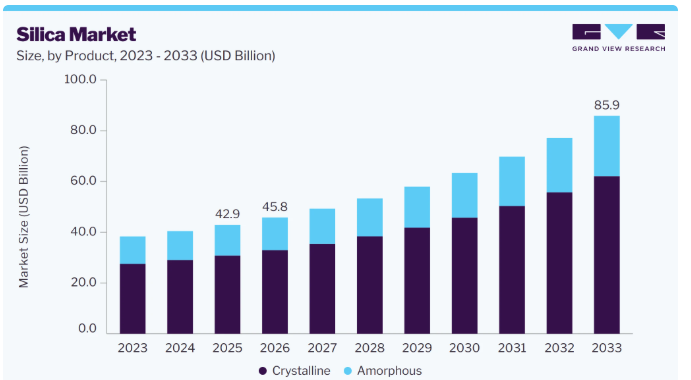
The silica market is no longer driven by a single industrial application. Its demand base now stretches from glass manufacturing and construction to tires, oil & gas, electronics, solar energy, coatings, and specialty chemicals. This broad Silica Market application footprint is supporting a market valued at USD 42.9 billion in 2025, projected to reach USD 85.9 billion by 2033 at a 9.4% CAGR from 2026 to 2033. Asia Pacific remained the largest regional market, accounting for 41.8% of global revenue in 2025.
Key Highlights
2025 market size: USD 42.9 billion | 2026 estimate: USD 45.8 billion | 2033 forecast: USD 85.9 billion | Growth rate: 9.4% CAGR | Leading product: Crystalline silica, 71.8% share | Leading end use: Glass manufacturing, 46.8% share | Regional leader: Asia Pacific, 41.8%
Why Silica Has So Many Markets
The strength of silica lies in its ability to perform very different functions depending on its form, purity, particle characteristics, and processing method.
In glass: it provides the fundamental silica content required for production.
In construction: it supports strength, durability, and performance in concrete and specialty materials.
In tires: specialty silica can improve reinforcement and performance characteristics.
In oil & gas: silica sand is used in hydraulic fracturing and drilling-related applications.
In electronics: high-purity silica supports specialized and advanced applications.
That diversity gives the market multiple demand engines.
The Glass Industry Remains the Volume Anchor
The glass manufacturing segment accounted for 46.8% of revenue in 2025.
Download a free sample report or claim your copy of this full market intelligence report
Silica is indispensable to the production of:
- Flat glass
- Container glass
- Fiberglass
- Specialty glass
- Automotive glass
- Solar glass
Growth in construction, packaging, automotive manufacturing, and renewable energy therefore has an indirect effect on silica consumption.
Solar manufacturing adds another dimension as the expansion of photovoltaic production supports demand for glass and high-purity silica-related materials.
Tires Are Turning Silica Into a Performance Material
The rubber industry is creating demand for silica that goes beyond simple volume consumption.
In tire production, specialty silica can improve reinforcement, abrasion resistance, and durability while supporting performance characteristics required by modern tire designs.
The shift toward electric vehicles is also creating an important opportunity.
EVs place different demands on tires because of vehicle weight, torque characteristics, and efficiency requirements. This is encouraging interest in tire formulations that combine durability and performance with lower rolling resistance.
Construction Creates the Structural Demand
Silica is deeply embedded in the construction value chain.
Concrete | Mortar | Flooring | Ceramic products | Adhesives | Sealants | Fiber cement
Fumed silica and other specialty forms can improve properties such as strength and durability, while silica sand remains an important component across numerous construction products.
Infrastructure modernization and urban development are therefore directly connected to silica demand.
Crystalline Still Dominates, But Amorphous Is Expanding the Application Base
Crystalline silica held 71.8% of market revenue in 2025.
Its hardness, thermal stability, and chemical properties make it useful across glass, construction, foundry, ceramics, and other industrial applications.
Amorphous silica plays a different role.
Its high surface area and chemical stability make it particularly valuable in:
Rubber reinforcement
Paints and coatings
Personal care
Food processing
Filtration
Specialty chemicals
Agriculture
This creates a clear distinction between volume-driven crystalline demand and application-driven specialty silica growth.
Five Areas Could Change the Market Faster
- Solar manufacturing
Photovoltaic glass and related processing require high-quality silica inputs.
- Semiconductor production
Growing electronics manufacturing is increasing interest in high-purity materials.
- Electric vehicles
EV expansion supports silica demand through tires, electronics, batteries, and related industrial systems.
- Advanced construction
High-performance concrete and specialty construction materials create opportunities for engineered silica products.
- Specialty formulations
Coatings, adhesives, personal care, and chemical applications are opening higher-value niches.
The Market’s Biggest Constraint
Silica is a high-volume industrial material, but not every form is interchangeable.
For producers and users, factors such as:
Purity
Particle size
Processing quality
Transportation cost
Application suitability
can strongly influence economics.
Health and environmental concerns related to crystalline silica dust exposure also remain an important challenge, increasing the need for safer handling and workplace controls.
Regional Demand Picture
Asia Pacific
Asia Pacific led the global market with a 41.8% revenue share in 2025, supported by industrialization, automotive production, construction activity, electronics manufacturing, and large-scale infrastructure development. China held the largest country position in the regional market.
North America
Construction, tire manufacturing, oil & gas, glass, adhesives, coatings, and advanced industrial applications support regional demand.
Europe
Automotive, construction, coatings, renewable energy, and environmental requirements are encouraging continued use of both conventional and specialty silica.
Latin America
Manufacturing, construction, automotive, and industrial activity provide a developing demand base.
Middle East & Africa
Infrastructure development, oil & gas activity, and industrial diversification create longer-term opportunities.
Market Outlook
The silica market is evolving in two directions simultaneously: higher volumes in established industries and higher-value applications in emerging technologies.
Glass and construction provide scale. Tires, electronics, solar, coatings, and specialty chemicals create diversification.
That combination gives silica an unusually broad role in the industrial economy and supports its projected expansion through 2033.
About us:
Grand View Research, a market research and consulting company, provides syndicated research reports, customized research reports, and consulting services. Grand View Research database is used by the world's renowned academic institutions and Fortune 500 companies to understand the global and regional business environment. Our database features thousands of statistics and in-depth analysis on 46 industries in 25 major countries worldwide.

 English
 Arabic
 French
 Portuguese
 Deutsch
 Turkish
 Dutch
Dutch
 Italiano
 Russian
 Romaian
 Portuguese (Brazil)
 Greek
Greek
