
Sensor-Integrated Side Mirrors Market Eyes USD 10.8 Billion by 2036
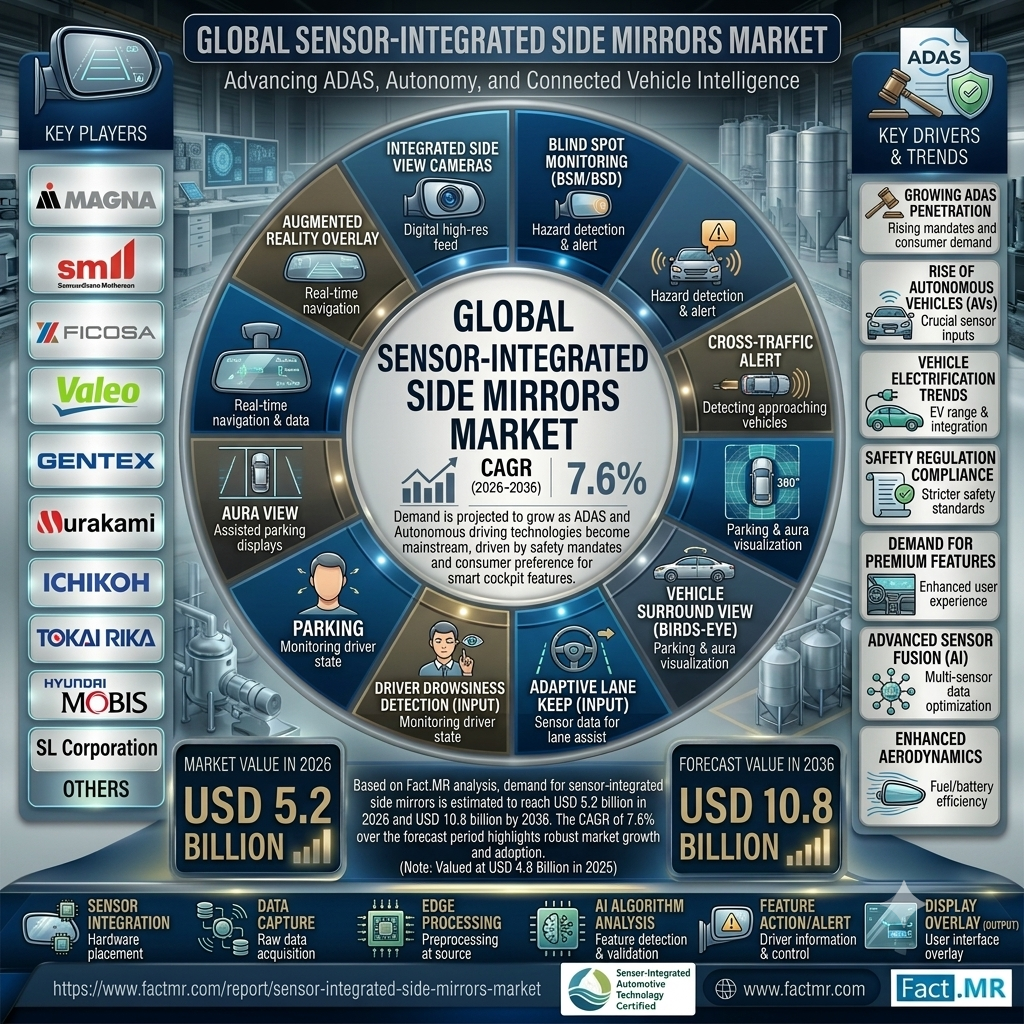
ROCKVILLE, Md., September 9, 2026 — The sensor-integrated side mirrors market is projected to grow from USD 5.2 billion in 2026 to USD 10.8 billion by 2036, advancing at a 7.6% CAGR, according to Fact.MR analysis, as automakers integrate cameras, blind-spot sensing, and driver monitoring functions into mirror assemblies.
The shift is moving beyond premium vehicles. Fact.MR analysis indicates that sensor-integrated mirrors are increasingly being fitted into high-volume mid-range passenger cars, where integrated assemblies can replace conventional mirrors rather than serve only as optional upgrades. In January 2026, Gentex Corporation demonstrated a next-generation Full Display Mirror with Dynamic View Assist at CES 2026, while Magna International reached a production milestone for its mirror-integrated Driver Monitoring System in late 2025.
Get detailed market forecasts, competitive benchmarking, and pricing trends: https://www.factmr.com/connectus/sample?flag=S&rep_id=14297
Sensor-Integrated Side Mirrors Market Moves Toward Broader OEM Fitment
The sensor-integrated side mirrors market was valued at USD 4.8 billion in 2025. Fact.MR estimates demand will reach USD 5.2 billion in 2026 and USD 10.8 billion by 2036.
That represents USD 5.6 billion in market value growth between 2026 and 2036.
The change is being driven by rising electronic content per vehicle and OEM demand for consolidated mirror-sensor modules. These systems can support blind-spot detection, lane-change assistance, camera-based visibility, and driver monitoring functions from an exterior mounting location.
Mature markets remain heavily replacement-led. Emerging automotive manufacturing hubs are adding incremental volume as ADAS-equipped vehicles become more common across passenger-car platforms.
Gentex and Magna Demonstrate New Mirror-Based Functions
Recent product developments show how mirror assemblies are becoming part of wider vehicle perception systems.
At CES 2026, Gentex Corporation introduced its latest Full Display Mirror with Dynamic View Assist. According to the supplied Fact.MR report, the system adjusts the digital camera feed according to driving conditions, expanding the field of view at low speeds, tilting downward during reverse, and widening the side-view perspective during lane changes.
Magna International reached a production milestone in late 2025 for its mirror-integrated Driver Monitoring System. The system places infrared sensors behind the mirror glass to monitor eye gaze and head position, supporting detection of drowsiness and distraction.
The development was linked in the Fact.MR report to strict Euro NCAP safety requirements for 2026.
The sensor-integrated side mirrors market is a vehicle component category that combines exterior mirror assemblies with electronic sensors for driver assistance and visibility functions.
This includes camera-integrated mirrors, radar and blind-spot systems, auto-dimming and signal functions, and other sensing technologies.
Camera-Integrated Mirrors Hold 52% Share
Fact.MR estimates that camera-integrated side mirrors accounted for 52% of the global market in 2025.
Camera integration supports blind-spot monitoring, lane-change assistance, and surround-view systems through a single exterior mounting location. It also reduces the need for separate sensing units mounted on other parts of the vehicle.
The development reflects a wider shift toward system consolidation. OEMs can integrate sensing hardware into an existing mirror architecture while retaining the physical mirror required in many vehicle applications.
Conventional mirrors with integrated sensors are also expected to remain dominant. Fact.MR estimates this mirror type will account for 67% of the market in 2026.
Physical reflective surfaces remain important because they support regulatory acceptance, driver familiarity, and cost control compared with fully digital mirror systems.
China Leads Country-Level Growth
China is projected to record the highest country-level CAGR in the supplied Fact.MR country analysis, reaching 8.6% from 2026 to 2036.
India follows at 8.1%, supported by increasing adoption of blind-spot and camera-integrated mirrors in mid-range passenger vehicles. South Korea is projected to grow at 7.4%, while Mexico records 7.0%.
The United States is expected to grow at 6.1%, Germany at 5.6%, France at 5.2%, and Japan at 4.7%.
|
Country |
CAGR, 2026–2036 |
|
China |
8.6% |
|
India |
8.1% |
|
South Korea |
7.4% |
|
Mexico |
7.0% |
|
United States |
6.1% |
|
Germany |
5.6% |
|
France |
5.2% |
|
Japan |
4.7% |
China's position reflects rapid ADAS standardization and high passenger-vehicle production. India is seeing increasing fitment in higher-trim and mid-range vehicles, while Mexico benefits from export-oriented vehicle assembly.
Regulation Shapes Mirror-Sensor Design
Vehicle safety regulations continue to influence the design and installation of sensor-integrated side mirrors.
UNECE Regulation No. 46 establishes provisions concerning the installation and field of vision of rear-view mirrors. U.S. vehicle safety and visibility regulations also shape mirror design and compliance requirements.
These frameworks help explain why conventional physical mirrors with embedded sensors maintain a strong position. Manufacturers can add sensing functions without completely replacing the established reflective architecture.
The market is also moving toward sensor convergence. Blind-spot detection, cameras, turn-signal indicators, and camera-assisted views can be integrated into mirror assemblies as OEMs build broader ADAS architectures.
OEM Suppliers Compete on Integration
The competitive landscape includes Magna International, SMR (Samvardhana Motherson), Ficosa, Valeo, Gentex, Murakami, Ichikoh, Tokai Rika, Hyundai Mobis, and SL Corporation.
Magna International and SMR are identified by Fact.MR as suppliers combining mirror systems with camera, radar, and blind-spot detection functions. Ficosa and Valeo focus on compact and modular designs, while Gentex and Murakami provide mirror technologies incorporating actuation and defrost functions.
Ichikoh and Tokai Rika are associated with sensor communication capabilities for ADAS and lane-assist applications. Hyundai Mobis and SL Corporation emphasize manufacturing and compliance capabilities across multiple automotive markets.
Magna Executive Points to Repeat OEM Adoption
Matteo Del Sorbo, President, Mechatronics, Mirrors and Lighting at Magna International, said:
“Our mirror-integrated DMS has proven itself globally, and we’re proud to see it scaling with a leading German OEM.”
Del Sorbo added that the milestone reflects Magna International's focus on safety innovation and its ability to deliver advanced technologies to customers.
Fact.MR interprets the development as evidence that validated mirror-sensor architectures are progressing from pilot programs into repeat OEM sourcing cycles.
Market Outlook
Fact.MR projects the sensor-integrated side mirrors market to reach USD 10.8 billion by 2036, up from USD 5.2 billion in 2026. The forecast represents a 7.6% CAGR over the 2026–2036 period.
The report covers sensor content, mirror type, vehicle segment, sales channel, and regional markets across more than 40 countries. It includes camera-integrated mirrors, radar and blind-spot systems, conventional mirrors with sensors, digital mirror systems, mid-range and premium vehicles, OEM/Tier 1 supply, aftermarket upgrades, and service replacement.
Fact.MR developed its market estimates using a hybrid top-down and bottom-up model based on vehicle production volumes, mirror fitment rates, ADAS adoption, and regulatory compliance. Primary research included interviews with mirror manufacturers, automotive OEM suppliers, sensor integrators, and vehicle safety engineers.
Top Reports:
https://adamaamresearch.blogspot.com/2026/09/cooling-tower-market-expected-to-reach.html
https://social.mytamam.com/blogs/38166/Cooling-Tower-Market-to-Reach-USD-9-48-Billion-by
https://zeuspage.org/blogs/50996/Cooling-Tower-Market-to-Hit-USD-9-48-Billion-by
https://kaamkaaziclub.com/read-blog/47795
About Fact.MR
Fact.MR is a market research and consulting firm providing market intelligence, forecasts, competitive analysis, and strategic insights across global industries. Its research combines primary interviews, secondary research, market modeling, and expert validation to support business, investment, procurement, and operational decisions.
ROCKVILLE, Md., September 9, 2026 — The sensor-integrated side mirrors market is projected to grow from USD 5.2 billion in 2026 to USD 10.8 billion by 2036, advancing at a 7.6% CAGR, according to Fact.MR analysis, as automakers integrate cameras, blind-spot sensing, and driver monitoring functions into mirror assemblies.
The shift is moving beyond premium vehicles. Fact.MR analysis indicates that sensor-integrated mirrors are increasingly being fitted into high-volume mid-range passenger cars, where integrated assemblies can replace conventional mirrors rather than serve only as optional upgrades. In January 2026, Gentex Corporation demonstrated a next-generation Full Display Mirror with Dynamic View Assist at CES 2026, while Magna International reached a production milestone for its mirror-integrated Driver Monitoring System in late 2025.
Get detailed market forecasts, competitive benchmarking, and pricing trends: https://www.factmr.com/connectus/sample?flag=S&rep_id=14297
Sensor-Integrated Side Mirrors Market Moves Toward Broader OEM Fitment
The sensor-integrated side mirrors market was valued at USD 4.8 billion in 2025. Fact.MR estimates demand will reach USD 5.2 billion in 2026 and USD 10.8 billion by 2036.
That represents USD 5.6 billion in market value growth between 2026 and 2036.
The change is being driven by rising electronic content per vehicle and OEM demand for consolidated mirror-sensor modules. These systems can support blind-spot detection, lane-change assistance, camera-based visibility, and driver monitoring functions from an exterior mounting location.
Mature markets remain heavily replacement-led. Emerging automotive manufacturing hubs are adding incremental volume as ADAS-equipped vehicles become more common across passenger-car platforms.
Gentex and Magna Demonstrate New Mirror-Based Functions
Recent product developments show how mirror assemblies are becoming part of wider vehicle perception systems.
At CES 2026, Gentex Corporation introduced its latest Full Display Mirror with Dynamic View Assist. According to the supplied Fact.MR report, the system adjusts the digital camera feed according to driving conditions, expanding the field of view at low speeds, tilting downward during reverse, and widening the side-view perspective during lane changes.
Magna International reached a production milestone in late 2025 for its mirror-integrated Driver Monitoring System. The system places infrared sensors behind the mirror glass to monitor eye gaze and head position, supporting detection of drowsiness and distraction.
The development was linked in the Fact.MR report to strict Euro NCAP safety requirements for 2026.
The sensor-integrated side mirrors market is a vehicle component category that combines exterior mirror assemblies with electronic sensors for driver assistance and visibility functions.
This includes camera-integrated mirrors, radar and blind-spot systems, auto-dimming and signal functions, and other sensing technologies.
Camera-Integrated Mirrors Hold 52% Share
Fact.MR estimates that camera-integrated side mirrors accounted for 52% of the global market in 2025.
Camera integration supports blind-spot monitoring, lane-change assistance, and surround-view systems through a single exterior mounting location. It also reduces the need for separate sensing units mounted on other parts of the vehicle.
The development reflects a wider shift toward system consolidation. OEMs can integrate sensing hardware into an existing mirror architecture while retaining the physical mirror required in many vehicle applications.
Conventional mirrors with integrated sensors are also expected to remain dominant. Fact.MR estimates this mirror type will account for 67% of the market in 2026.
Physical reflective surfaces remain important because they support regulatory acceptance, driver familiarity, and cost control compared with fully digital mirror systems.
China Leads Country-Level Growth
China is projected to record the highest country-level CAGR in the supplied Fact.MR country analysis, reaching 8.6% from 2026 to 2036.
India follows at 8.1%, supported by increasing adoption of blind-spot and camera-integrated mirrors in mid-range passenger vehicles. South Korea is projected to grow at 7.4%, while Mexico records 7.0%.
The United States is expected to grow at 6.1%, Germany at 5.6%, France at 5.2%, and Japan at 4.7%.
|
Country |
CAGR, 2026–2036 |
|
China |
8.6% |
|
India |
8.1% |
|
South Korea |
7.4% |
|
Mexico |
7.0% |
|
United States |
6.1% |
|
Germany |
5.6% |
|
France |
5.2% |
|
Japan |
4.7% |
China's position reflects rapid ADAS standardization and high passenger-vehicle production. India is seeing increasing fitment in higher-trim and mid-range vehicles, while Mexico benefits from export-oriented vehicle assembly.
Regulation Shapes Mirror-Sensor Design
Vehicle safety regulations continue to influence the design and installation of sensor-integrated side mirrors.
UNECE Regulation No. 46 establishes provisions concerning the installation and field of vision of rear-view mirrors. U.S. vehicle safety and visibility regulations also shape mirror design and compliance requirements.
These frameworks help explain why conventional physical mirrors with embedded sensors maintain a strong position. Manufacturers can add sensing functions without completely replacing the established reflective architecture.
The market is also moving toward sensor convergence. Blind-spot detection, cameras, turn-signal indicators, and camera-assisted views can be integrated into mirror assemblies as OEMs build broader ADAS architectures.
OEM Suppliers Compete on Integration
The competitive landscape includes Magna International, SMR (Samvardhana Motherson), Ficosa, Valeo, Gentex, Murakami, Ichikoh, Tokai Rika, Hyundai Mobis, and SL Corporation.
Magna International and SMR are identified by Fact.MR as suppliers combining mirror systems with camera, radar, and blind-spot detection functions. Ficosa and Valeo focus on compact and modular designs, while Gentex and Murakami provide mirror technologies incorporating actuation and defrost functions.
Ichikoh and Tokai Rika are associated with sensor communication capabilities for ADAS and lane-assist applications. Hyundai Mobis and SL Corporation emphasize manufacturing and compliance capabilities across multiple automotive markets.
Magna Executive Points to Repeat OEM Adoption
Matteo Del Sorbo, President, Mechatronics, Mirrors and Lighting at Magna International, said:
“Our mirror-integrated DMS has proven itself globally, and we’re proud to see it scaling with a leading German OEM.”
Del Sorbo added that the milestone reflects Magna International's focus on safety innovation and its ability to deliver advanced technologies to customers.
Fact.MR interprets the development as evidence that validated mirror-sensor architectures are progressing from pilot programs into repeat OEM sourcing cycles.
Market Outlook
Fact.MR projects the sensor-integrated side mirrors market to reach USD 10.8 billion by 2036, up from USD 5.2 billion in 2026. The forecast represents a 7.6% CAGR over the 2026–2036 period.
The report covers sensor content, mirror type, vehicle segment, sales channel, and regional markets across more than 40 countries. It includes camera-integrated mirrors, radar and blind-spot systems, conventional mirrors with sensors, digital mirror systems, mid-range and premium vehicles, OEM/Tier 1 supply, aftermarket upgrades, and service replacement.
Fact.MR developed its market estimates using a hybrid top-down and bottom-up model based on vehicle production volumes, mirror fitment rates, ADAS adoption, and regulatory compliance. Primary research included interviews with mirror manufacturers, automotive OEM suppliers, sensor integrators, and vehicle safety engineers.
Top Reports:
https://adamaamresearch.blogspot.com/2026/09/cooling-tower-market-expected-to-reach.html
https://social.mytamam.com/blogs/38166/Cooling-Tower-Market-to-Reach-USD-9-48-Billion-by
https://zeuspage.org/blogs/50996/Cooling-Tower-Market-to-Hit-USD-9-48-Billion-by
https://kaamkaaziclub.com/read-blog/47795
About Fact.MR
Fact.MR is a market research and consulting firm providing market intelligence, forecasts, competitive analysis, and strategic insights across global industries. Its research combines primary interviews, secondary research, market modeling, and expert validation to support business, investment, procurement, and operational decisions.

 English
 Arabic
 French
 Portuguese
 Deutsch
 Turkish
 Dutch
Dutch
 Italiano
 Russian
 Romaian
 Portuguese (Brazil)
 Greek
Greek
