
FDA Reinforces Validation Standards in 2026 as Sterile Filtration Module Market Targets USD 5.2 Billion by 2036
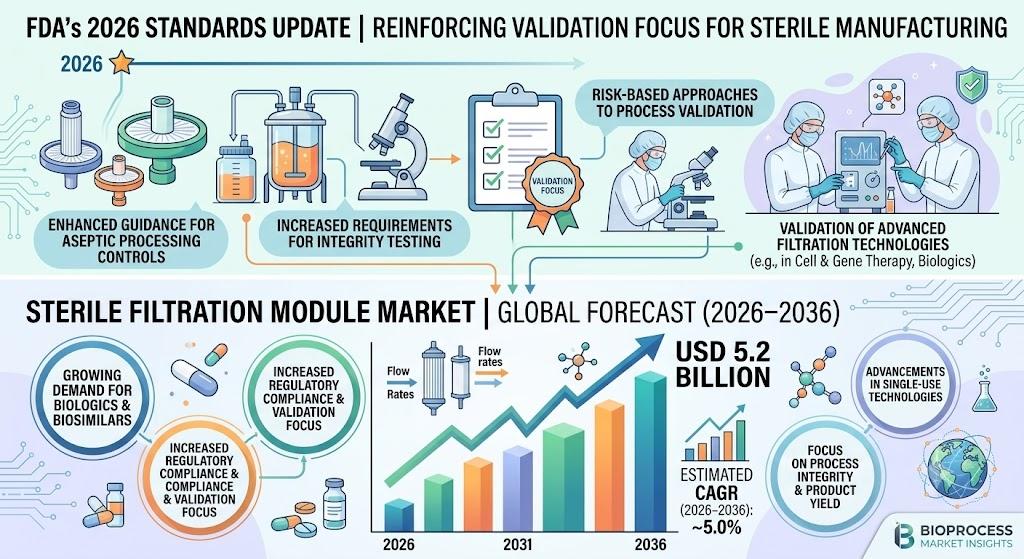
— The U.S. Food and Drug Administration updated its recognized consensus-standards information on May 25, 2026, including recognition details covering aseptic-processing standards and their relationship to sterilizing filtration, underscoring the importance of validated sterile-processing practices. Against this regulatory backdrop, Fact MR estimates that the global sterile filtration module market will grow from USD 3.1 billion in 2026 to USD 5.2 billion by 2036, expanding at a 5.3% CAGR.
Get detailed market forecasts, competitive benchmarking, and pricing trends: https://www.factmr.com/connectus/sample?flag=S&rep_id=13986
The market is being shaped less by filtration capacity alone and more by the ability to demonstrate microbial retention, process compatibility, integrity testing, extractables control and documentation suitable for regulated production. Sartorius AG, Merck KGaA, Pall Corporation and Thermo Fisher Scientific are among the companies identified in the Fact MR competitive landscape, alongside Repligen Corporation, Meissner Filtration Products, 3M, Parker Hannifin, Saint-Gobain Life Sciences and Donaldson Company.
Why is sterile filtration becoming a qualification decision rather than a simple component purchase?
Sterile filtration modules sit at a critical control point in biopharmaceutical and other high-purity manufacturing processes. The 0.2 µm category is expected to remain the leading pore-size segment, accounting for 43% of the market in 2026, supported by its established role in sterilizing-grade liquid filtration. Biopharmaceutical manufacturing represents the leading application at 38%.
This creates an important competitive distinction. Suppliers with strong membrane performance but limited validation documentation can face a different commercial hurdle from suppliers whose products are already integrated into qualified processes. Sartorius, Merck, Pall and Thermo Fisher therefore compete not only through filtration performance but also through application support, qualification documentation and compatibility with increasingly modular production systems.
The shift toward single-use and closed processing reinforces this dynamic. As manufacturing platforms become more flexible, filtration modules increasingly need to fit into complete process architectures rather than operate as isolated filtration components.
Where is the next layer of market opportunity?
Asia Pacific is identified by Fact MR as an important growth region, while country-level demand varies considerably. India is projected to expand at 7.1% CAGR from 2026 to 2036, ahead of the USA at 6.0%, China at 5.3%, South Korea at 5.0%, Germany at 4.7%, France at 4.4% and Japan at 4.1%.
The geographic pattern matters because sterile filtration demand follows the development of pharmaceutical, biotechnology and high-purity manufacturing capacity. Faster-growing markets can create opportunities for suppliers that combine validated products with regional technical support, while mature markets continue to generate demand through established manufacturing networks and replacement or upgrade cycles.
There is also a connection between geography and product architecture. Expansion of biologics production can increase demand for scalable single-use systems, while established manufacturing bases can place greater emphasis on qualification continuity, replacement compatibility and process reliability. This makes regional opportunity assessment inseparable from application and technology segmentation.
Analyst Perspective
“This market rewards validation strength as much as membrane performance. Buyers are not purchasing filtration modules as generic consumables. They are purchasing sterility assurance, process compatibility, and documentation confidence in regulated production settings.”
— Nikhil Kaitwade, Principal Consultant, Future Market Insights
Market Snapshot
- USD 3.1 billion — estimated global market value in 2026.
- USD 5.2 billion — projected market value by 2036.
- 5.3% — CAGR from 2026 to 2036.
- 43% — expected 2026 share of 0.2 µm pore-size modules.
- 38% — expected 2026 share of biopharmaceutical manufacturing applications.
What is driving demand?
Biologics manufacturing remains the principal demand engine because sterile filtration provides a microbial-control barrier where thermal sterilization may be unsuitable. Growth in injectable drugs, advanced therapies and flexible manufacturing platforms further supports adoption.
Regulatory expectations also increase the value of validated filtration systems. Manufacturers need documented retention performance, integrity-testing procedures, compatible materials and evidence that modules can operate consistently within qualified processes.
At the same time, process intensification is changing product requirements. Single-use architectures and closed manufacturing systems favor modules that can be integrated quickly into scalable workflows while minimizing contamination risk and qualification complexity.
About the Report
Fact MR ' Sterile Filtration Module Market study evaluates the market across pore size, membrane material, application, end user and region from 2026 through 2036. The report covers products including sterile filter modules, cartridges, capsules and modular units used in validated sterile processes.
The report assesses segments including 0.2 µm, 0.1 µm and other pore sizes; PES, PVDF, PTFE, Nylon and other membrane materials; biopharmaceutical manufacturing, sterile solutions and buffers, final fill and finish, food and beverage sterile filtration and other applications.
Top Trending Reports:
https://www.openpr.com/news/4510621/hydrogen-sensor-market-gains-strategic-momentum-as-hydrogen
https://www.openpr.com/news/4510650/bridge-inspection-services-market-outlook-digital-monitoring
https://www.openpr.com/news/4511852/warehouse-digital-twin-orchestration-software-reshapes-modern
https://www.openpr.com/news/4511869/industrial-waste-heat-to-cooling-systems-gain-momentum-as

 Arabic
 French
 Spanish
 Portuguese
 Deutsch
 Turkish
 Dutch
Dutch
 Italiano
 Russian
 Romaian
 Portuguese (Brazil)
 Greek
Greek
