
Space Situational Awareness Market Insights: Payload's Fast-Growing 4.7% CAGR Explained
There are now tens of thousands of tracked objects circling Earth — active satellites, spent rocket stages, and fragments from decades of collisions and breakups — and the number keeps climbing as mega-constellations launch thousands of new satellites each year. Space situational awareness (SSA) is the set of technologies and services that detect, track, identify, and predict the movement of every one of those objects, so operators can maneuver satellites out of the way before a collision happens. It's essentially air-traffic control for orbit, except the traffic never lands, debris from one collision creates more debris, and a single missed warning can permanently damage a billion-dollar asset — or worse, spark a cascading collision event that makes an entire orbital band unusable.
The Scale of the Problem, in Numbers
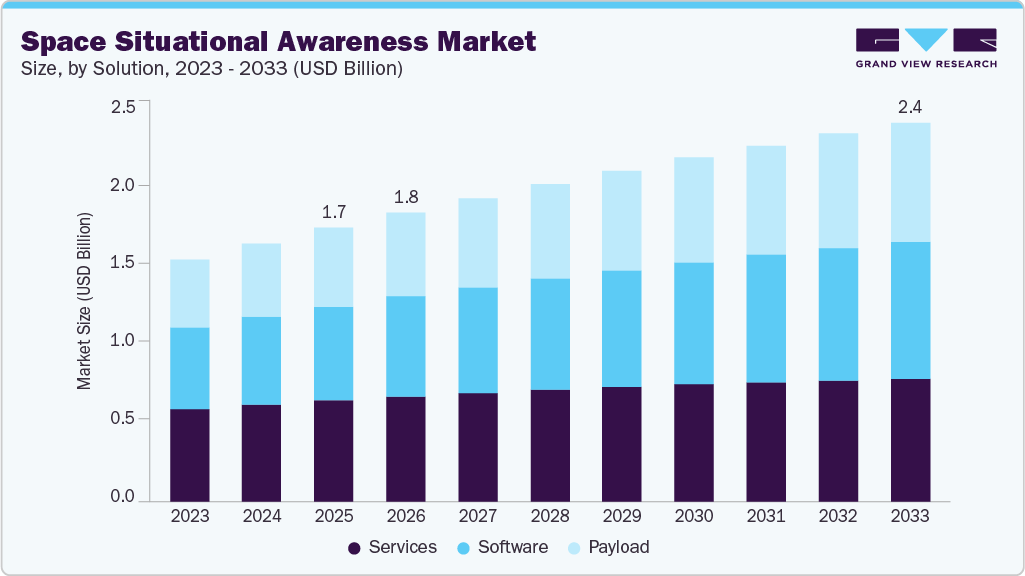
The global space situational awareness market was valued at USD 1.7 billion in 2025 and is projected to grow from USD 1.8 billion in 2026 to USD 2.4 billion by 2033, at a CAGR of 4.0%. That's a modest growth rate compared to flashier space-tech categories, and that's worth sitting with for a moment: SSA isn't a hype-driven market riding a single breakthrough technology. It's an infrastructure category growing in near-lockstep with the thing that creates the need for it — the sheer volume of objects now in orbit.
Fragmentation debris holds the largest share by object type in 2025, a direct result of how orbital collisions and breakups multiply the tracking burden: one satellite breakup event can scatter thousands of new trackable fragments overnight. Mission-related debris — spent rocket stages and defunct hardware — is expected to register a significant CAGR through 2033 as launch cadence itself keeps accelerating.
What's Actually Driving Demand
Three forces are converging here, and none of them is slowing down. First, mega-constellations for communication and Earth observation have multiplied the number of active satellites far faster than tracking infrastructure has historically scaled, creating orbital congestion that didn't meaningfully exist a decade ago. Second, the accumulation of space debris — defunct satellites and fragmentation debris — has become self-reinforcing: more debris means more collision risk, which means more debris, in a feedback loop that makes real-time tracking not optional but existential for anyone operating in crowded orbital bands. Third, governments and defense agencies increasingly treat space as a strategic domain in its own right, driving investment in SSA not just for collision avoidance but for threat detection and missile warning as space-based infrastructure becomes militarily indispensable.
By solution, services held the largest share at 37% in 2025 — reflecting how much of this market is about data analytics, tracking, and collision-avoidance expertise rather than hardware alone. But payload is the fastest-growing solution segment, expanding at roughly 4.7% CAGR, as miniaturization and AI-integrated sensors make it cheaper to put dedicated tracking hardware into orbit rather than relying solely on ground-based systems.
Download a free sample report or claim your copy of this full market intelligence report
Government Money Still Dominates, But the Growth Is Commercial
Government and military end use accounts for more than 61% of the market, unsurprising given that national security agencies were the original — and still largest — buyers of orbital tracking capability. But the commercial segment is expected to register the fastest CAGR through 2033, driven by the private space sector's own exposure to collision risk: a commercial satellite operator with a multi-satellite constellation now has as much financial incentive to track debris as a national space agency does, and increasingly the budget to pay for it directly rather than relying solely on government data-sharing.
This bifurcation matters for how the market will likely evolve. Government SSA programs are built around national security priorities and classified data-sharing constraints; commercial demand is built around asset protection and insurance requirements, which favors faster, more transparent, subscription-style data services. Expect the fastest product innovation to increasingly come from vendors serving commercial constellation operators rather than defense primes alone — a shift already visible in the growing number of commercial SSA-as-a-service providers offering conjunction-warning data directly to satellite operators.
Where the Capability Actually Sits Today
North America holds 39% of the global market, with the U.S. alone accounting for over 84% of the North American market, reflecting the concentration of both extensive satellite infrastructure and U.S. Space Force investment in radar networks and AI-driven tracking. Asia Pacific is forecast to grow at the fastest CAGR, above 6%, as China's expansive space program, India's satellite ambitions, and Japan and South Korea's growing constellations all simultaneously demand tracking infrastructure — a genuinely multi-country growth story rather than one dominant player. Europe's growth is largely collaborative, anchored in ESA-led programs and the EU Space Surveillance and Tracking consortium, reflecting a regulatory push toward shared sensor networks rather than any single nation building capability alone.
The Insight Most Coverage Misses
Most market coverage treats SSA purely as a defense or space-tech story. The more useful framing is that SSA is becoming orbital insurance infrastructure — the data layer that makes satellite insurance, constellation financing, and commercial space operations economically viable in the first place. As more capital flows into commercial satellite constellations, the demand for independent, real-time collision-risk data isn't a nice-to-have add-on; it's becoming a prerequisite for financing the satellites in the first place. That's a quieter, more durable growth driver than any single mega-constellation launch — and it's the reason commercial SSA demand is likely to keep outpacing government spending growth well beyond the current forecast window.
Looking for more in-depth data focusing on specific segments or regions? Get this report customized with inclusion of custom data sets to suit your exact business needs

 English
 Arabic
 French
 Spanish
 Portuguese
 Deutsch
 Turkish
 Dutch
Dutch
 Italiano
 Romaian
 Portuguese (Brazil)
 Greek
Greek
