
Cooling Tower Market Growth Set to Push Value to USD 9.48 Billion by 2036
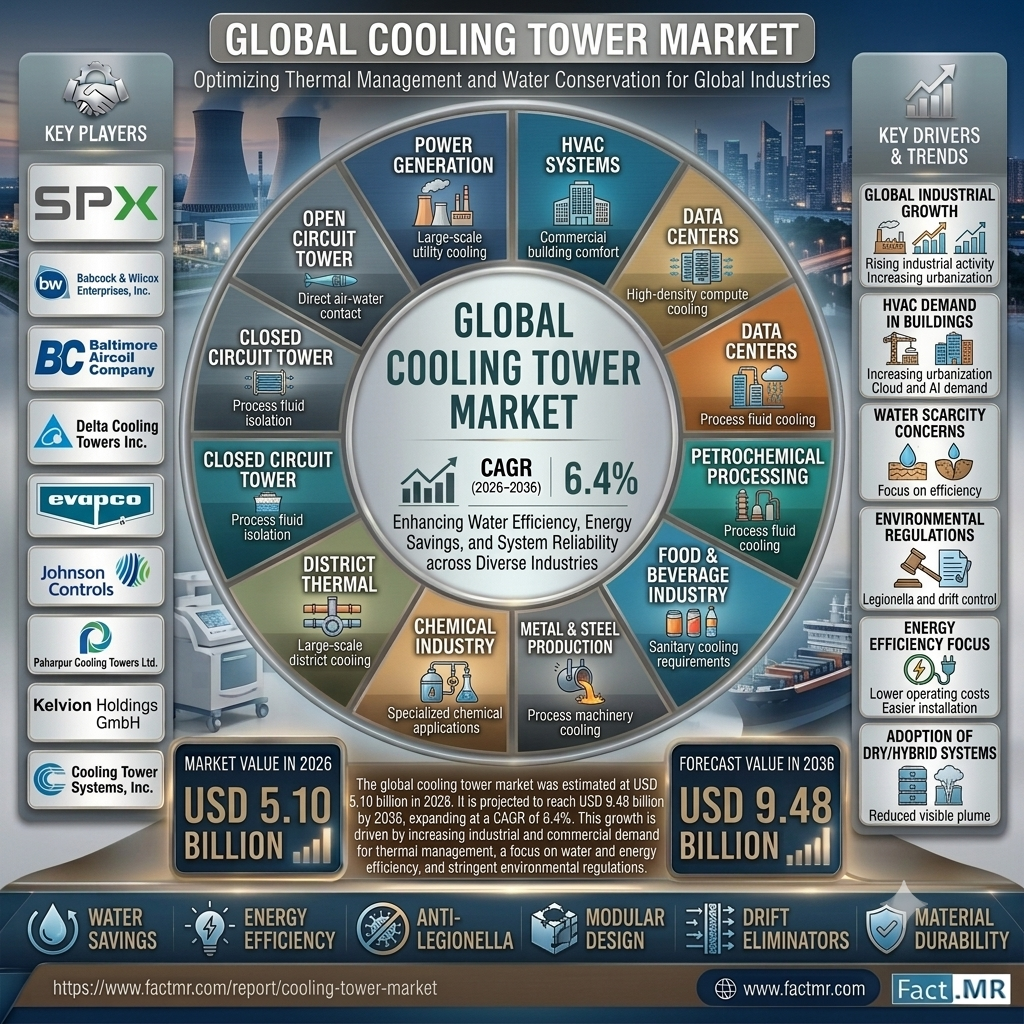
ROCKVILLE, MD — September 8, 2026 — The global cooling tower market is estimated at USD 5.10 billion in 2026 and is projected to reach USD 9.48 billion by 2036, expanding at a 6.4% CAGR during the forecast period, according to Fact.MR. The market was valued at approximately USD 4.79 billion in 2025, creating an absolute dollar opportunity of USD 4.38 billion between 2026 and 2036.
The market is being shaped by more than new industrial construction. Equipment modernization, replacement of aging installations, environmental compliance, and demand for lower-maintenance systems are influencing purchasing decisions across power generation, HVAC, oil and gas, chemical and petrochemical, and food and beverage applications.
Technology is also becoming a stronger part of the specification process. Remote monitoring, IoT-based controls, and predictive maintenance capabilities are increasingly influencing how buyers assess cooling tower systems, particularly where lifecycle costs and operational reliability matter.
Get detailed market forecasts, competitive benchmarking, and pricing trends: https://www.factmr.com/connectus/sample?flag=S&rep_id=12396
Why Is the Cooling Tower Market Growing?
Industrial operators are replacing older equipment with energy-efficient and lower-maintenance alternatives. At the same time, expanding water, wastewater, and utility infrastructure in emerging economies is generating new procurement opportunities.
Demand is also spreading into sectors such as food processing, pharmaceuticals, chemicals, and petrochemicals. These industries require dependable process cooling, creating opportunities beyond traditional power-generation applications.
Environmental and noise regulations are adding another layer to purchasing decisions. Buyers are increasingly looking at products that can meet evolving efficiency and compliance requirements while supporting longer operating cycles.
The opportunity is particularly visible in Asia Pacific. India is projected to grow at 8.4% CAGR through 2036, while China is expected to expand at 7.9% CAGR, according to Fact.MR analysis.
Wet Cooling Towers Continue to Lead
Wet Cooling Towers are estimated to account for 60% of the product type segment in 2026. Their position reflects an established installed base, broad application coverage, and familiarity among industrial procurement teams.
Open Circuit Cooling Towers lead the design type segment with an estimated 65% share in 2026. Their established use across industrial applications and broad availability through distribution channels support continued demand.
Fiberglass Reinforced Plastic (FRP) accounts for 40% of the material type segment in 2026. Its established presence across core applications keeps it ahead of other material categories.
Dry Cooling Towers, however, are emerging as an important growth area. Buyers in newer installations are increasingly assessing lifecycle costs, operating flexibility, and water-use considerations when selecting cooling technologies.
India and China Set the Pace Across Major Markets
India represents the fastest-growing country market covered by the study, with an 8.4% CAGR through 2036. Industrial capacity additions in chemicals, pharmaceuticals, and food processing are creating new demand. Pollution-control requirements and replacement of existing installations are also supporting procurement.
China follows with a 7.9% CAGR. Environmental enforcement, pharmaceutical and semiconductor cleanroom expansion, and replacement of legacy power-generation systems are supporting demand.
Saudi Arabia is projected to grow at 7.3% CAGR, supported by Vision 2030 infrastructure programs, domestic supply-chain development under IKTVA, and rising project standards.
The U.S. market is forecast to expand at 6.4% CAGR, with installed-base replacement and regulatory compliance upgrades forming key demand channels.
|
Country |
CAGR, 2026–2036 |
|
India |
8.4% |
|
China |
7.9% |
|
Saudi Arabia |
7.3% |
|
USA |
6.4% |
|
Brazil |
6.2% |
|
Germany |
5.6% |
Buyers Put Greater Weight on Lifecycle Costs
The cooling tower market is moving toward specifications that consider more than initial equipment pricing.
Shambhu Nath Jha, Principal Consultant at Fact.MR, said:
“The cooling tower market is moving beyond volume-driven growth toward value-led expansion. Buyers are increasingly specifying products based on lifecycle cost, energy efficiency, and integration capability rather than upfront price alone.”
He added that suppliers with stronger technical portfolios and aftermarket service networks are positioned to benefit from this change. Demand in India and China is also being supported by structural capacity additions rather than one-time procurement cycles.
Competition Centers on Technology and Service
The global cooling tower market remains moderately fragmented, with multinational suppliers competing alongside regional specialists and value-oriented manufacturers.
SPX Corporation, Babcock & Wilcox Enterprises, Inc., Baltimore Aircoil Company, and Delta Cooling Towers Inc. maintain strong positions through broad product portfolios, distribution networks, and established market presence.
Other active participants include EVAPCO, Inc., Johnson Controls International Plc., Paharpur Cooling Towers Ltd., Kelvion Holdings GmbH, Liang Chi Industry Co. Ltd., and Cooling Tower Systems, Inc.
Competition is increasingly influenced by technical capability, total cost of ownership, delivery lead times, local service availability, and aftermarket support.
Recent activity cited in the report includes SPX Corporation's product portfolio expansion in January 2026, Baltimore Aircoil Company's strategic partnership activity in February 2026, and capacity and technology initiatives involving other major participants.
Key Market Numbers
- 2025 market value: USD 4.79 billion
- 2026 market value: USD 5.10 billion
- 2036 projected value: USD 9.48 billion
- CAGR, 2026–2036: 6.4%
- Absolute dollar opportunity: USD 4.38 billion
- Wet Cooling Towers share: 60% in 2026
- Open Circuit Cooling Towers share: 65% in 2026
- FRP share: 40% in 2026
- Fastest-growing country: India at 8.4% CAGR
What Could Limit Market Expansion?
High upfront capital costs remain a barrier for smaller operators and price-sensitive buyers. Fragmented aftermarket infrastructure in emerging economies can also increase maintenance difficulties and total ownership costs.
Supply-chain constraints involving specialty components and raw materials may extend delivery schedules and affect production planning.
At the same time, service-based monitoring and maintenance models are creating new opportunities. Demand for connected platforms could allow suppliers to generate recurring revenue while helping customers monitor equipment performance and schedule maintenance.
About the Cooling Tower Market Report
The Fact.MR study covers wet, dry, and hybrid cooling towers across open and closed circuit configurations. It examines product type, design type, material type, application, end-use industry, capacity, and regional markets.
The research combines secondary research, primary interviews, and forecast modeling. The study draws on 120+ secondary sources, benchmarks 65+ company product portfolios, and covers 30+ countries through a demand-side model supported by top-down validation. Primary validation includes 25+ interviews with manufacturers, distributors, system integrators, and end users.
The forecast model considers end-use activity, infrastructure spending, equipment replacement rates, regulatory changes, shipments, pricing trends, channel mix, and product launches.
Top Reports:
https://adamaamresearch.blogspot.com/2026/09/brake-dust-reduction-kits-market-to-add.html
https://zeuspage.org/blogs/50308/Brake-Dust-Reduction-Kits-Market-to-Reach-0-4-Billion
https://kaamkaaziclub.com/read-blog/47337
https://net-pals.com/blogs/31036/Brake-Dust-Reduction-Kits-Market-Poised-to-Reach-0-4
About Fact.MR
Fact.MR is a market research and consulting firm providing market intelligence, forecasting, and strategic insights across industries. Its research combines primary interviews, secondary research, proprietary analysis, and quantitative forecasting to support business and investment decisions.

 English
 Arabic
 French
 Spanish
 Portuguese
 Deutsch
 Dutch
Dutch
 Italiano
 Russian
 Romaian
 Portuguese (Brazil)
 Greek
Greek
