
CMOS Image Sensor Market Growth Driven by Rising Demand for Advanced Imaging Technologies
CMOS Image Sensor Market: Growth, Segmentation, Trends, Drivers and Recent Developments
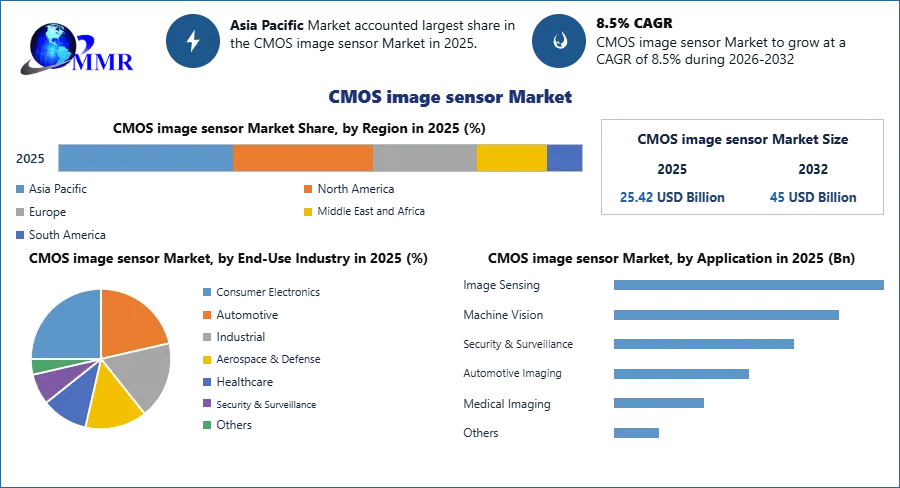
The CMOS Image Sensor Market is witnessing significant growth as imaging technology becomes increasingly important across smartphones, consumer electronics, automotive systems, industrial automation, security and surveillance, healthcare, aerospace, defense, and emerging artificial intelligence applications. A CMOS image sensor is a semiconductor device that converts light into electrical signals and ultimately produces digital images. Compared with conventional CCD technology, CMOS image sensors offer advantages such as lower power consumption, faster image processing, compact size, and easier integration with processing circuitry. These characteristics have made CMOS technology an essential component of modern cameras and machine-vision systems. According to the latest Maximize Market Research analysis, the global CMOS Image Sensors Market was valued at USD 25.42 billion in 2025 and is expected to reach nearly USD 45.00 billion by 2032, expanding at a CAGR of 8.5% from 2026 to 2032.
𝐃𝐨𝐰𝐧𝐥𝐨𝐚𝐝 𝐅𝐫𝐞𝐞 𝐏𝐃𝐅 𝐁𝐫𝐨𝐜𝐡𝐮𝐫𝐞 @https://www.maximizemarketresearch.com/request-sample/115290/
CMOS Image Sensor Market Overview
CMOS image sensors have evolved from basic image-capturing components into highly integrated imaging platforms capable of supporting advanced functions. Modern sensors can incorporate signal processing, analog-to-digital conversion, memory, and other digital functionalities on or around the imaging chip. This integration enables manufacturers to develop smaller, faster, and more energy-efficient camera systems for applications ranging from smartphones and digital cameras to autonomous vehicles, medical instruments, satellites, industrial inspection systems, and smart security devices. The increasing requirement for high-definition images, high frame rates, improved low-light performance, high dynamic range, and real-time image processing is encouraging continued investment in sensor development.
The growing adoption of artificial intelligence is also transforming the role of CMOS image sensors. Cameras increasingly serve as input devices for AI systems that identify objects, analyze environments, monitor activities, and support automated decision-making. This trend is particularly important for autonomous driving, robotics, smart surveillance, industrial machine vision, and edge-computing applications. As visual data becomes an important source of information for AI systems, demand for high-performance image sensors is expected to increase.
Key CMOS Image Sensor Market Segmentation
The CMOS Image Sensor Market is segmented by application, end-use industry, technology, spectrum type, resolution, and region. By application, the market includes image sensing, machine vision, security & surveillance, automotive imaging, medical imaging, and others. Image sensing and consumer-oriented camera applications represent a major portion of overall demand, while security, automotive imaging, machine vision, and medical imaging are creating additional growth opportunities. The surveillance segment is expected to gain momentum as smart cameras, IoT devices, and network-connected security systems become increasingly common.
By end-use industry, the market covers consumer electronics, automotive, industrial, aerospace & defense, healthcare, security & surveillance, and others. Consumer electronics remains a particularly important segment because smartphones, tablets, digital cameras, action cameras, laptops, and other connected devices increasingly depend on multiple imaging sensors. Automotive is another rapidly developing application area as vehicles incorporate cameras for advanced driver-assistance systems, parking assistance, driver monitoring, surround-view systems, and autonomous driving.
Based on technology, the market is divided into Front-Side Illuminated (FSI), Back-Side Illuminated (BSI), and Stacked CMOS Sensors. BSI technology improves the ability of pixels to capture light by moving the wiring structure behind the photodiode, making it particularly valuable for compact devices and low-light imaging. Stacked CMOS sensors separate sensor and processing layers, allowing manufacturers to achieve higher performance and greater functionality within compact packages.
The report also segments the market by spectrum type into Single Blade, Twin Blade, Triple Blade, and Multi-Blade, and by resolution into VGA & Below, 1–5 MP, 5–10 MP, and Above 10 MP. The continued shift toward high-resolution cameras is encouraging manufacturers to develop sensors with greater pixel counts while simultaneously improving dynamic range, sensitivity, noise performance, and power efficiency.
Rising Smartphone and Consumer Electronics Demand
The expanding use of smartphones and other connected electronics remains one of the most important growth drivers for the CMOS Image Sensor Market. Consumers increasingly expect smartphones to provide professional-quality photography and video capabilities, encouraging manufacturers to install multiple cameras with different focal lengths and functions. High-resolution main cameras, ultrawide cameras, telephoto systems, depth sensors, and front-facing cameras all contribute to sensor demand.
Smartphone manufacturers are also competing through computational photography, HDR, low-light imaging, optical zoom, and AI-assisted image enhancement. These developments require sensors capable of delivering high-quality raw data to increasingly sophisticated image-processing systems. As a result, sensor manufacturers are focusing on pixel architecture, dynamic range, readout speed, noise reduction, and power efficiency.
Growing Security and Surveillance Applications
Security and surveillance represent another major growth opportunity. The expansion of IP cameras, smart-city infrastructure, intelligent transportation systems, residential security systems, smart doorbells, and commercial monitoring is increasing demand for compact, high-resolution CMOS sensors.
Modern surveillance systems require reliable image capture under challenging conditions, including low-light environments, high-contrast scenes, and changing illumination. AI-enabled surveillance further increases demand for sensors capable of producing high-quality data for object recognition, facial analysis, vehicle detection, and other computer-vision functions. The Maximize Market Research report identifies increasing security and surveillance adoption as a significant market driver.
Automotive Imaging and ADAS Driving New Opportunities
Automotive imaging is becoming one of the most attractive growth areas for CMOS image sensor manufacturers. Modern vehicles can contain multiple cameras positioned around the vehicle to support ADAS, driver monitoring, occupant monitoring, parking assistance, surround-view systems, and autonomous driving.
Automotive sensors must deliver high dynamic range, low-light performance, reliability, and consistent operation across changing environmental conditions. The development of sensors specifically designed for automotive applications is therefore accelerating. In October 2025, OMNIVISION introduced the OX05C, a 5-megapixel global-shutter HDR sensor designed for in-cabin driver and occupant monitoring applications. The product addresses the need for improved imaging performance in challenging lighting conditions and supports the development of advanced driver-monitoring systems.
AI, Machine Vision and Robotics Expand the Addressable Market
Artificial intelligence, machine vision, and robotics are creating new applications beyond traditional photography. Factories are increasingly using cameras to inspect products, identify defects, guide robots, monitor production processes, and improve quality control. Machine-vision systems require sensors with high frame rates, low distortion, accurate color reproduction, and low latency.
Robotics is also emerging as an important application. In March 2026, STMicroelectronics collaborated with Leopard Imaging to introduce an integrated multi-sensor vision module optimized for NVIDIA Jetson-powered humanoid and industrial robotics systems. The development demonstrates how CMOS imaging is increasingly being combined with edge-AI computing platforms to support real-time perception and robotic decision-making.
Medical Imaging Creates High-Value Applications
Healthcare is another important application area for CMOS image sensors. Minimally invasive procedures increasingly rely on compact cameras and imaging systems that allow physicians to visualize internal anatomical structures. CMOS technology can provide the small form factors, fast imaging, and low power consumption required for endoscopic and other medical devices.
Beyond conventional medical imaging, CMOS sensors are being applied to microscopy, laboratory equipment, dental imaging, diagnostic systems, and surgical visualization. As healthcare providers increasingly adopt minimally invasive techniques and digital diagnostic technologies, demand for compact and high-performance imaging components is expected to increase.
Technology Advancements Supporting Market Growth
Continuous technological innovation is a major characteristic of the CMOS Image Sensor Market. Manufacturers are developing smaller pixels, improved BSI structures, stacked architectures, global shutters, higher dynamic range, advanced HDR capabilities, and AI-enabled processing. These technologies allow sensors to deliver better performance without proportionally increasing device size.
Recent product launches demonstrate this direction. In March 2026, Sony Semiconductor Solutions introduced the IMX908, a 4K CMOS sensor using 1.45-micron LOFIC pixels for security cameras, with the objective of improving AI recognition accuracy in high-contrast lighting. Samsung also advanced smartphone imaging with the Galaxy S26 Ultra and continued development of its ISOCELL HPA sensor technology featuring ultra-high dynamic range capabilities.
Recent Developments in the CMOS Image Sensor Market
The competitive landscape has become increasingly innovation-driven. In October 2025, STMicroelectronics introduced its ST BrightSense family of 5MP CMOS sensors, including the VD1943 and VB1943, featuring on-chip RGB-IR separation for smart security and retail applications. Integrating this capability on-chip can reduce system footprint and eliminate the need for certain external components.
Another important development occurred in August 2026, when Sony and Taiwan Semiconductor Manufacturing Company (TSMC) announced a $4.69 billion joint venture to develop and manufacture next-generation image sensors in Kumamoto, Japan. Volume production is expected to begin in 2029, with Sony leading core sensor technology and product design while TSMC contributes advanced semiconductor manufacturing expertise. The partnership highlights the industry's emphasis on strengthening image-sensor manufacturing capacity and preparing for future demand from smartphones and advanced imaging applications.
𝐃𝐨𝐰𝐧𝐥𝐨𝐚𝐝 𝐅𝐫𝐞𝐞 𝐏𝐃𝐅 𝐁𝐫𝐨𝐜𝐡𝐮𝐫𝐞 @https://www.maximizemarketresearch.com/request-sample/115290/
Regional Outlook
Asia Pacific dominated the CMOS Image Sensors Market in 2025 and is expected to maintain its leading position through the forecast period. The region benefits from a strong semiconductor manufacturing ecosystem and the presence of major sensor companies in China, Japan, South Korea, and other Asian markets. The region's large consumer electronics and automotive industries also provide a substantial customer base for CMOS image sensors.
China is particularly important because of its expanding electronics manufacturing ecosystem and growing domestic demand for cameras and imaging systems. Japan remains a major center for image-sensor technology and manufacturing, while South Korea has significant expertise in semiconductor and smartphone technologies. India and Southeast Asian countries are also becoming increasingly important as electronics manufacturing and semiconductor investment expand.
North America represents another important market due to its advanced automotive, aerospace, defense, healthcare, industrial automation, and security industries. Demand for machine vision, autonomous systems, AI-enabled cameras, and specialized imaging technologies is supporting regional growth.
Europe benefits from its strong automotive, industrial automation, healthcare, aerospace, and security sectors. The region's focus on vehicle safety and advanced manufacturing is creating opportunities for automotive-grade and industrial CMOS image sensors. Meanwhile, the Middle East and Africa and South America are expected to experience increasing adoption through smart infrastructure, surveillance, automotive, healthcare, and industrial applications.
Competitive Landscape
The global CMOS Image Sensor Market is highly competitive, with major companies investing heavily in sensor innovation, manufacturing capacity, and application-specific products. Key players identified by Maximize Market Research include Sony Semiconductor Solutions Corporation, Samsung Electronics, OmniVision Technologies, onsemi, STMicroelectronics, Panasonic, SK Hynix, GalaxyCore, Himax Technologies, SmartSens Technology, Canon, Teledyne Technologies, Hamamatsu Photonics, ams OSRAM, PixelPlus, Silicon Optronics, Sharp, Tower Semiconductor, TSMC, and United Microelectronics Corporation.
Competition is increasingly focused on high dynamic range, low-light sensitivity, high resolution, global-shutter technology, stacked architectures, AI processing, automotive reliability, and energy efficiency. Companies that can combine advanced pixel technologies with strong manufacturing capabilities and application-specific solutions are expected to remain well positioned.
For full access to the comprehensive strategic report, visit:https://www.maximizemarketresearch.com/market-report/global-cmos-image-sensor-market/115290/
Conclusion
The global CMOS Image Sensor Market is entering an important phase of expansion as imaging becomes a fundamental technology across consumer electronics, automobiles, industrial automation, healthcare, security, robotics, and AI-enabled systems. With the market valued at USD 25.42 billion in 2025 and projected to reach nearly USD 45.00 billion by 2032 at a CAGR of 8.5%, the industry offers substantial opportunities for sensor manufacturers, semiconductor companies, camera-system developers, and technology providers.
Consumer electronics will continue generating substantial demand, but automotive imaging, machine vision, surveillance, robotics, and medical imaging are expected to become increasingly important sources of growth. BSI and stacked CMOS architectures, higher resolutions, improved HDR, global shutters, AI-enabled sensing, and edge processing are transforming conventional image sensors into intelligent visual-data platforms. Recent investments and product launches from Sony, TSMC, Samsung, STMicroelectronics, and OMNIVISION further demonstrate the industry's strong focus on next-generation imaging. With Asia Pacific retaining its dominant position and new applications emerging across AI, autonomous systems, and industrial automation, the CMOS Image Sensor Market is expected to maintain strong momentum through 2032.
About Maximize Market Research
Maximize Market Research is a multifaceted market research and consulting company with professionals from several industries. Some of the industries we cover include medical devices, pharmaceutical manufacturers, science and engineering, electronic components, industrial equipment, technology and communication, cars and automobiles, chemical products and substances, general merchandise, beverages, personal care, and automated systems. To mention a few, we provide market-verified industry estimations, technical trend analysis, crucial market research, strategic advice, competition analysis, production and demand analysis, and client impact studies.
Contact Maximize Market Research
3rd Floor, Navale IT Park, Phase 2
Pune Bangalore Highway, Narhe,
Pune, Maharashtra 411041, India
sales@maximizemarketresearch.com
+91 96071 95908, +91 9607365656

 English
 Arabic
 French
 Spanish
 Portuguese
 Deutsch
 Turkish
 Dutch
Dutch
 Italiano
 Russian
 Romaian
 Greek
Greek
