
Reclosable Zipper Packaging Market Horizon Projected at USD 3.9 Billion Driven
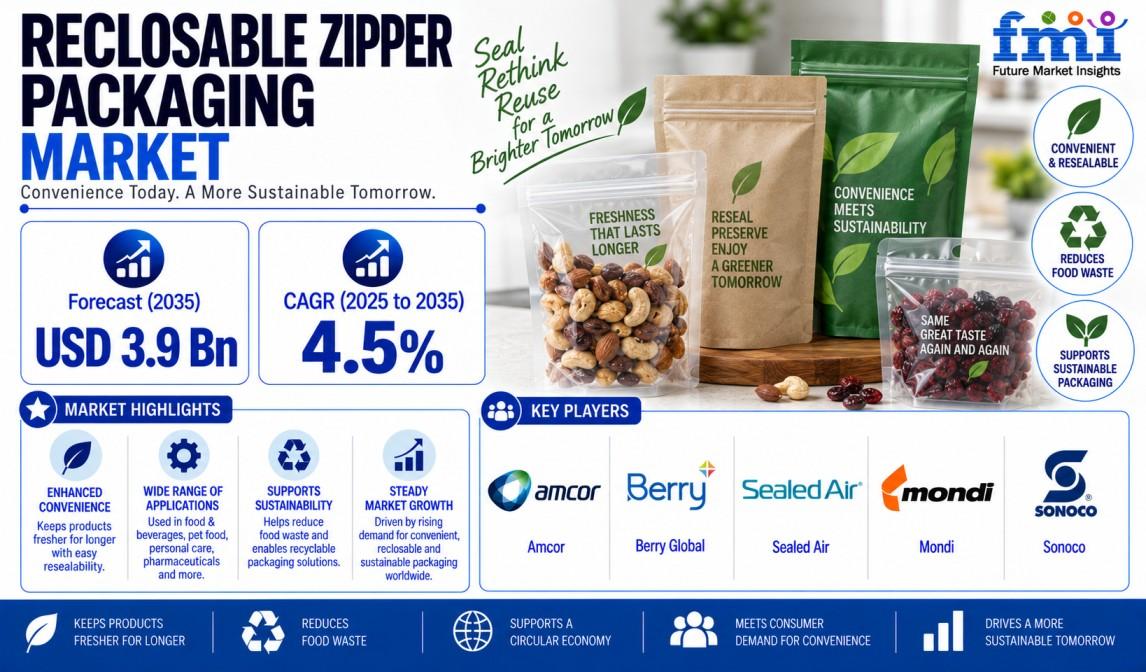
The global reclosable zipper packaging market is projected to grow from USD 2.5 billion in 2025 to USD 3.9 billion by 2035, advancing at a 4.5% CAGR, as brands increasingly use resealable packaging to combine product protection, portion control and consumer convenience.
Food and beverage applications remain central to this expansion, with reclosable formats increasingly used for snacks, frozen foods, dairy products and other products that may be consumed over multiple occasions. At the same time, personal care, household products, pet care and e-commerce are extending the role of zipper-equipped pouches and bags beyond traditional food applications.
The market is led by established packaging groups including Amcor, Berry Global, Sealed Air, Mondi and Sonoco, with competition increasingly shaped by closure reliability, material compatibility, barrier performance, recyclability and the ability to integrate zipper structures into high-volume packaging production.
Get Access of Report Sample: https://www.futuremarketinsights.com/reports/sample/rep-gb-24689
Why are resealable formats gaining ground across packaging categories?
The value proposition of reclosable zipper packaging is increasingly tied to what happens after the first opening. A package that can be opened, closed and stored repeatedly can help preserve product quality while giving consumers greater control over consumption.
FMI estimates that food and beverages will account for 65.0% of market revenue in 2025, making it the largest application category. Press-to-close zippers are expected to represent 60.0% of the zipper-type segment, reflecting their established use in flexible pouches and bags where straightforward opening and resealing are important.
This combination is creating opportunities across both mass-market and premium packaging. Manufacturers are refining tactile feedback, closure strength and sealing reliability while brands use zipper-equipped structures to support convenience and product differentiation.
How is material selection changing the zipper-packaging opportunity?
Polyethylene, including LDPE and HDPE, is projected to hold 45.0% of market revenue in 2025, making it the leading material category.
PE remains attractive because its flexibility, moisture resistance and compatibility with flexible packaging processes allow zipper systems to be incorporated across a broad range of bag and pouch structures. LDPE can provide flexibility and clarity, while HDPE can contribute greater stiffness and strength where the application requires it.
However, the sustainability discussion is changing material specifications. Recyclable structures, mono-material designs and bioplastics are increasingly being evaluated alongside conventional multi-layer constructions.
The commercial challenge is therefore not simply adding a zipper to a package. The closure, film structure and end-of-life pathway increasingly need to be evaluated as one packaging system.
Analyst Perspective
“Reclosable packaging is being evaluated less as a closure feature and more as part of the complete package system. The strongest commercial propositions will combine reliable resealing with material structures that preserve barrier performance, filling-line efficiency and an increasingly important recovery pathway.”
— Nandini Roy Choudhury, Principal Consultant, Future Market Insights
Reclosable Zipper Packaging Market Snapshot
- 2025 market value: USD 2.5 billion
- 2035 projected value: USD 3.9 billion
- Forecast CAGR: 4.5%
- Leading material: Polyethylene (LDPE/HDPE) — 45.0% share in 2025
- Leading zipper type: Press-to-close zipper — 60.0% share in 2025
- Leading application: Food & beverages — 65.0% share in 2025
- Fastest profiled country: China — 6.1% CAGR
What is driving demand for reclosable zipper packaging?
Convenience and portion control remain primary demand drivers. Resealable packaging allows consumers to open products without necessarily consuming the entire contents, particularly across snacks, frozen foods, coffee, pet food and household products.
E-commerce is also creating opportunities for flexible packages that combine low weight with product protection. Resealable structures can support repeat use after delivery while providing a familiar consumer opening experience.
Material innovation is another important growth factor. Packaging manufacturers are working to reduce material complexity and improve recyclability while retaining the mechanical and barrier characteristics required by zipper-equipped bags and pouches.
At the same time, raw-material prices and recycling challenges remain constraints. Multi-layer films and incompatible zipper components can complicate recovery, creating pressure for structures that deliver both functional performance and a clearer end-of-life route.
Get Access of Report Sample: https://www.futuremarketinsights.com/reports/sample/rep-gb-24689
Which countries are showing the strongest growth?
China is forecast to record the highest CAGR among the profiled countries at 6.1% through 2035, followed by India at 5.6%, Germany at 5.2%, France at 4.7%, the UK at 4.3%, the USA at 3.8% and Brazil at 3.4%.
China and India provide the strongest growth rates as packaged food, modern retail and e-commerce expand the addressable market for resealable formats.
Mature markets such as the USA and UK present a different opportunity. Slower overall growth can still support demand for premium structures, recyclable packaging and application-specific zipper solutions as brands seek to improve functionality without compromising established packaging systems.
What is shaping competition among zipper-packaging suppliers?
Competition is increasingly moving toward complete flexible-packaging solutions rather than closure hardware alone.
Amcor brings broad flexible-packaging capabilities to zipper-equipped pouches and bags, while Berry Global combines large-scale polymer and packaging manufacturing capabilities with closure applications. Sealed Air's position is strengthened by food-protection applications, while Mondi competes across flexible packaging and paper-based packaging development. Sonoco adds diversified packaging capabilities across food and consumer applications.
Across the market, competitive differentiation is increasingly tied to the ability to provide reliable resealing, barrier protection, machine compatibility and material options within a single commercial specification.
About the Reclosable Zipper Packaging Market Report
The Reclosable Zipper Packaging Market study evaluates the market by material type, zipper type, application and region. The assessment covers North America, Latin America, Western Europe, Eastern Europe, East Asia, South Asia and Pacific, and the Middle East & Africa, with analysis across 40+ countries.
FMI Research Methodology: https://www.futuremarketinsights.com/methodology
Reclosable Zipper Packaging Market: https://www.futuremarketinsights.com/reports/reclosable-zipper-packaging-market
Molded Fiber Blister Packs Market: https://www.futuremarketinsights.com/reports/molded-fiber-blister-packs-market
Desiccant Closures Market: https://www.futuremarketinsights.com/reports/desiccant-closures-market
Counter Display Boxes Market: https://www.futuremarketinsights.com/reports/counter-display-boxes-market
About Future Market Insights, Inc.
Future Market Insights, Inc. is a global market research and consulting organization registered in Delaware as Future Market Insights, Inc., Christiana Corporate, 200 Continental Drive, Suite 401, Newark, Delaware 19713, United States.
FMI maintains additional offices and delivery operations across the United States, United Kingdom, United Arab Emirates and India and serves clients across international markets.
Media Contact
Future Market Insights, Inc.
Christiana Corporate
200 Continental Drive, Suite 401
Newark, Delaware 19713, United States
Email: sales@futuremarketinsights.com
Disclosure
This release summarizes findings from FMI syndicated research and is intended for informational and media purposes. Market estimates, forecasts and segment shares reflect FMI's defined market scope and research methodology. Company names are included for competitive context and do not constitute endorsements.

 English
 Arabic
 French
 Spanish
 Portuguese
 Deutsch
 Turkish
 Dutch
Dutch
 Russian
 Romaian
 Portuguese (Brazil)
 Greek
Greek
