
Stearic Acid Market to Reach USD 80.5 Billion by 2036 as Industrial Demand and Bio Based Applications Expand Globally
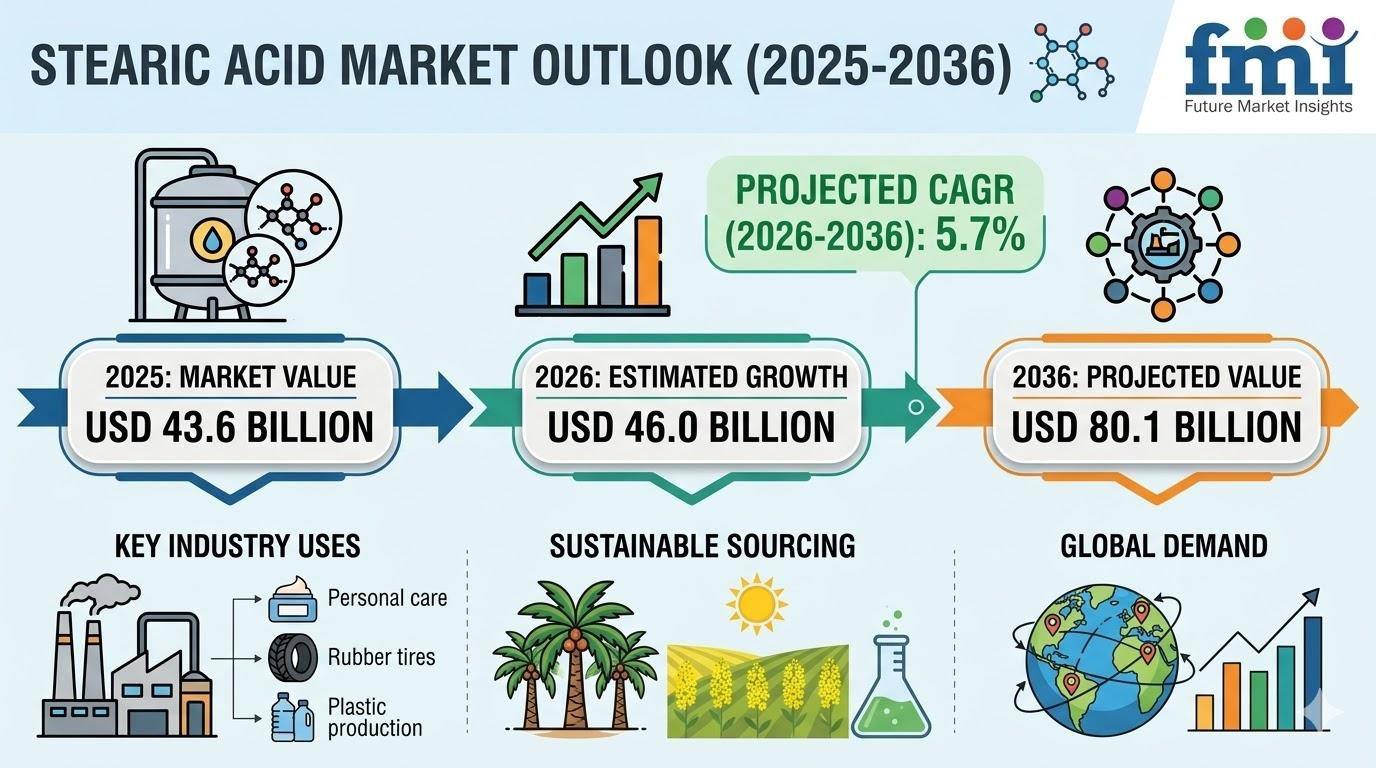
The global stearic acid market is experiencing robust growth as manufacturers, industrial processors, and consumer‑product companies increasingly adopt saturated fatty acids derived from vegetable oils and animal fats for a wide range of applications. Stearic acid — a long‑chain saturated fatty acid — is gaining traction across rubber processing, plastics, personal care, cosmetics, pharmaceuticals, and other end‑use industries due to its multifunctional properties such as emulsification, lubrication, and vulcanization assistance.
The stearic acid market was valued at approximately USD 46.0 billion in 2026 and is projected to expand to USD 80.5 billion by 2036, advancing at a CAGR of 5.7% during the forecast period. Demand growth is supported by expanding automotive and tire manufacturing, rapid growth in personal care and cosmetic formulations, rising preference for sustainable and bio‑based chemical inputs, and increasing penetration of stearic acid in high‑growth regions.
Request a Sample Report: https://www.futuremarketinsights.com/reports/sample/rep-gb-1043
Market Growth Drivers
• Rising Industrial Usage: Stearic acid acts as a key processing agent in rubber manufacturing, especially as a vulcanization activator, fuelling demand from the automotive and tire industries.
• Personal Care and Cosmetics Demand: Its use as an emulsifier, thickener, and stabilizer in soaps, lotions, creams, and shampoos is increasing with the growth of the beauty and personal care sector.
• Bio‑Based Ingredient Preference: Manufacturers are shifting toward vegetable‑derived stearic acid for sustainability and zero‑deforestation compliance, particularly in Europe and North America.
• Expansion in Plastics & Lubricants: Stearic acid enhances flexibility, surface finish, and processing characteristics in plastics, lubricants, and PVC stabilizers, broadening its industrial footprint.
• Regulatory and Green Chemistry Trends: Environmental regulations and demand for biodegradable, low‑toxicity chemicals are encouraging stearic acid adoption over synthetic alternatives.
Segmental Insights
• By Feedstock: Vegetable‑based sources dominate due to sustainability and regulatory drivers, capturing the majority of market share.
• By Application: Rubber processing accounts for the largest consumption share owing to its indispensable role in vulcanization; personal care and cosmetics represent the fastest‑growing end‑use segment.
• By Region: Asia Pacific leads growth due to rapid industrialization, expanding manufacturing bases, and rising consumer disposable incomes.
Key Industry Trends
• Sustainability and Certified Feedstocks: Companies are increasingly sourcing RSPO‑certified palm oil and other traceable vegetable oils to meet stringent environmental standards and brand transparency mandates.
• Product Innovation in Personal Care: Growth in organic, “clean‑label” skincare drives demand for high‑purity stearic acid grades tailored for cosmetic formulations.
• Diversification into High‑Value Applications: Beyond traditional industrial uses, stearic acid is gaining traction in pharmaceuticals, biodegradable plastics, and advanced polymer additives.
Regional Highlights
• Asia Pacific: Dominant region with the largest consumption share, driven by expansive rubber, plastics, and personal care sectors in China, India, and Southeast Asian nations.
• North America: Growth is propelled by stable automotive demand and robust cosmetics and personal care industries.
• Europe: Regulatory focus on sustainability and green chemistry supports adoption of bio‑based stearic acid, particularly in Germany, France, and the UK.
• Latin America & MEA: Increasing industrial activities and rising consumption of personal care products are expanding regional markets, though growth is moderate compared to Asia Pacific.
Competitive Landscape
The stearic acid market is highly competitive, with global oleochemical producers and specialty chemical manufacturers expanding capacity, forming strategic partnerships, and investing in sustainable feedstock sourcing. Key players are focusing on product differentiation, traceability, and upstream integration to mitigate raw material price volatility and supply chain disruptions.
Key Players
• Oleon (Avril)
• Godrej Industries
• Musim Mas
• Wilmar International
• KLK OLEO
• Emery Oleochemicals
• Kao Corporation
• Stepan Company
• Twin Rivers Technologies
• VVF Group
Analyst Outlook
Stearic acid is expected to remain one of the most versatile chemical intermediates across multiple industries owing to its functional benefits, renewable feedstock potential, and alignment with sustainability trends. Manufacturers prioritizing certified raw materials, enhanced product grades, and application‑specific innovations are likely to achieve sustained competitive advantage over the next decade.
Future Opportunities
Future growth opportunities are anticipated in bio‑based personal care ingredients, biodegradable plastics, advanced polymer additives, eco‑friendly surfactants, and regional capacity expansions in high‑growth Asian markets. Expansion in e‑commerce channels for specialty grades and regulatory support for low‑toxicity chemicals will further fuel market growth worldwide.

 English
 Arabic
 French
 Spanish
 Portuguese
 Turkish
 Dutch
Dutch
 Italiano
 Russian
 Romaian
 Portuguese (Brazil)
 Greek
Greek