
Respiratory Protective Equipment Market Analysis of Industrial Safety Requirements
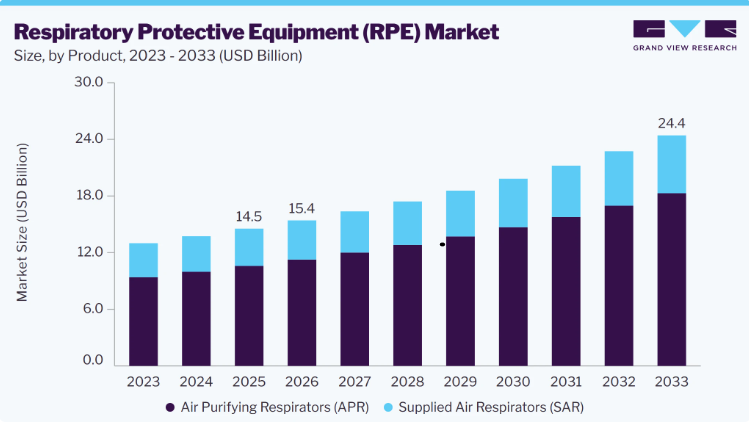
The global Respiratory Protective Equipment Market is moving beyond pandemic-driven demand and becoming an increasingly important component of workplace health and safety programs. Valued at USD 14.5 billion in 2025, the market is projected to reach USD 24.4 billion by 2033, expanding at a 6.8% CAGR from 2026 to 2033.
North America led the market with a 29.2% revenue share in 2025, while Asia Pacific is expected to register the fastest growth through 2033.
What Is Driving the Respiratory Protective Equipment Market?
The answer increasingly lies in workplace safety, regulation, and industrial exposure.
Workers across manufacturing, construction, mining, oil & gas, chemicals, healthcare, and pharmaceuticals can encounter airborne contaminants, hazardous particles, gases, dust, and infectious agents. As awareness of these risks increases, employers are placing greater emphasis on respiratory protection.
At the same time, governments and regulatory bodies are strengthening occupational safety requirements.
This creates a long-term demand cycle:
Stricter safety standards → greater employer compliance → higher RPE adoption → continued market expansion
The COVID-19 pandemic significantly increased demand for disposable masks, but the market is now being supported by broader occupational health requirements rather than depending solely on pandemic-related consumption.
Download a free sample report or claim your copy of this full market intelligence report
Which Product Segment Leads?
Air purifying respirators (APRs) represented the dominant product category, accounting for 72.8% of market revenue in 2025.
Their widespread use across healthcare, mining, emergency response, military, and other applications has supported their leading position. Disposable masks, including N95 and surgical masks, also contributed significantly to segment demand during the pandemic and continue to have relevance in respiratory protection.
Meanwhile, supplied air respirators (SARs) are expected to experience steady development. These products are particularly relevant where negative-pressure conditions exist or where powered air-purifying respirators may not provide sufficient protection.
Expansion of chemical, pharmaceutical, and oil & gas industries in Asia Pacific is expected to support SAR demand.
Why Is Healthcare a Major End-Use Market?
Healthcare accounted for the largest end-use revenue share of 17.7% in 2025.
Healthcare workers require respiratory protection against airborne pathogens, infectious diseases, and hazardous medical aerosols. Increased healthcare expenditure, hospital infrastructure expansion, diagnostic laboratories, long-term care facilities, and infection-prevention programs are contributing to continued demand.
The experience of COVID-19, Influenza A (H1N1), and Ebola has also reinforced the importance of preparedness within healthcare environments.
But healthcare is only one part of the opportunity.
Construction is also expected to record significant demand growth as workers can encounter hazards such as silica dust, lead dust, and silica vapors.
Where Is the Market Facing a Limitation?
One structural restraint is that organizations often prioritize engineering and administrative controls before relying on personal protective equipment.
Where hazards can be eliminated or reduced through workplace design, ventilation, process changes, or administrative measures, RPE may not be the first control strategy.
This can limit the addressable demand for respiratory protection in some environments.
However, where airborne hazards cannot be sufficiently controlled, respiratory equipment remains an important protective measure.
Could Smart PPE Change the Market?
Technology is opening another avenue for market development.
The industry is experiencing innovation around smart respirators, sensors, filtration technologies, ergonomic designs, and improved usability.
The opportunity is particularly relevant because respiratory protection must achieve more than basic filtration. Products also need to be comfortable enough for workers to use correctly and consistently.
The development pathway can therefore be viewed as:
Traditional protection → improved filtration → lighter designs → greater comfort → connected/smart PPE
Manufacturers that successfully combine protection, usability, comfort, and regulatory compliance can strengthen their position in a moderately concentrated market.
What Does Market Concentration Mean for Competition?
The respiratory protective equipment market is moderately concentrated, with established companies benefiting from technological capabilities, certifications, and global distribution networks.
Regulatory compliance and certification requirements create significant barriers for new entrants. At the same time, regional manufacturers and specialized players continue to compete in localized markets.
Mergers and acquisitions also remain relevant as larger companies seek specialized technologies, new product capabilities, and expanded geographic reach.
Regulations remain particularly influential because they affect product design, testing, certification, and market access.
Which Region Currently Leads?
North America accounted for 29.2% of global revenue in 2025, supported by demand from oil & gas drilling, electric power utilities, combustible-dust environments, healthcare, construction, and manufacturing.
The U.S. accounted for 79.9% of North America's market in 2025. Its strong industrial base and strict occupational safety requirements support broad adoption of respiratory protection.
Canada is also experiencing growth as energy, mining, and construction industries increasingly emphasize workplace safety.
Europe represents a mature and highly regulated market. Germany is particularly important because of its large industrial base, including automotive, chemicals, and heavy manufacturing.
Where Is the Fastest Growth Emerging?
Asia Pacific is expected to record the fastest CAGR from 2026 to 2033.
Industrial expansion, air-pollution concerns, occupational hazards, respiratory health awareness, and strengthening regulatory frameworks are contributing to regional demand.
China leads the regional market, supported by its extensive manufacturing, construction, mining, and chemical industries.
India represents a particularly strong growth opportunity, with the market projected to expand at a 12.5% CAGR during the forecast period. Industrialization, construction activity, healthcare expansion, evolving safety standards, and increasing awareness of air pollution are supporting RPE adoption.
The opportunity also extends across the Middle East & Africa, where oil & gas, construction, and manufacturing activities continue to create workplace respiratory protection requirements.
Central & South America is benefiting from mining, agriculture, construction, manufacturing, and infrastructure activity, with Brazil representing a major regional market.
Key Respiratory Protective Equipment Companies
The competitive landscape includes established PPE manufacturers with broad product portfolios and strong distribution capabilities.
Key companies profiled in the study include:
- 3M
- Alpha Pro Tech Limited
- Ansell Ltd.
- Honeywell International Inc.
- Avon Rubber plc
3M is recognized for its broad technology and personal protective equipment portfolio, while Ansell provides protective solutions across healthcare and industrial environments.
The Bigger Market Opportunity
The respiratory protective equipment market is increasingly being shaped by a fundamental change in how organizations approach worker protection.
Pandemic preparedness created major awareness.
Occupational health requirements are sustaining demand.
Industrial expansion is creating new exposure environments.
Stricter regulations are strengthening compliance.
Smart PPE and filtration innovation are creating opportunities for product differentiation.
Together, these forces position respiratory protection as a long-term workplace safety requirement rather than a temporary pandemic-era product category. With the market projected to rise from USD 14.5 billion in 2025 to USD 24.4 billion by 2033, the next phase of growth will increasingly depend on safety compliance, industrial activity, advanced product design, and adoption across emerging markets.
About us:
Grand View Research, a market research and consulting company, provides syndicated research reports, customized research reports, and consulting services. Grand View Research database is used by the world's renowned academic institutions and Fortune 500 companies to understand the global and regional business environment. Our database features thousands of statistics and in-depth analysis on 46 industries in 25 major countries worldwide.

 English
 Arabic
 French
 Spanish
 Portuguese
 Deutsch
 Turkish
 Dutch
Dutch
 Italiano
 Russian
 Portuguese (Brazil)
 Greek
Greek
