
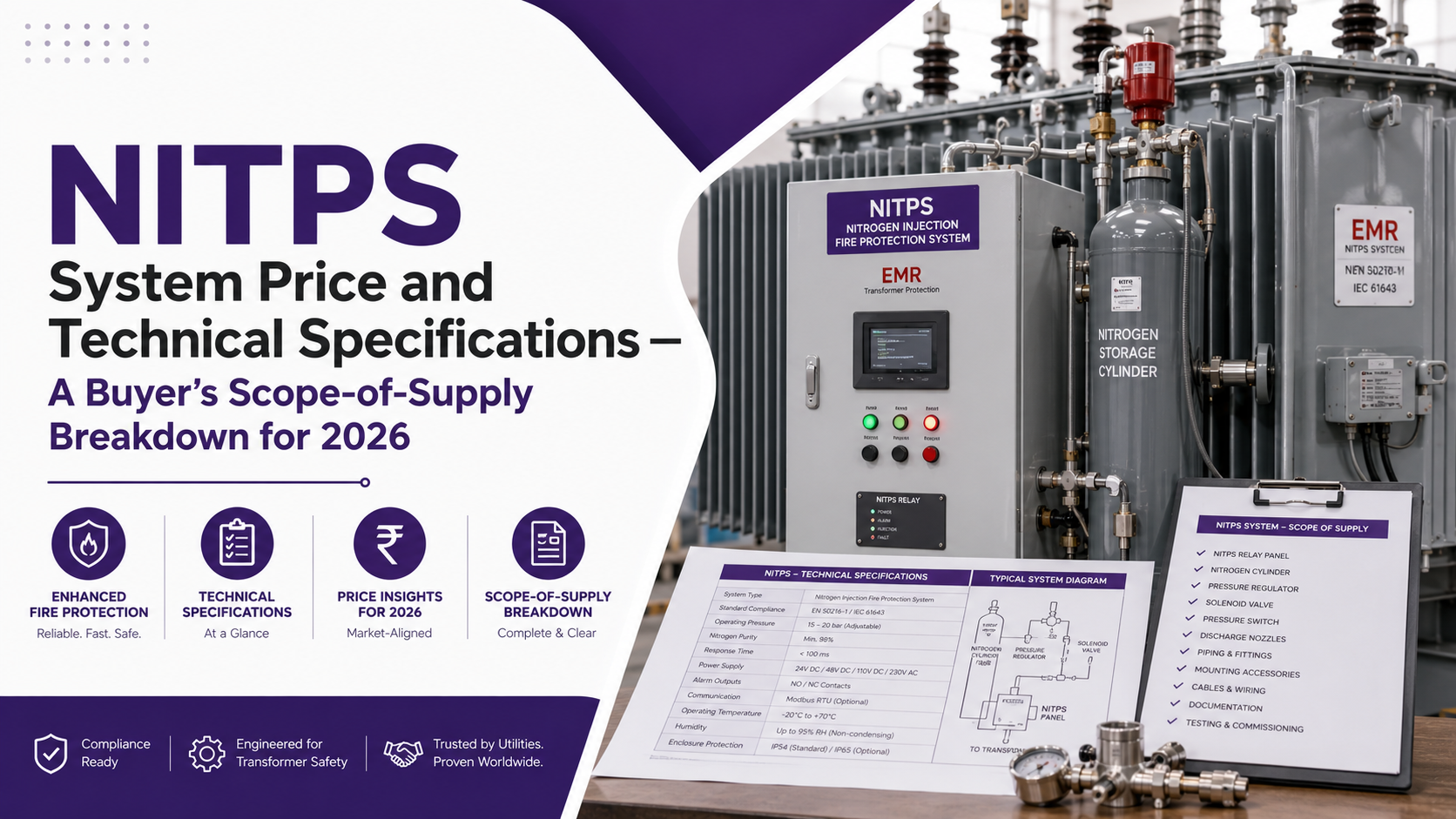
NITPS System Price and Technical Specifications, A Buyer's Scope-of-Supply Breakdown for 2026
Why This Post Doesn't Give You a Price — and Why That's the Honest Answer
NITPS system pricing is not a published number. It is not a catalogue item with a list price. It is a project-specific procurement outcome determined by the scope of supply, the fault duty class of the specific transformer, the integration requirements of the existing protection scheme, and the commercial terms of the bid.
Two NITPS bids for two 220 kV transformers at the same substation can differ by 40% if the nitrogen cylinder configuration is different, if one includes commissioning and the other doesn't, if one includes IEC 61850 integration and the other delivers only hardwired contacts.
What this post provides is the scope-of-supply checklist that lets a procurement team understand exactly what they are buying, why two bids differ in price, and what questions to ask before they open the commercial envelopes.
What Drives the NITPS System Price
Factor 1: Nitrogen cylinder volume and skid configuration
The fire protection study determines how much nitrogen volume is required to suppress an arc in the specific OLTC tank volume. A larger OLTC tank requires a larger nitrogen cylinder. Some installations require a twin-cylinder skid for redundancy or for the additional volume a double-compartment OLTC requires. The cylinder-and-skid configuration is typically the largest single cost driver in the NITPS supply.
Factor 2: Fault current rating and arc-test class
NITPS systems are tested and rated for specific internal arc fault levels — expressed in kA for a defined duration. A 220 kV class transformer with 40 kA fault duty requires a system rated for that fault level, with an arc-test certificate to prove it. A 132 kV installation with 25 kA fault duty may accept a lower-rated system. The arc-test class determines the design complexity and cost.
Factor 3: Integration with the existing protective relay
If the installation has an existing OSR relay, Buchholz relay, and differential relay, the NITPS needs to be integrated with those devices through the existing wiring and relay contacts. If new protection relays are being installed alongside the NITPS, the relay cost adds to the total. The integration scope — which relay provides the trigger, how many contact inputs the NITPS accepts, whether the NITPS output feeds the existing trip circuit or requires its own — varies across installations and affects both cost and commissioning complexity.
Factor 4: SCADA and communications integration
A NITPS with IEC 61850 GOOSE messaging integration for digital substation connectivity costs more than one with hardwired contacts only. IEC 60870-5-104 integration for SCADA hookup adds configuration scope. The utility's digital substation strategy determines whether this integration is required or optional.
Factor 5: Commissioning, testing, and site work
Factory acceptance testing (FAT) at the manufacturer's facility, site acceptance testing (SAT) with the utility's engineer's witness, nitrogen filling at site, integration testing with the protection scheme, and the as-built documentation handover are all scope items that may be included or excluded from different bids. A bid that excludes commissioning appears lower in price but transfers the commissioning cost to the buyer's own project budget.
Factor 6: AMC and nitrogen refill provisions
A NITPS that is activated in service — because a fault occurred and the nitrogen was injected — requires nitrogen cylinder refill and system recertification before it is ready for the next event. AMC provisions that include nitrogen cylinder health monitoring, periodic FAT simulation, and refill call-out should be included in the lifecycle cost evaluation even if they don't appear in the initial procurement price.
The Technical Specification Sheet a Bidder Must Provide
When evaluating NITPS bids, the technical comparison should cover the following parameters at a minimum:
| Parameter | What to Specify | Why It Matters |
|---|---|---|
| N₂ cylinder volume | Litres | Determines suppression capacity for specific OLTC tank volume |
| Pre-charge pressure | Bar or PSI | Determines injection driving force and duration |
| Injection opening time | Milliseconds | Must be within the 10–20 ms design target to prevent rupture |
| Pressure rise in OLTC tank | Bar | Confirms the injection creates the arc-suppression pressure wave |
| Arc-quenching time | Milliseconds | Confirmed by arc-test certificate — not a calculated value |
| Fault detection compatibility | OSR / Buchholz / Differential | Must be confirmed against the specific protection scheme |
| Operating temperature range | °C min/max | India's ambient range spans -5°C to +55°C across regions |
| Enclosure IP class | IP55 / IP65 | Determines suitability for outdoor substation installation |
| Communication protocol | IEC 61850 / IEC 60870-5-104 / hardwired | Must match utility SCADA architecture |
| Alarm and annunciation contacts | Volt-free contacts, quantities | Must be wired to substation annunciation panel |
Buyer's Due Diligence Checklist
Before accepting a NITPS bid as technically complete, the buyer's engineering team should verify:
Internal arc test certificate. This is the single most important document. It should state the arc fault level (kA), the duration, the test standard, and the testing laboratory. If a bidder cannot produce an arc test certificate, the bid should be treated as technically unqualified regardless of price.
Third-party type-test certificate. Independent verification that the system meets the claimed specifications. The testing laboratory should be NABL-accredited or equivalent for Indian procurement purposes.
Factory acceptance test protocol. The FAT should include nitrogen injection simulation, response time measurement, alarm and trip contact verification, and SCADA integration test. The FAT protocol should be reviewed and approved before the FAT is conducted — not after.
Indian reference list. At minimum three Indian installations, with transformer voltage class, year of commissioning, and utility contact for reference verification. A NITPS supplier without Indian references is introducing commissioning risk that the specification should be written to address through additional FAT and SAT scope.
Spare parts catalogue. Fast-acting solenoid valves, pressure transmitters, and control relays have defined replacement intervals. The spare parts catalogue should be provided as part of the bid — confirming that the critical items are commercially available and not subject to single-source supply constraints.
How to Write the Tender Specification to Get Fair Bids
The tender specification that produces the most competitive and comparable bids is performance-based rather than brand-specific. Specify what the system must do — not which brand's components it must use.
Example performance specification language: "The system shall quench a [25 kA] internal arc in the OLTC compartment within [100 ms] of fault relay command, demonstrated by internal arc test certificate from an accredited testing laboratory. The system shall operate within the ambient temperature range of [-5°C to +55°C] without auxiliary heating or cooling. The system shall integrate with the existing [OSR / Buchholz / differential] relay via volt-free contact inputs."
This language describes the performance requirement without specifying how the bidder achieves it — which widens the competitive field, improves pricing, and still delivers the protection outcome the specification requires.
EMR Global's AIGCS and NITPS capability — backed by the parent MR technology that developed the NITPS concept — is capable of meeting performance specifications written at exactly this level. The Indian utility that writes a strong performance specification for NITPS protection will find EMR Global at the top of the technically qualified bid list.

 English
 Arabic
 Spanish
 Portuguese
 Deutsch
 Turkish
 Dutch
Dutch
 Italiano
 Russian
 Romaian
 Portuguese (Brazil)
 Greek
Greek
