
Flexible Battery Market Growth:Reasons IoT Is Becoming Critical
The Flexible Battery Market is entering a period in which battery technology is becoming increasingly connected to the physical design of electronic products. Instead of focusing only on capacity and energy output, manufacturers are also looking at flexibility, thickness, weight, integration, and adaptability.
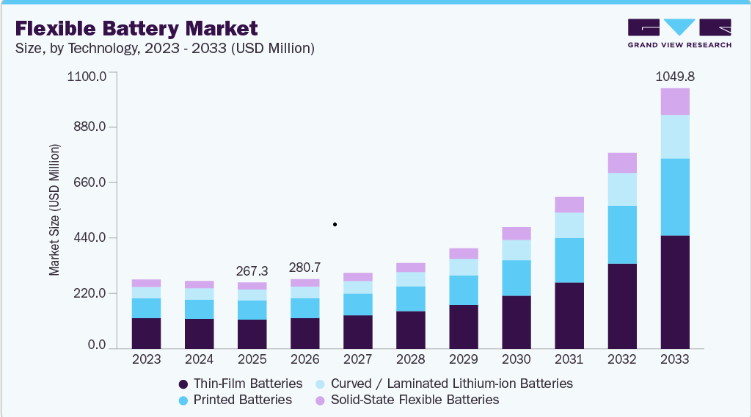
The global Flexible Battery Market was valued at USD 267.3 million in 2025 and is forecast to reach USD 1,049.8 million by 2033, registering a 20.7% CAGR from 2026 to 2033. North America accounted for 34.4% of global revenue in 2025, while Asia Pacific is projected to be the fastest-growing region.
Seven areas stand out as particularly important for the market's future.
- Wearable Electronics: The Established Demand Center
Wearables are currently the strongest application base.
The segment accounted for 33.0% of market revenue in 2025, supported by demand for smartwatches, fitness trackers, health-monitoring devices, and other wearable electronics.
These products require batteries that can deliver reliable power without adding unnecessary bulk.
Flexible batteries can therefore become an important component in the continuing miniaturization of wearable technology.
The opportunity is particularly significant because wearable products must combine functionality with physical comfort.
- IoT: The Fastest Application Opportunity
The next major growth opportunity is IoT.
The IoT devices segment is projected to grow at 21.3% CAGR between 2026 and 2033, making it the fastest-growing application segment.
Connected sensors are being deployed across healthcare, industrial automation, logistics, and smart homes.
Many sensors operate in compact or remote environments, where conventional battery formats can be difficult to integrate or replace.
Flexible batteries can provide a way to place energy storage directly within small and irregularly shaped connected devices.
The opportunity: more connected sensors can translate into more demand for miniature, lightweight, adaptable power.
Download a free sample report or claim your copy of this full market intelligence report
- Smart Packaging: A Market Beyond Traditional Electronics
Smart packaging could represent one of the most distinctive opportunities for flexible battery manufacturers.
Printed batteries can power smart labels and RFID tags used for product tracking, authentication, and shelf-life monitoring.
This opens opportunities across:
Retail → Pharmaceuticals → Food & Beverages → Logistics
Unlike conventional electronics, smart packaging requires batteries that can be extremely thin, lightweight, customizable, and suitable for high-volume applications.
This is one reason printed battery technology is becoming increasingly important.
- Thin-Film Batteries: The Current Technology Leader
Thin-film batteries accounted for 44.3% of revenue in 2025, making them the largest technology segment.
Their compact structure makes them suitable for miniaturized electronics, including smartwatches, fitness trackers, and smart cards.
Some thin-film designs also use solid-state approaches that can improve safety and reliability.
The broader opportunity is clear: as device thickness decreases, battery technology must increasingly operate within tighter physical constraints.
- Printed Batteries: The Scalability Opportunity
Printed batteries are projected to grow at a 21.2% CAGR, making them the fastest-growing technology segment.
Their attraction comes from the ability to use printing processes on flexible substrates, supporting scalable and customizable designs.
This makes them particularly relevant to applications where batteries need to be produced in compact formats and potentially at high volumes.
The strongest opportunities include:
- Smart labels
- RFID tags
- IoT sensors
- Smart packaging
- Low-power disposable electronics
If manufacturing efficiency improves, printed batteries could help expand flexible battery adoption into applications where conventional battery production is less suitable.
- Ultra-Small Batteries: Less Capacity, More Applications
Another important opportunity is emerging at the lower end of the capacity spectrum.
The 10–100 mAh segment held 46.6% of market revenue in 2025, reflecting its suitability for wearables, IoT sensors, medical patches, smart cards, and compact electronics.
However, the below-10 mAh segment is expected to grow at 21.1% CAGR.
Why does such a small capacity matter?
Because many emerging applications do not require large amounts of energy. Smart labels, RFID tags, and other low-power devices may need only enough power to support specific functions.
This means that battery value is increasingly determined by application fit rather than simply by capacity.
- Rechargeability and Disposable Power Will Grow Side by Side
Secondary rechargeable batteries dominated the market with a 75.7% share in 2025.
They are particularly attractive for devices requiring repeated operation because they can be reused and provide long-term cost advantages.
But primary batteries are projected to grow even faster, recording a 21.4% CAGR through 2033.
This creates two complementary markets.
Rechargeable → Wearables + Connected Systems
Primary → Medical Patches + Smart Packaging + Short-Term Low-Power Applications
Rather than one battery type eliminating the other, application requirements are likely to determine which format gains adoption.
What Could Hold the Market Back?
The growth opportunity comes with a significant manufacturing challenge.
Flexible batteries can require specialized materials and production processes. Thin-film deposition and printed electronics can raise manufacturing costs and require specialized technical expertise.
Energy density is another constraint.
Flexible batteries are often designed for low-power applications, limiting their ability to serve devices that require high power or long operating times.
Therefore, the next stage of market development will depend on improving:
Manufacturing scalability
Energy density
Cost efficiency
Reliability
Lifecycle performance
Regional Opportunity Is Also Shifting
North America remains the largest regional market, accounting for 34.4% of revenue in 2025. Strong demand across wearables, medical technologies, and IoT is supporting the region.
Asia Pacific, however, is expected to grow at 21.0% CAGR, supported by electronics manufacturing capabilities in China, Japan, and South Korea and rising adoption of connected and flexible technologies.
Europe is building opportunities in healthcare, consumer electronics, and smart packaging, while Latin America is seeing demand for compact power solutions in mobile electronics, smart labels, and tracking applications.
In the Middle East & Africa, smart-city initiatives, IoT healthcare applications, remote monitoring, and compact consumer electronics are supporting market development.
Key Companies
The market includes AMOGREENTECH Co., Ltd., CATL, CCL Design, Enfucell, LG Energy Solution, Panasonic, ProLogium Technology, Samsung SDI, Ultralife Corporation, and Zinergy UK Limited.
Competitive strategies focus on improving flexibility, energy density, durability, reliability, manufacturing efficiency, and cost performance.
The Market Opportunity in One View
The future of the Flexible Battery Market can be understood through seven connected opportunities:
Wearables create today's demand.
IoT creates rapid future expansion.
Thin-film technology provides an established foundation.
Printed batteries offer scalable growth potential.
Smart packaging creates new applications.
Ultra-small batteries enable new low-power products.
Rechargeable and primary technologies serve different use cases.
Together, these trends explain why a market valued at USD 267.3 million in 2025 is projected to approach USD 1.05 billion by 2033.
The industry's long-term potential will depend on whether manufacturers can make flexible power not only thinner and more adaptable, but also more affordable, scalable, and energy-efficient.
About us:
Grand View Research, a market research and consulting company, provides syndicated research reports, customized research reports, and consulting services. Grand View Research database is used by the world's renowned academic institutions and Fortune 500 companies to understand the global and regional business environment. Our database features thousands of statistics and in-depth analysis on 46 industries in 25 major countries worldwide.

 English
 Arabic
 French
 Spanish
 Portuguese
 Deutsch
 Turkish
 Italiano
 Russian
 Romaian
 Portuguese (Brazil)
 Greek
Greek
