
Hydrogen Generator Market Expected to Reach $1.72 Billion by 2036
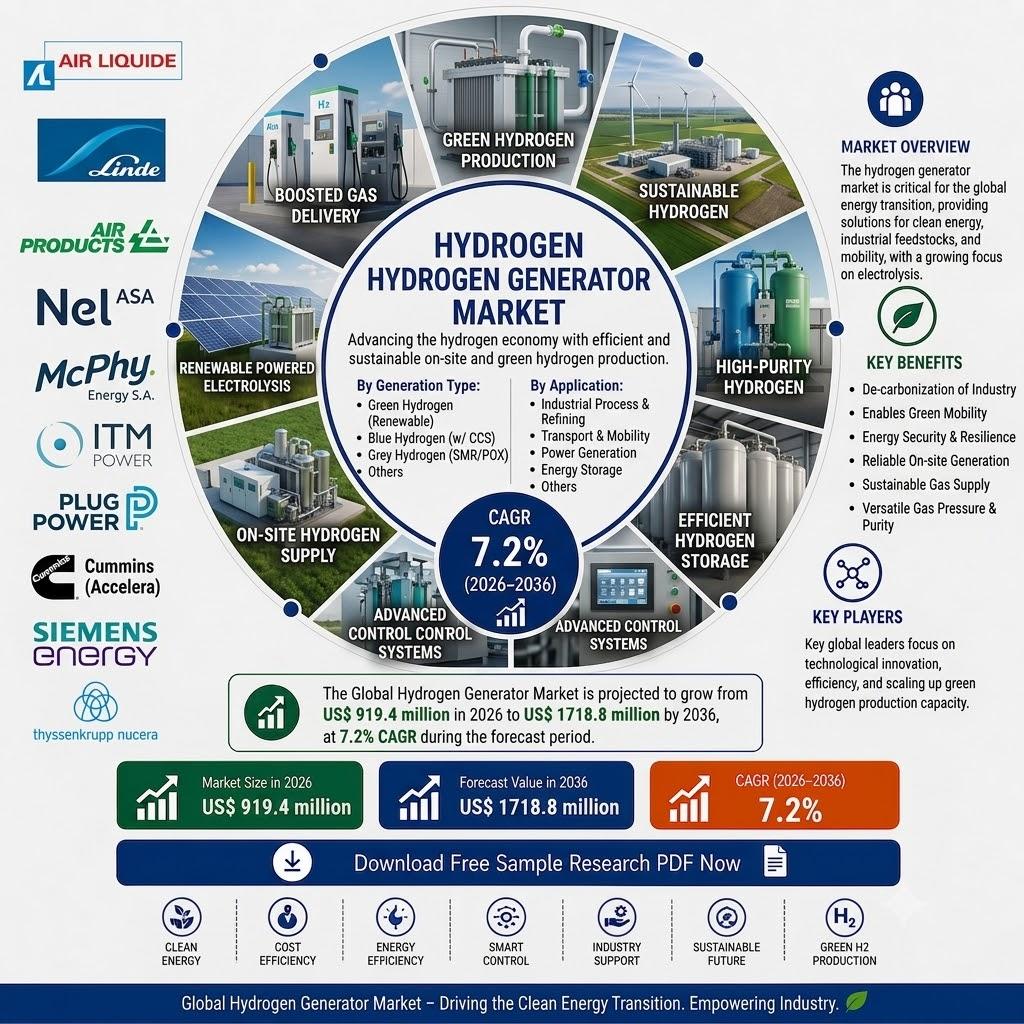
The global Hydrogen Generator Market is estimated at US$919.4 million in 2026 and is projected to reach US$1,718.8 million by 2036, expanding at a 7.2% CAGR during the forecast period, according to Fact.MR analysis.
The market was valued at approximately US$857.6 million in 2025. Between 2026 and 2036, the market is expected to create an absolute dollar opportunity of US$799.5 million. Industrial hydrogen consumption, green hydrogen policy incentives, falling electrolyzer costs, and expanding hydrogen applications are shaping demand.
Hydrogen generators produce hydrogen gas through electrolysis, steam methane reforming, or other chemical processes. These systems serve industrial, energy, and mobility applications and can operate through centralized, distributed, mobile, or on-site configurations.
Get detailed market forecasts, competitive benchmarking, and pricing trends: https://www.factmr.com/connectus/sample?flag=S&rep_id=11470
Electrolysis Holds 37.5% Product Share
Electrolysis hydrogen generators account for 37.5% of the product segment in 2026, according to Fact.MR. Their position is supported by growing demand for hydrogen produced from water and renewable electricity without direct carbon emissions.
PEM and alkaline electrolysis represent the two primary technology platforms. PEM systems offer higher current density and dynamic response, while alkaline systems provide lower capital costs at larger scales.
Gigawatt-scale manufacturing is also affecting system economics. Air Liquide and Siemens Energy operate a joint venture gigafactory in Berlin, with capacity ramping toward 3 GW per year. Nel ASA has expanded its Wallingford, Connecticut facility toward 500 MW and introduced a pressurized alkaline platform with estimated turnkey costs below US$1,450 per kW at 25 MW scale.
Industrial Gas Production Leads Application Demand
Industrial gas production represents 32.8% of the application segment in 2026. Petroleum refining, ammonia synthesis, and methanol manufacturing remain important sources of hydrogen consumption.
The shift toward lower-carbon industrial processes is creating additional demand for electrolyzer installations at existing industrial sites. Refiners and chemical producers are evaluating hydrogen generation systems that can provide the pressure and purity specifications required by established processes.
The chemical industry accounts for 35.4% of the end-use segment, driven by hydrogen requirements across refining, ammonia synthesis, and specialty chemical manufacturing.
Fact.MR defines the Hydrogen Generator Market as systems that produce hydrogen through electrolysis, steam reforming, or chemical processes for industrial, energy, and mobility applications.
The market excludes hydrogen storage systems, fuel cells, separately sold distribution infrastructure, laboratory-scale generators without industrial or commercial capacity, and hydrogen generated as a byproduct without dedicated generation equipment.
Policy Support Shapes Project Economics
Government incentives remain a major factor behind electrolyzer deployment. Green hydrogen programs in the United States, European Union, India, and Australia are improving project economics and supporting investment decisions.
In the United States, IRA Section 45V clean hydrogen production tax credits can provide up to US$3 per kilogram, while Department of Energy Regional Clean Hydrogen Hub funding is directing investment toward seven hub locations.
India's National Green Hydrogen Mission includes INR 19,744 crore in funding and production targets of 5 million tonnes per annum by 2030. These targets are supporting electrolyzer manufacturing and deployment, particularly around refinery and fertilizer applications.
China's market is supported by its large industrial hydrogen consumption base and government support for electrolyzer manufacturing. Fuel cell vehicle programs across commercial bus and truck fleets are also creating demand for distributed hydrogen generation at fueling locations.
India and China Record Fast Growth
India is projected to record a 7.6% CAGR through 2036, making it the fastest-growing country among the markets highlighted by Fact.MR. China follows at 7.5%, while the United States is projected to expand at 7.3%.
India's outlook reflects National Green Hydrogen Mission targets, refinery hydrogen consumption, and growing electrolyzer manufacturing activity. China benefits from industrial hydrogen demand, manufacturing scale, and fuel cell vehicle deployment.
The United States combines clean hydrogen production incentives with refinery decarbonization investment and expanding electrolyzer deployment across industrial and transportation sites.
Large-Scale Electrolyzers Define the Next Product Phase
Electrolyzer systems rated at 10 MW and above are emerging as an important product trend. Dedicated hydrogen facilities are increasingly pairing large-scale PEM or alkaline systems with renewable electricity and long-term offtake agreements.
The scale-up is moving beyond single-digit megawatt demonstrations toward projects reaching 100 MW and beyond. Modular architectures allow developers to stack electrolyzer capacity while managing balance-of-plant requirements.
Air Liquide's 200 MW Normand'Hy project in France, expected to begin operations in 2026, illustrates the scale of commercial deployment identified in the Fact.MR analysis. The project is expected to produce up to 28,000 tonnes of green hydrogen per year.
Shambhu Nath Jha, Principal Consultant at Fact.MR, said, “The hydrogen generator market is being reshaped by the convergence of industrial hydrogen demand stability and green hydrogen policy acceleration.”
Jha added that commercial differentiation is increasingly linked to system integration, including the ability to combine electrolyzers with renewable power, hydrogen storage, and end-use offtake under bankable project structures.
Company Activity Expands Across Electrolyzer Technologies
The competitive landscape includes industrial gas companies and specialized electrolyzer manufacturers. Key companies identified by Fact.MR include Air Liquide, Linde plc, Air Products and Chemicals, Nel ASA, McPhy Energy S.A., ITM Power, Plug Power, Cummins (Accelera), Siemens Energy, and thyssenkrupp nucera.
Recent developments illustrate the market's commercial activity. In May 2026, Nel ASA launched a next-generation pressurized alkaline electrolyzer system targeting large-scale green hydrogen production.
In March 2025, Nel Hydrogen US received a US$6 million purchase order from Collins Aerospace for PEM electrolyzer stacks. During the same month, Nel Hydrogen US received a US$7 million order for two containerized PEM electrolyzers totaling 5 MW for hydrogen production at a new US steel mill.
Siemens Energy delivered the first electrolyzers from its Berlin gigafactory to Air Liquide's 200 MW Normand'Hy facility in 2025, according to the Fact.MR analysis.
Fact.MR's research methodology combines secondary research, primary interviews, and forecast modeling. The analysis draws on 130+ secondary sources, benchmarks 60+ company product portfolios, covers 30+ countries, and incorporates 25+ interviews with electrolyzer manufacturers, industrial gas companies, project developers, and end users.
To View Top Reports
https://social.mytamam.com/blogs/36947/Zero-Waste-Packaging-Market-Set-to-Reach-US-917-5
https://net-pals.com/blogs/29723/Zero-Waste-Packaging-Market-Projected-to-Hit-US-917-5
https://uddokta64.com/blogs/6507/Global-Zero-Waste-Packaging-Market-Expected-to-Reach-US-917
https://acmingle.com/blogs/16990/Zero-Waste-Packaging-Market-Forecast-to-Reach-US-917-5
About Fact.MR
Fact.MR is a market research and consulting firm providing market intelligence, industry analysis, and forecasts across global markets. Its research combines secondary research, primary interviews, demand-side analysis, and forecast modeling to assess market size, competitive activity, technology trends, and growth opportunities.

 English
 Arabic
 French
 Spanish
 Portuguese
 Deutsch
 Dutch
Dutch
 Italiano
 Russian
 Romaian
 Portuguese (Brazil)
 Greek
Greek
