
Flame Retardant Market Size Expands With Advanced Electronics Applications
Fire safety is no longer limited to building codes or emergency systems. It is increasingly becoming a material-design requirement across electronics, construction, transportation, automotive, textiles, and industrial products. As plastics and polymer-based materials become more widely used, manufacturers are under growing pressure to improve fire resistance without compromising performance, sustainability, or recyclability.
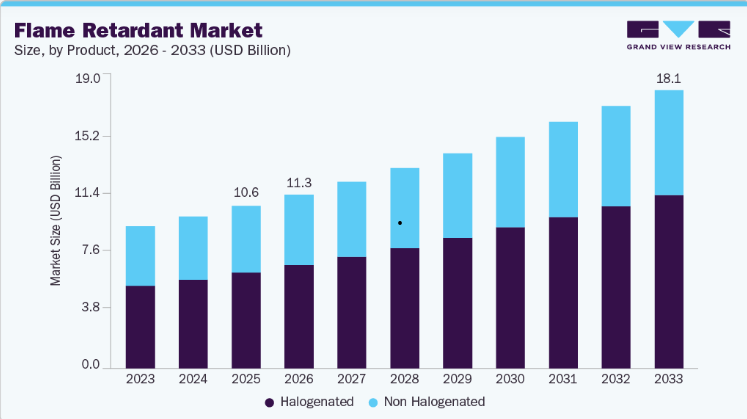
Against this backdrop, the global Flame Retardant Market was valued at USD 10.6 billion in 2025 and is projected to reach USD 18.1 billion by 2033, expanding at a 6.9% CAGR from 2026 to 2033. Asia Pacific accounted for the largest share, at 44.4% in 2025.
Rather than viewing the industry simply through product segments, its future can be understood through five major forces shaping demand and competition.
Force 1: Fire Safety Regulations Are Creating Structural Demand
One of the strongest forces behind the market is regulation.
Governments and regulatory authorities are tightening fire-safety requirements for products and materials used in residential, commercial, and industrial environments. Flame retardants help limit flame propagation and provide additional time for evacuation, making them important in applications where fire performance is a critical requirement.
This regulatory pressure is particularly significant across:
- Building insulation and construction materials
- Electrical wiring and electronic housings
- Automotive components
- Textiles
- Plastics and polymer products
Standards such as UL94 and IEC 60695 also influence material selection in electrical and electronics applications.
Download a free sample report or claim your copy of this full market intelligence report
As regulations become more demanding, fire resistance is increasingly becoming a baseline product requirement rather than an optional feature.
Force 2: Electronics Is Changing What “Fire Protection” Means
The second force comes from the rapid expansion of electrical and electronic products.
The electrical and electronics segment represented 41.5% of flame retardant market revenue, making it the leading end-use category.
Modern electronic systems are becoming smaller, more powerful, and more densely packed. This increases the importance of managing heat and reducing the risk of ignition in components such as:
- Printed circuit boards
- Connectors
- Casings
- Wiring systems
- Insulation components
The growth of electric vehicles, consumer electronics, renewable energy systems, and other electrical technologies is widening this demand base.
The result is a shift toward flame retardants that can provide fire protection while maintaining electrical, mechanical, and thermal performance.
Force 3: Sustainability Is Redrawing the Product Landscape
The most important transformation within the industry may be the movement away from conventional halogenated formulations toward non-halogenated alternatives.
The non-halogenated segment accounted for 58.9% of market revenue in 2025, reflecting increasing demand for materials aligned with environmental and regulatory requirements.
Manufacturers are increasingly exploring phosphorus-, nitrogen-, aluminum hydroxide-, and magnesium-based solutions.
The transition is being encouraged by:
- Environmental regulations
- Demand for reduced smoke and toxic emissions
- Corporate sustainability goals
- Recyclability requirements
- Preference for environmentally compliant materials
This does not mean halogenated flame retardants disappear immediately. Their strong flame-suppression performance and cost advantages continue to support applications where high fire resistance is essential.
Instead, the market is moving toward performance optimization—finding formulations that balance fire protection, environmental requirements, cost, and polymer compatibility.
Force 4: Construction Is Becoming a High-Growth Opportunity
Construction is another major force influencing the market, particularly as urbanization and infrastructure development accelerate.
Flame retardants are incorporated into materials such as insulation foams, cables, coatings, paints, and structural plastics to improve fire performance.
The construction end-use segment is projected to grow at a 7.2% CAGR from 2026 to 2033, making it the fastest-growing end-use segment.
The opportunity is particularly relevant in emerging economies where rapid infrastructure development is occurring alongside stronger safety requirements.
Energy-efficient buildings also create additional material challenges because insulation and polymer-based components must deliver energy performance while meeting fire-safety requirements.
This combination makes construction a key intersection between urban development, energy efficiency, and fire protection.
Force 5: Polymer Innovation Is Expanding the Application Base
The fifth force is material innovation.
Polyolefins held the largest application share at 26.0% in 2025. Polypropylene and polyethylene are widely used in wires, cables, construction components, and other products where fire resistance must be added without significantly affecting mechanical properties.
Engineering thermoplastics are also creating opportunities because materials such as polyamides, polycarbonate, and ABS are increasingly used in automotive, electrical, and electronic components.
This is creating demand for flame retardant formulations that can deliver multiple properties simultaneously:
Fire resistance + thermal stability + mechanical performance + processability + environmental compliance
That combination is becoming increasingly important as manufacturers develop lighter and more sophisticated products.
Where the Biggest Opportunities Are Emerging
The strongest opportunities in the Flame Retardant Market are appearing where several of these forces overlap.
Electronics + Sustainability
Electronic manufacturers need fire protection but are also under pressure to reduce environmental impact. This is supporting demand for non-halogenated formulations.
EVs + Thermal Safety
The expansion of electric mobility is increasing demand for flame-retardant materials across electrical components, polymer housings, wiring, and related systems.
Construction + Regulation
Stricter building requirements combined with infrastructure expansion are creating sustained demand for fire-resistant insulation, cables, coatings, and plastics.
Advanced Polymers + Performance
As engineering plastics move into demanding applications, flame retardants must become increasingly compatible with high-performance materials.
Regional Perspective: Why Asia Pacific Leads
Asia Pacific accounted for 44.4% of the global market in 2025, making it the industry's largest regional market.
The region benefits from its extensive electronics manufacturing, automotive production, construction activity, and industrial base. China led the regional market and accounted for a 44.1% revenue share in 2025.
India is also becoming an important growth market. Its flame retardant market generated USD 642.6 million in 2025 and is projected to reach USD 1,206.5 million by 2033, representing an 8.2% CAGR.
North America remains an important technology and demand center, with the U.S. market projected to reach USD 3.50 billion by 2033.
Key Companies
The competitive environment is moderately to highly concentrated, with established chemical companies benefiting from R&D capabilities, manufacturing infrastructure, product portfolios, and regulatory expertise.
Key companies include:
- BASF SE
- Albemarle Corporation
- ICL Group
- LANXESS
- CLARIANT AG
- Italmatch Chemicals S.p.A.
- Huber Engineered Materials
- DSM
- THOR
- Nabaltec AG
- FRX Innovations
- DuPont
Competition is increasingly focused on developing high-performance non-halogenated formulations, improving polymer compatibility, meeting regulatory requirements, and creating solutions for emerging applications.
The Market's Next Competitive Test
The future of the Flame Retardant Market will not simply depend on producing materials that resist fire. The bigger challenge will be developing solutions that can satisfy several requirements at once.
Manufacturers will need to balance safety, sustainability, performance, cost, recyclability, and regulatory compliance.
That is where the next generation of flame retardant innovation is likely to emerge—and where suppliers capable of solving multiple material challenges simultaneously can capture the strongest opportunities through 2033.
About us:
Grand View Research, a market research and consulting company, provides syndicated research reports, customized research reports, and consulting services. Grand View Research database is used by the world's renowned academic institutions and Fortune 500 companies to understand the global and regional business environment. Our database features thousands of statistics and in-depth analysis on 46 industries in 25 major countries worldwide.

 English
 Arabic
 French
 Spanish
 Portuguese
 Deutsch
 Turkish
 Dutch
Dutch
 Italiano
 Romaian
 Portuguese (Brazil)
 Greek
Greek
