
Exoskeleton Market Growth Accelerates With AI-Powered Mobility Solutions
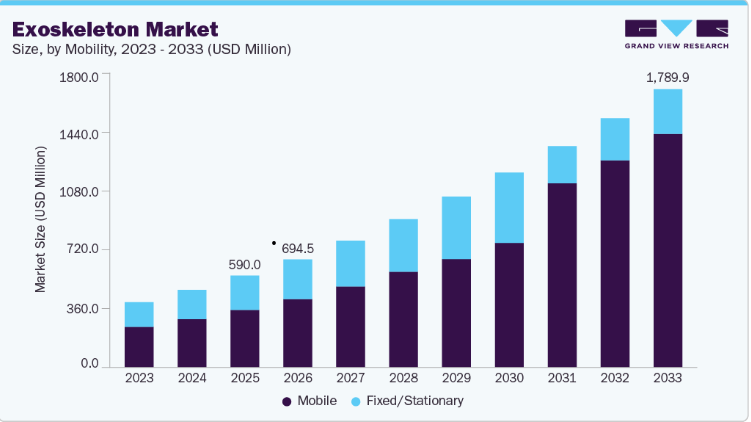
The global Exoskeleton Market is moving from a niche robotics technology toward a broader wearable-technology opportunity spanning healthcare, rehabilitation, military applications, manufacturing, logistics, automotive, and construction. As organizations seek ways to improve mobility, reduce physical strain, and enhance worker productivity, exoskeleton systems are gaining greater commercial relevance.
The global exoskeleton market was valued at USD 590.0 million in 2025 and is projected to reach USD 1,790.0 million by 2033, expanding at a 14.5% CAGR from 2026 to 2033. North America accounted for the largest revenue share at 44.1% in 2025, while Asia Pacific is expected to register the fastest growth during the forecast period.
Why Is the Exoskeleton Market Expanding?
Several developments are pushing exoskeleton technology beyond traditional rehabilitation environments.
- Growing geriatric population: Increasing age-related mobility challenges are creating demand for technologies that can support walking, balance, and physical independence.
- Rising spinal cord and neurological injuries: Rehabilitation applications are becoming an important area of adoption as healthcare providers explore robotic assistance for patients with severe mobility limitations.
- Workplace ergonomics: Manufacturing, logistics, automotive, and construction companies are increasingly interested in wearable systems that can reduce physical strain during repetitive or demanding tasks.
- Advances in robotics and AI: Sensors, artificial intelligence, motion analysis, and adaptive control technologies are making exoskeletons more responsive to individual movement patterns.
- Broader healthcare adoption: Hospitals and rehabilitation centers provide controlled environments where robotic systems can support repetitive therapy and monitored movement training.
The industry is therefore developing around two complementary needs: helping people regain or maintain mobility and helping workers perform physically demanding activities more safely.
Download a free sample report or claim your copy of this full market intelligence report
The Technology Story: Powered Systems Still Lead
Powered exoskeletons represented 71.40% of market revenue in 2025, supported by their ability to provide active assistance, improve lifting motion, and reduce physical strain.
At the same time, non-powered technology is gaining momentum. These systems can provide mechanical assistance without depending on an external power source, making them attractive where simplicity, weight, operating cost, and ease of deployment matter. The global non-powered segment is projected to grow at a 17.4% CAGR from 2025 to 2033.
This creates an interesting competitive landscape: powered systems are currently dominant, while lighter and more cost-conscious designs can open additional adoption opportunities.
Healthcare Remains the Core Application
Healthcare accounted for 48.76% of global exoskeleton market revenue in 2025, making it the leading end-use segment.
Exoskeletons can support rehabilitation programs involving:
- Spinal cord injury recovery
- Stroke rehabilitation
- Gait training
- Mobility assistance
- Neurological rehabilitation
- Physical therapy
The technology is also moving toward everyday mobility. In January 2026, RoboCT introduced its GoGo Exoskeleton series at CES 2026, highlighting the industry's movement from clinical rehabilitation toward daily-use mobility assistance.
From Hospitals to Factories: The Industrial Opportunity
The next major growth opportunity is emerging outside healthcare.
Industrial users are evaluating exoskeletons for activities involving lifting, carrying, overhead work, repetitive movements, and physically demanding operations. This is particularly relevant to manufacturing, logistics, automotive, and construction.
The global industry exoskeleton segment generated USD 115.6 million in 2025 and is projected to reach USD 425.0 million by 2033, representing a 17.1% CAGR.
This shift changes the market's value proposition. Instead of focusing only on rehabilitation outcomes, industrial exoskeletons can be evaluated around:
worker comfort + reduced physical strain + productivity + workplace ergonomics
German Bionic's Exia, unveiled in 2025, illustrates this direction by combining AI-based assistance with lifting support for applications across manufacturing, logistics, retail, and healthcare.
Mobility and Body Design Are Also Evolving
Mobile systems dominated the mobility category with a 62.64% revenue share in 2025, reflecting strong demand for wearable systems capable of supporting movement outside fixed rehabilitation environments.
Meanwhile, the lower-body segment accounted for 40.72% of revenue, highlighting the importance of walking, gait, and lower-extremity assistance. Upper-body applications are also creating opportunities as manufacturers address lifting, arm movement, and workplace ergonomics.
Regional Outlook
North America remains the market leader, supported by technological innovation, healthcare investment, military applications, and the presence of major exoskeleton developers. The U.S. market alone was valued at approximately USD 234.2 million in 2025 and is projected to reach USD 640.3 million by 2033.
Asia Pacific represents the fastest-growing regional opportunity. Expanding healthcare infrastructure, rehabilitation demand, industrial applications, and technological development are supporting adoption. India's exoskeleton market, for example, is projected to reach USD 16.8 million by 2033, growing at a 20.9% CAGR from 2026 to 2033.
Europe also remains important because of its medical-device ecosystem, industrial automation capabilities, and emphasis on workplace safety and advanced rehabilitation technologies.
Key Companies
Major companies operating in the Exoskeleton Market include:
- Ekso Bionics
- ARMASTEC PTE. LTD.
- Hocoma
- Lockheed Martin Corporation
- Suit X
- Rex Bionics Plc.
- RB3D
- ReWalk Robotics
- Cyberdyne, Inc.
- ActiveLink (Panasonic Corporation)
- DIH Medical
Competition is increasingly centered on AI integration, lightweight construction, personalized movement assistance, clinical validation, industrial ergonomics, and geographic expansion.
What Comes Next?
The future of the Exoskeleton Market will likely depend less on whether wearable robots work and more on where they can deliver measurable value at an acceptable cost.
Healthcare will remain a critical foundation, but industrial applications, consumer mobility, rehabilitation, and specialized military uses can broaden the addressable market. As systems become lighter, more intelligent, easier to operate, and better adapted to individual users, exoskeleton technology could become an increasingly familiar part of both healthcare and the workplace.
The market's projected expansion to USD 1.79 billion by 2033 signals that wearable robotics is moving toward a much broader commercial role.
About us:
Grand View Research, a market research and consulting company, provides syndicated research reports, customized research reports, and consulting services. Grand View Research database is used by the world's renowned academic institutions and Fortune 500 companies to understand the global and regional business environment. Our database features thousands of statistics and in-depth analysis on 46 industries in 25 major countries worldwide.

 English
 Arabic
 Spanish
 Portuguese
 Deutsch
 Turkish
 Dutch
Dutch
 Italiano
 Russian
 Romaian
 Portuguese (Brazil)
 Greek
Greek
