Thermal Power Plant Market Overview
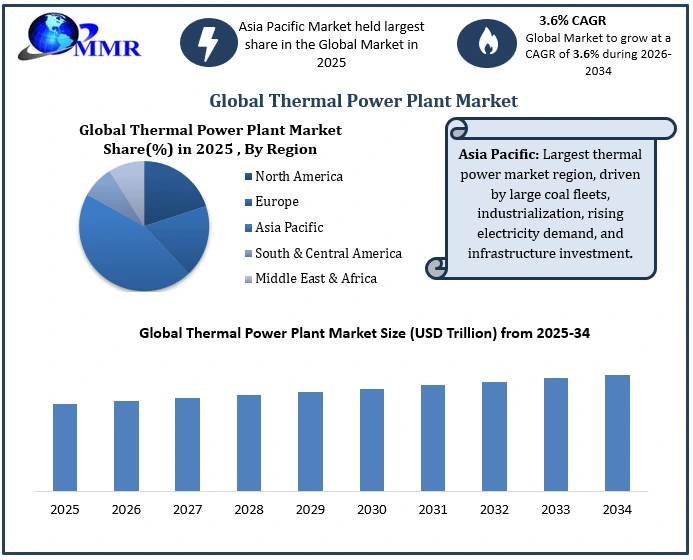
The global Thermal Power Plant Market is entering a period of transition in which efficiency, flexibility, reliability, and modernization are becoming as important as new generation capacity. According to Maximize Market Research, the market was valued at USD 1.57 trillion in 2025 and is estimated to reach USD 2.13 trillion by 2034, expanding at a CAGR of 3.6% during 2026–2034. Thermal power plants remain an important component of electricity systems because they can provide dispatchable generation when power demand rises or renewable output fluctuates. Growing electricity consumption, industrialization, expanding data-center infrastructure, and increasing requirements for grid stability are supporting investment in thermal generation, particularly in emerging economies. At the same time, the industry is facing structural pressure from renewable energy expansion, carbon-reduction policies, and changing power-generation economics. The result is a market increasingly focused on high-efficiency generation, flexible operation, retrofit programs, digitalization, and lower-emission technologies rather than conventional capacity expansion alone. MMR notes that global electricity demand increased by around 3% in 2025, adding nearly 800 TWh, highlighting the continuing need for dependable generation capacity.
𝐃𝐨𝐰𝐧𝐥𝐨𝐚𝐝 𝐅𝐫𝐞𝐞 𝐏𝐃𝐅 𝐁𝐫𝐨𝐜𝐡𝐮𝐫𝐞 @https://www.maximizemarketresearch.com/request-sample/318656/
Key Thermal Power Plant Market Segmentations
The Thermal Power Plant Market can be segmented by fuel type, capacity, turbine type, installation type, application, and region. By fuel type, the market includes Coal, Natural Gas, Oil, and Others. Coal remained the dominant fuel type in 2025 because of its extensive installed generation base and established fuel-supply infrastructure, particularly in China, India, and other Asian markets. However, natural gas is expected to experience stronger growth during 2026–2034, supported by its operational flexibility, relatively lower emissions intensity compared with coal, and ability to complement variable renewable generation.
By capacity, the market is categorized into Up to 400 MW, 400–800 MW, and More than 800 MW. Large-capacity plants continue to play an important role in utility-scale electricity generation, while smaller and mid-sized facilities can serve industrial, captive, and localized power requirements. Capacity selection depends on electricity demand, grid requirements, fuel availability, project economics, and the intended application.
By turbine type, the market is divided into Simple Cycle and Combined Cycle. Combined-cycle systems are gaining importance because they combine gas turbines and steam-cycle generation to achieve higher efficiency than conventional simple-cycle configurations. Their ability to respond to changing electricity requirements also makes them increasingly relevant in power systems with growing renewable penetration.
By installation type, the market includes New Installation and Retrofit / Modernization. While new projects continue to support market revenues, modernization is becoming a particularly important opportunity as operators seek to extend plant lifetimes, improve efficiency, reduce emissions, and introduce advanced control and monitoring systems into existing facilities. By application, the market covers Utility-Scale Power Generation, Industrial / Captive Power, Commercial, and Others. Utility-scale generation remains central to the industry, while industrial and captive facilities provide demand from energy-intensive manufacturing operations.
Rising Global Electricity Demand Driving Market Growth
One of the fundamental growth drivers is the continuing increase in global electricity consumption. Electricity demand is being stimulated by industrial expansion, urbanization, increased appliance ownership, electric vehicles, cooling requirements, heat pumps, and digital infrastructure. MMR reports that global electricity demand grew by around 3% in 2025 and notes that the IEA expects demand growth of 3.6% in 2026 and 3.8% in 2027.
Thermal power plants remain valuable in markets where electricity systems require dependable and dispatchable generation. This is particularly important when renewable generation cannot fully match demand because of weather conditions or time-of-day variations. Consequently, thermal generation is increasingly being evaluated not only for its baseload contribution but also for its ability to provide firm capacity, reserve power, and grid-balancing services.
Data Centers and AI Infrastructure Create New Power Demand
The rapid expansion of artificial intelligence and data-center infrastructure is emerging as another important factor influencing thermal generation. MMR estimates that global data-center electricity consumption could more than double from approximately 460 TWh in 2024 to 945 TWh by 2030.
Data centers require highly reliable electricity supplies because interruptions can affect computing operations and critical digital services. This requirement is encouraging interest in dispatchable generation, particularly natural-gas-fired power plants and other technologies capable of supporting high-load facilities. Recent industry developments reinforce this trend: Siemens Energy reported strong 2026 demand for gas turbines associated with AI data centers and major infrastructure projects in the Middle East.
Natural Gas and Combined-Cycle Generation Gain Importance
Natural gas is becoming an increasingly significant part of the thermal power landscape. According to the IEA, global gas-fired generation is forecast to grow at an average annual rate of 2.6% during 2026–2030, while coal-fired generation is expected to contract by approximately 0.9% annually over the same period.
This shift reflects the growing importance of flexible generation. Gas turbines can respond more quickly to changes in electricity demand and renewable output, making them useful for grids with increasing shares of solar and wind power. Combined-cycle plants further improve fuel utilization by capturing heat from gas-turbine exhaust and using it to produce additional electricity.
Plant Modernization and Flexible Operations
Modernization is becoming a major opportunity across the Thermal Power Plant Market. Existing plants can be upgraded through improved turbines, boilers, generators, emissions-control equipment, digital monitoring systems, automation, predictive maintenance, and enhanced control systems. These upgrades can improve operating efficiency while extending asset life.
Another important trend is the movement from traditional baseload operation toward flexible thermal generation. Thermal plants increasingly need to ramp up and down in response to renewable output and changing electricity demand. This creates demand for equipment and software capable of handling more frequent operational changes while maintaining reliability.
In India, for example, the Central Electricity Authority has proposed a two-shift operating model for 151 aging coal-fired power units with a combined capacity of 34.5 GW, with the objective of helping integrate surplus renewable electricity and improving grid flexibility.
Digitalization and Efficiency Improvements
Digital technologies are becoming increasingly important in thermal plant operations. Advanced sensors, predictive analytics, artificial intelligence, remote monitoring, automated controls, and digital twins can help operators identify equipment problems earlier and optimize plant performance. Digitalization can also support predictive maintenance by identifying unusual equipment behavior before failures occur.
The integration of digital systems with turbines, boilers, generators, cooling systems, and emissions-control equipment is helping transform thermal power plants into more data-driven facilities. This trend is particularly relevant for aging plants where operators need to improve performance without completely replacing existing infrastructure.
Decarbonization Creates Both Challenges and Opportunities
The transition toward renewable and low-carbon electricity represents one of the major challenges for thermal generation. Renewable capacity additions reached a record 692 GW in 2025, representing 85.6% of total global capacity additions, according to MMR. The IEA also reports that renewable and nuclear generation growth exceeded the overall increase in global electricity generation in 2025, while fossil-fuel generation declined slightly.
Nevertheless, thermal generation is not disappearing uniformly. Instead, the market is increasingly moving toward cleaner and more flexible technologies, including efficient natural-gas generation, carbon-capture integration, alternative fuels, and modernization of existing facilities. MMR identifies hydrogen and ammonia co-firing, carbon capture, plant retrofits, and combined-cycle natural-gas facilities as important opportunity areas.
𝐃𝐨𝐰𝐧𝐥𝐨𝐚𝐝 𝐅𝐫𝐞𝐞 𝐏𝐃𝐅 𝐁𝐫𝐨𝐜𝐡𝐮𝐫𝐞 @https://www.maximizemarketresearch.com/request-sample/318656/
Regional Market Outlook
Asia Pacific represents the leading regional market, supported by large electricity demand, industrialization, extensive coal-fired generation fleets, and continued investment in power infrastructure. China and India remain particularly important markets because of their substantial electricity requirements and large installed thermal generation bases. However, the regional power mix is changing as renewable energy expands. The IEA reported that coal-fired electricity output declined in both China and India in 2025, marking the first simultaneous decline in five decades.
North America is witnessing growing interest in gas-fired generation, particularly because of increasing electricity consumption from data centers and AI infrastructure. Europe is experiencing stronger pressure to reduce fossil-fuel generation, although energy-security considerations continue to influence thermal plant operations. South America represents an emerging market, while the Middle East and Africa offer opportunities associated with industrial development, energy infrastructure expansion, and rising electricity demand.
Recent Developments in the Thermal Power Plant Market
Recent developments demonstrate the industry's shift toward flexible and high-efficiency generation. In August 2026, Siemens Energy announced plans to focus more strongly on gas turbines and electrical grids, reflecting strong demand associated with data centers, AI, and grid infrastructure. GE Vernova's gas-power backlog and slot reservations reached 116 GW in July 2026, with production targeted at 30 GW annually by 2030. MMR also highlights a 2.5 GW gas-plus-nuclear project in Texas being advanced by GE Vernova Hitachi and Blue Energy, with a final investment decision targeted for 2027.
In February 2026, Siemens Energy committed USD 1 billion toward expanding U.S. gas-turbine and grid-equipment manufacturing, supporting the broader expansion of gas-generation and power-infrastructure capacity. These developments indicate that thermal power investment is increasingly being connected with grid expansion, large industrial loads, AI infrastructure, and the need for reliable electricity.
Competitive Landscape
The Thermal Power Plant Market includes major global engineering, turbine, power-generation, and equipment companies. Key players identified by MMR include GE Vernova, Siemens Energy, Mitsubishi Heavy Industries, Doosan Enerbility, Harbin Electric, Dongfang Electric, Shanghai Electric, NTPC, BHEL, and other regional power-generation and engineering companies.
Competition is increasingly focused on turbine efficiency, combined-cycle technology, digital plant management, emissions reduction, modernization services, flexible operation, and long-term maintenance contracts. Companies with strong engineering capabilities and global service networks are positioned to benefit from both new projects and the modernization of existing thermal facilities.
For full access to the comprehensive strategic report, visit:https://www.maximizemarketresearch.com/market-report/thermal-power-plant-market/318656/
Future Outlook
The global Thermal Power Plant Market is expected to grow from USD 1.57 trillion in 2025 to USD 2.13 trillion by 2034, registering a 3.6% CAGR during 2026–2034. The market's future will be shaped by a combination of rising electricity demand, data-center expansion, energy security requirements, renewable integration, emissions policies, and technological modernization. Rather than following a simple expansion-or-decline trajectory, thermal power is moving toward a more selective model centered on high-efficiency gas generation, flexible capacity, plant retrofits, digital technologies, emissions-reduction solutions, and lifecycle services. As electricity systems become increasingly diversified, thermal plants that can operate efficiently, respond quickly to changing grid conditions, and integrate with cleaner energy technologies are likely to remain strategically important in the global power-generation landscape.


 English
 Arabic
 Spanish
 Portuguese
 Deutsch
 Turkish
 Dutch
Dutch
 Italiano
 Russian
 Romaian
 Portuguese (Brazil)
 Greek
Greek
