Selecting the right Tattoo Removal in Dubai is the most critical factor in ensuring that your skin returns to its natural state without permanent damage. In a region where aesthetic standards are exceptionally high, "specialist" care implies more than just owning a laser; it signifies a deep mastery of laser physics, skin anatomy, and the biological process of ink elimination. Unlike general beauty centers, medical specialists in Dubai operate within a clinical framework that prioritizes the "No-Scar" protocol. This means every pulse of energy is calculated to shatter ink while preserving the delicate dermal matrix. By choosing a dedicated clinical environment, you are opting for a roadmap to clear skin that is governed by safety, transparency, and the latest global advancements in dermatological science.
The hallmark of a specialist is the ability to treat complex, multi-colored tattoos on diverse skin tones (Fitzpatrick I-VI) with absolute precision and predictable outcomes.
The Role of a Medical Laser Specialist
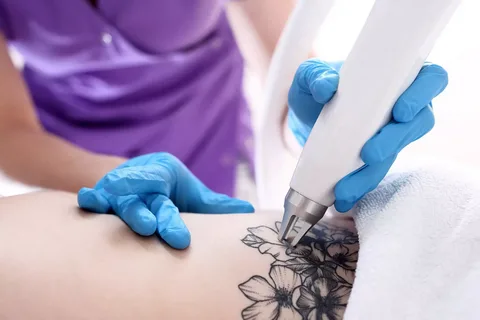
A specialist does not just "fire" a laser; they perform a real-time clinical assessment during every minute of your session.
What does specialist-led treatment feel like? During your session, the specialist will constantly monitor your skin's "End-Point" reaction. You may notice them adjusting the "Spot Size" or the "Fluence" as they move across different parts of the tattoo. Based on post-procedure follow-ups, we observe that patients feel much more secure when the practitioner explains these adjustments. The sensation is controlled and rhythmic. Specialist clinics also use "Active Cooling" systems that synchronize with the laser, making the experience feel significantly more refined and less "sharp" than in a standard setting.
Why Specialist Care is Mandatory for Permanent Results
Achieving 100% clearance of a tattoo requires a level of expertise that goes beyond basic operation:
-
Differential Diagnosis: Specialists can distinguish between "Ink Shadowing" and "Existing Scarring" from the original tattoo process, ensuring the treatment plan addresses both.
-
Paradoxical Darkening Management: Certain cosmetic inks (like those in permanent makeup) can turn black when hit by a laser. Specialists know how to identify these "oxidizing" pigments before they are treated.
-
Lymphatic Optimization: A specialist provides medical advice on how to boost your body's ability to "flush" the ink, including hydration protocols and activity recommendations.
-
Customized Wavelengths: Access to a full suite of Pico-second (1064nm, 532nm, 755nm) lasers ensures that even stubborn greens and yellows are targeted effectively.
Realistic Recovery: The Specialist-Guided Timeline
Specialist care extends into the "Home Recovery" phase, providing you with medical-grade topicals to ensure your skin heals without texture changes.
-
Phase 1 (The First 48 Hours): Use of specialized "Barrier Repair" ointments to prevent infection and soothe the "thermal" sensation.
-
Phase 2 (Days 3–7): Monitoring for any "Photo-Acoustic" blistering, which specialists manage with clinical dressings if necessary.
-
Phase 3 (Weeks 2–8): The "Immune Clearance" phase, where the specialist evaluates your fading progress via high-resolution photos for the next session's calibration.
"I went to a small shop first and it was a disaster—my skin felt like it was on fire. Then I found a specialist in Dubai. The difference was night and day. They used a cooler, they checked my skin every two minutes, and most importantly, the tattoo is finally disappearing safely." — Sultan
Information Gain: The "Laser End-Point" Expertise
A critical technical skill of a specialist in 2026 is identifying the "Clinical End-Point." When a laser hits a tattoo, the skin reacts in specific ways: "Frosting" (white steam), "Purpura" (minor bruising), or "Erythema" (redness). A general technician might stop at the first sign of frosting, but a specialist knows that different colors and depths require different end-points. For instance, deep black ink requires a "Snap" sound and instant frosting, whereas treating red ink with a 532nm wavelength requires a much "softer" end-point to avoid damaging the skin's natural pigment. This "Visual Intelligence" is what prevents scars and ensures that your tattoo removal is truly permanent and aesthetically perfect.
"The specialist explained that the 'white' I saw on my skin was actually a good sign of the ink breaking. She adjusted the laser for the red parts of my tattoo because they needed a different 'touch.' My skin looks great, and the red is almost gone." — Maya
Why Choose Tajmeels Clinic?
At Tajmeels Clinic, our tattoo removal department is led by specialists who are recognized for their expertise in laser dermatology. As part of Burjeel Holdings, we adhere to the highest international medical standards, utilizing only FDA-approved Pico-second and Nd:YAG technologies. We don't believe in "one-size-fits-all" settings; every patient receives a customized "Ink Clearance Roadmap" based on their specific skin biology and tattoo history. By combining advanced medical cooling, AI-assisted planning, and specialist-led execution, we ensure that your path to a clear, ink-free appearance is the safest and most effective journey available in the UAE.
FAQs
Can a specialist remove a tattoo "faster" than a regular clinic?
Yes, often. Because specialists use higher-quality, medical-grade lasers (like the Enlighten PICO) and can safely use higher energy settings, they can shatter more ink in a single session. This typically results in fewer total sessions being needed to reach 100% clearance.
Is specialist removal more expensive?
The price per session may be slightly higher due to the medical expertise and advanced technology involved. However, because you usually need fewer sessions and have a much lower risk of needing "corrective" treatments for scars or pigment loss, the total cost is often more economical in the long run.
Can specialists treat tattoos on the face or neck safely?
Yes. The skin on the face and neck is thinner and has a higher blood supply, making it more sensitive but also faster to heal. Specialists use "Large Spot Sizes" and specific wavelengths to ensure these delicate areas are treated with absolute safety.
What if I have a "Traumatic Tattoo" from an accident?
Specialists are uniquely qualified to treat "Traumatic Tattoos" (where dirt or asphalt is forced into the skin). These require a medical assessment to ensure no foreign bodies are trapped before the laser is used to shatter the "accidental" pigment.
Do I need a doctor's referral for specialist removal?
No referral is necessary. You can book a direct consultation with our laser specialists. We will perform a full skin and tattoo analysis during your first visit to determine if you are a candidate for our advanced removal protocols.
Why is a medical-grade laser so much better?
Medical-grade lasers have "Beam Uniformity," meaning the energy is spread perfectly across the laser spot. Cheaper, cosmetic lasers often have "Hot Spots" in the beam, which can cause localized burns or "Pinpoint Scarring." Beam uniformity is the secret to a perfectly smooth, clear result.


 English
 Arabic
 French
 Spanish
 Portuguese
 Deutsch
 Turkish
 Dutch
Dutch
 Russian
 Romaian
 Portuguese (Brazil)
 Greek
Greek