
North America Smart Space Market Analysis: Key Drivers, Emerging Technologies, and Forecast 2025–2031
The North America Smart Space Market is being shaped by IoT integration, smart building automation, advanced sensors, and data-driven facility management. Increasing emphasis on energy efficiency and operational optimization is expected to strengthen regional market growth.
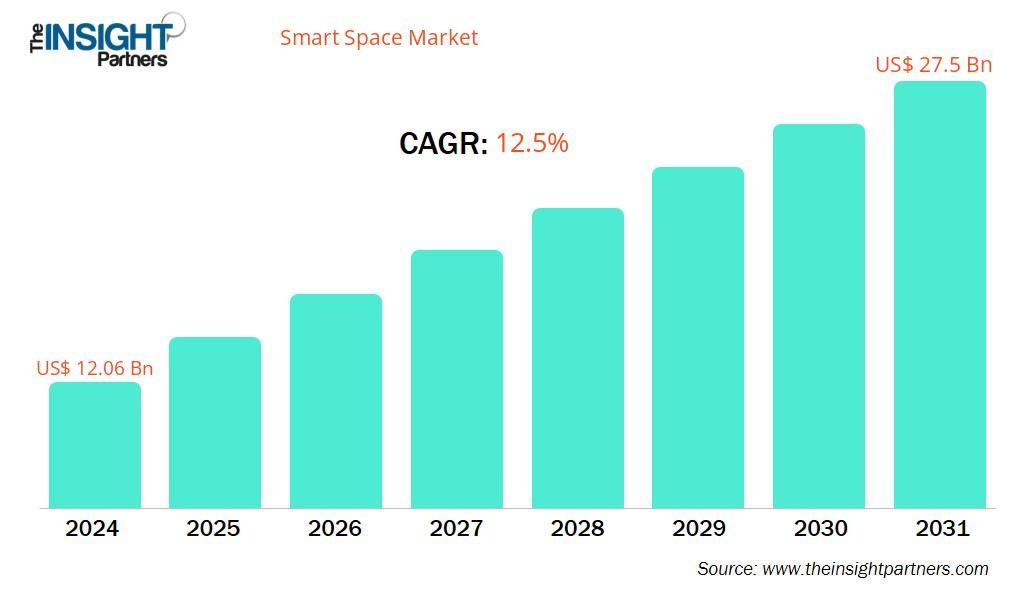
According to The Insight Partners, The Smart Space Market size is expected to reach US$ 27.5 Billion by 2031. The market is anticipated to register a CAGR of 12.5% during 2025–2031.
Get Sample PDF@ https://www.theinsightpartners.com/sample/TIPRE00005027
Key Smart Space Market Growth Drivers
One of the major factors supporting the Smart Space Market is the proliferation of IoT. IoT devices provide the connectivity required to monitor and control different aspects of a building or environment. Sensors can collect information related to occupancy, temperature, lighting, energy consumption, equipment performance, and security. Organizations can use this information to optimize operations and respond to changing conditions.
Another important driver is the growing focus on green building initiatives and environmental concerns. Businesses and governments are increasingly looking for ways to reduce energy consumption, improve resource efficiency, and lower the environmental impact of buildings. Smart energy management solutions can help organizations monitor consumption and optimize heating, cooling, lighting, and other systems.
Smart spaces can also contribute to improved occupant experiences. In commercial environments, connected technologies can support intelligent room management, workplace automation, access control, and environmental monitoring. In residential settings, smart technologies can provide automated lighting, security, energy management, and connected home functions.
Role of Smart Technologies in Modern Buildings
Smart spaces combine hardware, software, connectivity, and data analytics to create responsive environments. Sensors and connected devices act as data collection points, while software platforms help interpret information and support operational decisions. Automation allows selected systems to respond to predefined conditions without requiring continuous human intervention.
For example, occupancy sensors can help determine whether a room or facility is being used. Building management systems can use this information to adjust lighting or environmental controls. Security systems can combine cameras, sensors, access-control technologies, and analytics to improve monitoring.
The integration of these technologies is particularly valuable for large commercial buildings, offices, campuses, healthcare facilities, retail properties, and other complex environments where efficient management of multiple systems is essential.
Smart Space Market Segmentation
By Component
Based on component, the Smart Space Market is segmented into solutions and services. Solutions include technology platforms and systems designed to manage, monitor, secure, and optimize smart environments. Services support implementation, integration, maintenance, consulting, and other requirements associated with smart space deployments.
The demand for integrated solutions is expected to remain important as organizations seek technologies that can connect different systems and provide centralized visibility into operations.
By Premises
Based on premises, the Smart Space Market is segmented into commercial, residential, and others. Commercial premises represent an important application area because businesses increasingly require connected workplaces that improve operational efficiency and employee experiences.
Residential smart spaces are also developing as consumers adopt connected home technologies. Meanwhile, other premises can include environments where intelligent monitoring, automation, security, and resource optimization provide operational advantages.
By Application
The application segment includes energy management and optimization, emergency management, security management, and others. Energy management solutions help organizations monitor and optimize resource consumption. Emergency management technologies can assist with monitoring and response during critical situations.
Security management is another significant application, incorporating connected surveillance, access control, monitoring, and intelligent detection capabilities. As security requirements become more sophisticated, organizations are increasingly integrating physical and digital technologies into unified smart-space environments.
Smart Space Market Regional Outlook
The Smart Space Market spans North America, Europe, Asia-Pacific, South and Central America, and the Middle East and Africa. The market analysis also considers country-level developments and regional trends.
North America is an important market because of its mature technology ecosystem, adoption of connected infrastructure, and strong focus on building automation and security. Organizations across commercial and institutional environments continue to explore smart technologies to improve efficiency and operational visibility.
Europe is supported by growing attention to energy efficiency, sustainability, building modernization, and intelligent infrastructure. Smart solutions can help organizations address resource-efficiency objectives while improving building management.
Asia-Pacific presents significant opportunities because of urbanization, infrastructure development, expanding commercial facilities, and increasing technology adoption. Countries such as China, India, Japan, and Australia are included in the regional analysis.
The Middle East and Africa and South and Central America also represent emerging opportunities as businesses and governments invest in modern infrastructure, connected buildings, energy optimization, and security technologies.
Smart Space Market Challenges
Despite its growth potential, the Smart Space Market faces challenges, including high initial capital expenditure. Implementing a smart environment can require investment in sensors, connectivity infrastructure, software platforms, security systems, integration, and professional services. These costs can make adoption more difficult for organizations with limited technology budgets.
Integration complexity can also be a challenge. Smart environments frequently involve multiple technologies and vendors, making interoperability and centralized management important considerations. Organizations must also consider cybersecurity, data management, system maintenance, and workforce requirements when deploying connected environments.
Competitive Landscape
The Smart Space Market includes technology and industrial companies offering connected solutions, infrastructure, automation, analytics, and related services.
- Cisco Systems, Inc.
- Coor
- Huawei Technologies Company Ltd.
- Hitachi Vantara Corporation (Hitachi Ltd.)
- Iconics Inc.
- IBM Corporation
- Schneider Electric SE
- Siemens AG
- SmartSpace Software Plc
- Ubisense
Market participants are pursuing both organic and inorganic growth strategies. Product launches, partnerships, collaborations, acquisitions, patents, and industry events can help companies expand their technology capabilities and customer bases. The competitive environment is therefore expected to evolve as vendors develop increasingly integrated solutions for intelligent buildings and connected environments.
Future Outlook for the Smart Space Market
The future of the Smart Space Market is closely connected with the continued development of IoT, automation, artificial intelligence, sensing technologies, and connected infrastructure. As buildings and environments become increasingly digitized, organizations are likely to place greater emphasis on real-time monitoring, predictive operations, energy optimization, security, and occupant experience.
About The Insight Partners
The Insight Partners delivers market intelligence and consulting services to help clients make informed decisions. The firm covers industries such as Aerospace and Defense, Automotive and Transportation, Semiconductor and Electronics, Biotechnology, Healthcare IT, Manufacturing, Medical Devices, Technology, Media, and Chemicals and Materials.
Contact Us
Email: sales@theinsightpartners.com
Website: www.theinsightpartners.com
Phone: +1-646-491-9876
Also Available in :

 English
 Arabic
 French
 Spanish
 Portuguese
 Deutsch
 Turkish
 Dutch
Dutch
 Italiano
 Russian
 Portuguese (Brazil)
 Greek
Greek
