
Industrial Laundry Equipment ROI: How Much Daily Volume Do You Need to Justify the Investment?
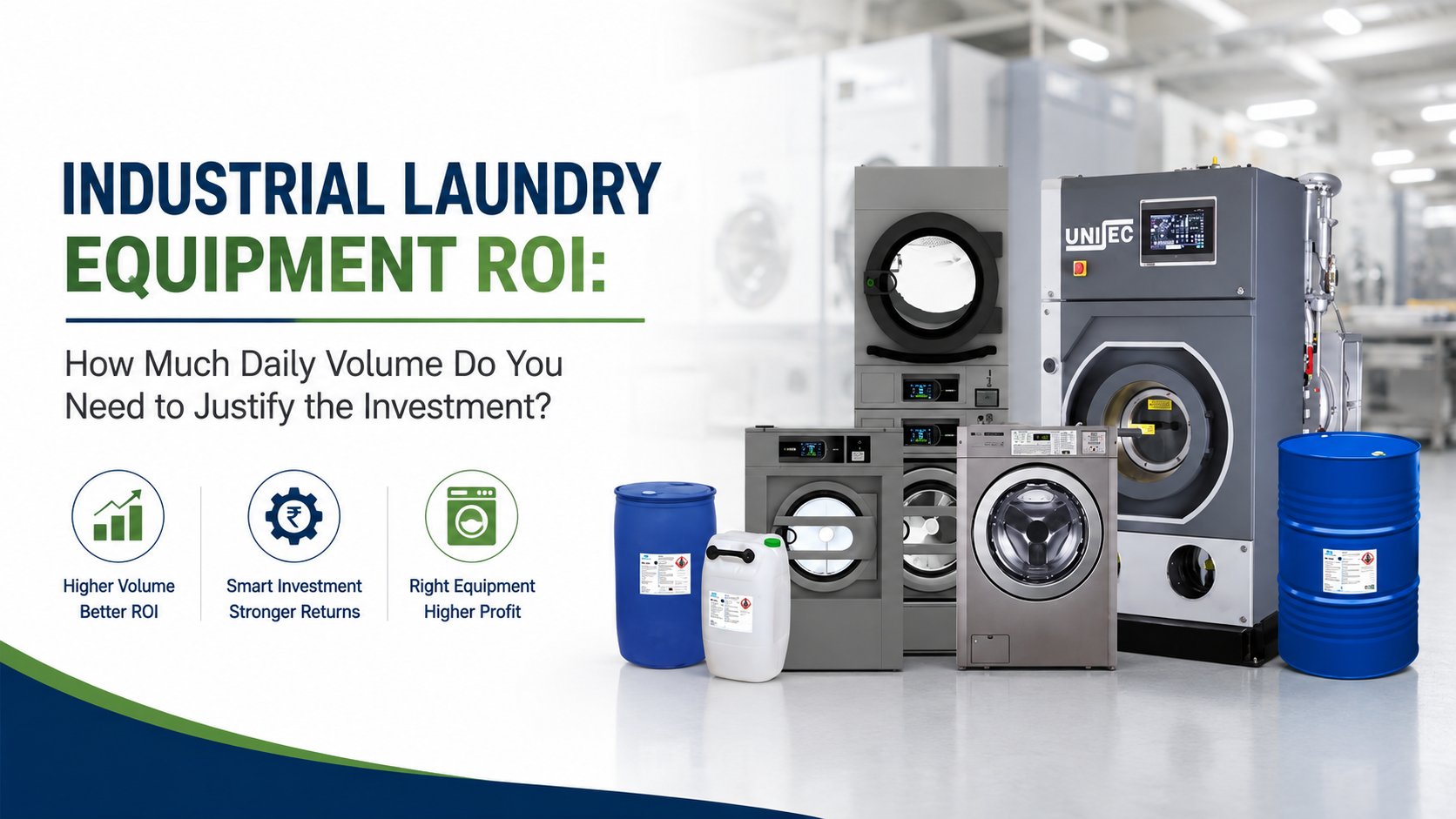
Investing in industrial laundry equipment can help build a high-capacity laundry operation capable of serving hotels, hospitals, institutions, restaurants, and other commercial clients. But buying larger machines does not automatically create a profitable business.
The real question is whether your daily laundry volume can keep that equipment productive enough to justify the investment.
Before setting up or expanding a laundry plant, business owners should understand expected KG per day, machine utilization, operating costs, pricing, and customer contracts. These factors determine whether equipment becomes a productive asset or expensive unused capacity.
What Is Industrial Laundry Equipment?
Industrial laundry equipment refers to machines designed for professional, high-volume laundry processing. Depending on the operation, an industrial laundry setup may include washer extractors, tumble dryers, flatwork ironers, presses, finishing machines, chemical dosing systems, and supporting equipment.
Unlike equipment selected for occasional use, an industrial laundry machine should be chosen around consistent workload, operating hours, linen type, and required turnaround time.
The objective is not simply higher capacity—it is reliable production at a commercially viable cost.
Why Is ROI Important Before Investing in Laundry Equipment?
Laundry equipment ROI tells you whether the expected earnings from your operation can reasonably support the capital invested.
Suppose you build a high-capacity plant but process only a small amount of laundry every day. Even if the machines perform well, a large part of your available production capacity remains unused.
Before investing, ask:
How much laundry can I realistically process and sell every day?
That question should come before deciding machine size.
How Much Does Industrial Laundry Equipment Cost?
There is no universal industrial laundry equipment price because every project is different.
Your total investment may depend on machine capacity, number of machines, heating systems, finishing requirements, automation, site preparation, electrical infrastructure, water systems, steam requirements, installation, and supporting equipment.
A better calculation is:
Total Laundry Plant Investment = Equipment + Installation + Utilities + Site Preparation + Supporting Systems
This gives a more realistic picture than looking only at the purchase price of an industrial washing machine.
What Determines the Return on Investment of a Laundry Plant?
Several factors influence laundry machine ROI:
- Daily KG processed
- Selling price per KG or contract
- Machine utilization
- Labour expense
- Water and energy consumption
- Chemical cost
- Rewash
- Maintenance
- Delivery and logistics
- Customer retention
Two laundries with identical equipment can therefore produce completely different financial results.
How Much Daily Laundry Volume Do You Need to Break Even?
There is no fixed KG/day figure that guarantees break-even.
Calculate your own break-even volume using:
Break-Even KG per Month = Monthly Fixed Costs ÷ Contribution per KG
Where:
Contribution per KG = Average Selling Price per KG − Variable Processing Cost per KG
Then:
Break-Even KG per Day = Break-Even Monthly KG ÷ Operating Days
For example, if a hypothetical laundry has ₹3,00,000 in monthly fixed costs and earns ₹15 contribution per KG:
₹3,00,000 ÷ ₹15 = 20,000 KG/month
At 26 operating days:
20,000 ÷ 26 ≈ 769 KG/day
This example is illustrative only. Your actual pricing and costs should be used before making an investment decision.
How Daily Laundry KG Affects Equipment ROI
Higher daily volume can improve equipment utilization because your capital investment is spread across more processed KG.
But volume alone is not enough.
A laundry processing 500 KG/day at poor margins may perform worse financially than a 300 KG/day operation with stronger pricing and better cost control.
Track:
Revenue per KG − Processing Cost per KG = Contribution per KG
The goal should be profitable volume rather than maximum volume.
What Happens If You Buy More Capacity Than You Need?
Oversizing commercial laundry equipment can leave expensive production capacity unused.
It may also increase the initial project budget and, depending on the selected equipment, affect space and utility requirements.
For example, buying equipment designed around significantly higher production than your confirmed demand may extend the time required to recover your investment.
Allow room for growth, but avoid paying for capacity you have no realistic plan to use.
What Happens If Your Equipment Capacity Is Too Small?
Undersizing creates the opposite problem.
Machines may need to operate for longer hours, production queues can increase, turnaround time can suffer, and taking larger contracts becomes difficult.
If a new hotel contract suddenly adds substantial daily linen volume, an undersized plant may struggle to absorb it.
The correct capacity should balance current demand + expected growth + practical operating hours.
How Much Laundry Volume Is Needed for a 100 KG/Day Setup?
If your expected workload is around 100 KG/day, do not assume you need a single machine capable of holding the entire day's volume.
Machines process multiple loads.
A useful starting calculation is:
Average Load Requirement = Daily Laundry KG ÷ Practical Loads per Day
If 100 KG is processed over five practical loads:
100 ÷ 5 = 20 KG average load
Actual machine selection must still account for textile type, sorting, load factors, cycle times, peak days, and model specifications.
How Much Laundry Volume Is Needed for a 300 KG/Day Setup?
At 300 KG/day, workflow becomes increasingly important.
Suppose the operation plans ten practical washing loads:
300 KG ÷ 10 = 30 KG average load
This does not automatically mean one 30 KG machine is the correct solution. Businesses must consider available operating hours, sorting requirements, backup capacity, drying throughput, and peak production.
Your dryer and finishing section must also be able to keep pace.
How Much Laundry Volume Is Needed for a 500 KG/Day Setup?
At around 500 KG/day, the operation starts requiring more deliberate production planning.
The question becomes:
How will 500 KG move through the complete plant within the required turnaround time?
Consider washer capacity, number of loads, industrial tumble dryer throughput, finishing requirements, operators, shift length, utilities, and dispatch schedules.
A 500 KG/day washing capacity has limited value if drying or finishing can process only a much smaller volume within the same working period.
Which Customers Generate the Fastest ROI?
No customer category automatically provides the fastest ROI.
Hotels can generate recurring linen volume. Hospitals and healthcare facilities can have substantial laundry requirements with specific process and hygiene procedures. Restaurants, banquet facilities, spas, gyms, institutions, and commercial clients can provide additional recurring workloads.
The stronger opportunity is usually a customer base that provides:
Consistent Volume + Sustainable Pricing + Predictable Payments + Operational Fit
This is more valuable than chasing volume alone.
Hotels vs Hospitals vs Commercial Clients: Which Is More Profitable?
Profitability depends on contract pricing, textile mix, processing requirements, service level, logistics, labour, rewash, and volume.
Industrial laundry equipment for hotels may need to handle large quantities of sheets, towels, pillowcases, restaurant linen, and banquet linen.
Industrial laundry equipment for hospitals may need to support the facility's required procedures for healthcare linen and workflow segregation.
Other commercial clients can have completely different volumes and turnaround expectations.
Compare contribution and operational requirements contract by contract rather than assuming one sector is always more profitable.
How Do Washer Extractors and Dryers Affect Profitability?
Washer extraction and drying should be considered together.
If linen leaves the washer with more residual moisture, the drying stage may require additional time and energy. Effective extraction can help reduce the drying burden for suitable textiles.
Likewise, an undersized dryer can become a bottleneck even when washing capacity is sufficient.
Your production line should therefore be planned as:
Washing → Extraction → Drying → Finishing → Dispatch
The slowest stage can limit overall plant output.
How Long Does It Take to Recover Industrial Laundry Equipment Investment?
Payback depends on how much contribution the business generates after operating costs.
A simplified formula is:
Estimated Payback Period = Total Relevant Investment ÷ Monthly Contribution Available for Investment Recovery
If a hypothetical laundry plant investment is ₹30 lakh and the operation generates ₹3 lakh per month available toward investment recovery, the simple payback would be approximately 10 months.
This is only an illustrative example and should not be treated as an expected investment, return, or payback period.
Common Mistakes That Delay Laundry Equipment ROI
A common mistake is buying machines before validating demand.
Other problems include oversizing, ignoring dryer and finishing capacity, underestimating utility requirements, poor pricing, excessive rewash, weak cost-per-KG tracking, and relying too heavily on one customer.
A successful commercial laundry business needs both production capacity and sufficient profitable demand.
How to Calculate ROI Before Buying Industrial Laundry Equipment
Build your investment decision in this order:
Expected Daily KG → Selling Price per KG → Processing Cost per KG → Contribution per KG → Monthly Volume → Monthly Contribution → Total Investment → Estimated Payback
You can also calculate:
ROI (%) = Annual Return Attributable to Investment ÷ Total Relevant Investment × 100
Use conservative volume estimates rather than assuming the plant will operate at full capacity immediately.
This provides a more realistic foundation for your laundry business investment.
How Orgaearth Can Help Plan the Right Laundry Investment
Orgaearth can help businesses evaluate industrial laundry equipment according to expected daily volume, customer type, operating hours, linen mix, available space, utilities, drying requirements, finishing requirements, and future expansion.
Instead of selecting machines independently, the objective is to build a balanced workflow where washing, drying, and finishing capacity support each other.
For entrepreneurs planning an industrial or commercial laundry setup, evaluating equipment against realistic KG/day requirements can help create a more practical investment plan.
Contact Us
Orgaearth Laundry Solutions
Plot no 774 Udyog Vihar, Phase 5, Gurugram, Haryana, India- 122016
Email: marketing@orgaearth.com
Contact No.- +91 7042912777
FAQs
How much daily volume do I need to justify industrial laundry equipment?
There is no universal minimum. Calculate your break-even KG using fixed costs, contribution per KG, operating days, and investment requirements.
Is industrial laundry equipment profitable for a new laundry business?
It can support a profitable operation when sufficient demand, appropriate pricing, cost control, machine utilization, and efficient workflow are in place.
How do I calculate laundry equipment ROI?
A basic calculation is ROI (%) = Annual Return Attributable to Investment ÷ Total Relevant Investment × 100. For investment planning, also calculate the estimated payback period.
Should I buy equipment based on current or future laundry capacity per day?
Use current validated demand as the foundation while allowing reasonable capacity for expected growth. Avoid significantly oversizing equipment based only on uncertain future contracts.
What should I check before investing in an industrial laundry setup?
Evaluate daily KG, customer contracts, washer and dryer throughput, finishing requirements, operating hours, utilities, space, labour, processing cost per KG, total equipment cost, service requirements, and expansion plans.

 English
 French
 Spanish
 Portuguese
 Deutsch
 Turkish
 Dutch
Dutch
 Italiano
 Russian
 Romaian
 Portuguese (Brazil)
 Greek
Greek
