
KRW 268.5 Billion Industrial Innovation Push Accelerates South Korea’s Shift Toward Automated Machine-Tending Cells
Rockville, MD— September 2, 2026 — South Korea’s Ministry of Trade, Industry and Resources announced KRW 268.5 billion for its Industrial Innovation Infrastructure Project in January 2026, including AI-based manufacturing infrastructure and shared facilities for testing, evaluation, certification, and demonstration. The investment comes as manufacturers across electronics and automotive production increase their focus on repeatable machine loading, creating a favorable environment for automated machine-tending cell deployment.
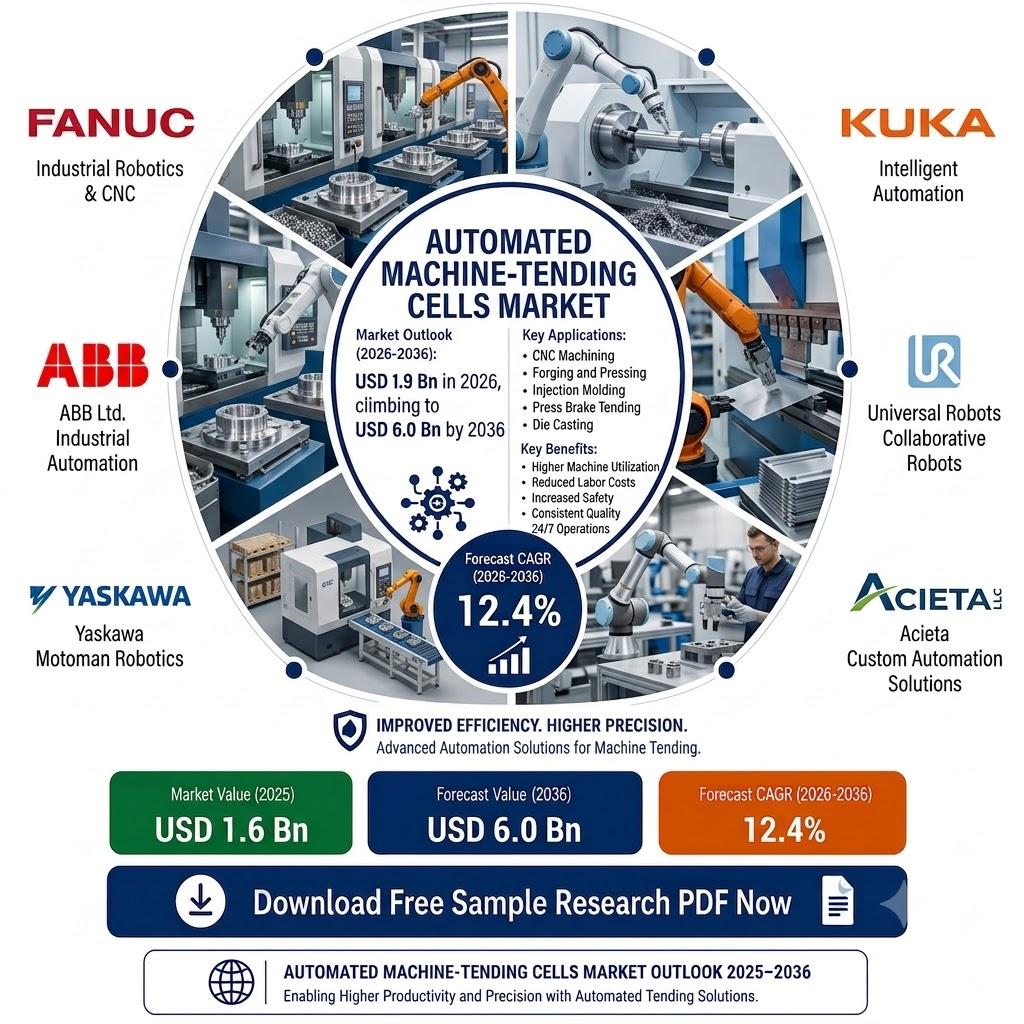
Fact.MR analysis indicates that this country-level manufacturing investment is part of a broader shift toward unattended and repeatable production operations. The global automated machine-tending cells market is estimated at USD 1.9 billion in 2026 and is projected to reach USD 6.0 billion by 2036, expanding at a 12.4% CAGR during the forecast period.
Get detailed market forecasts, competitive benchmarking, and pricing trends https://www.factmr.com/connectus/sample?flag=S&rep_id=16067
Why South Korea Is Becoming a Key Automation Market
South Korea is projected to register the fastest growth among the profiled countries, with a 14.5% CAGR from 2026 to 2036. Electronics and automotive factories provide a strong application base because many production steps require predictable loading, unloading, and part-transfer cycles.
The country's industrial modernization programs also create conditions in which machine communication, robotics integration, and automated production cells can move from isolated projects toward broader factory deployment.
This matters for suppliers because the opportunity is no longer limited to selling robot arms. Machine-tending projects increasingly require grippers, guarding, sensors, controls, CNC interfaces, commissioning, and ongoing service. The resulting value proposition shifts toward complete cell engineering rather than standalone robotic hardware.
CNC Machining Remains the Core Application
CNC machining is expected to account for 39.0% of the market in 2026, making it the leading machine-served category. Lathes and machining centers offer highly repeatable loading and unloading cycles, allowing manufacturers to directly evaluate the effect of automation on machine utilization.
Unattended CNC loading is identified as a major near-term demand driver, with an estimated +3.0% impact on CAGR. Machine shops can use robotic tending to keep production machines supplied between operator rounds and reduce periods in which expensive equipment remains idle.
Articulated robots are expected to hold 47.0% share in 2026, supported by their reach, payload flexibility, and ability to access different machine openings and fixtures. Fixed cells are forecast to capture 54.0% share, particularly where production volumes, machine positions, guarding, and part presentation remain stable.
Analyst Perspective
Shambhu Nath Jha, Principal Consultant at Fact.MR, said:
“Machine-tending cells draw attention because they convert a familiar manual task into a controlled production step. Acceptance is expected to depend on gripper proof, safety validation and CNC communication before a cell is released. Suppliers that combine application engineering with service response are better placed than vendors selling only a robot arm.”
The emphasis on gripper validation and machine communication is particularly relevant as manufacturers consider retrofitting older equipment. While robot hardware can be standardized across applications, the final production result depends heavily on tooling, part presentation, safety zones, and machine-interface engineering.
Market Snapshot
- 2026 market value: USD 1.9 billion
- 2036 forecast value: USD 6.0 billion
- 2026–2036 CAGR: 12.4%
- Absolute dollar opportunity: USD 4.10 billion
- Articulated robots: 47.0% share in 2026
- CNC machining: 39.0% share in 2026
- Fixed cells: 54.0% share in 2026
- Automotive: 30.0% share in 2026
- South Korea: 14.5% CAGR through 2036
What's Driving Near-Term Demand?
The strongest immediate driver is unattended CNC loading. Manufacturers are increasingly evaluating automation according to spindle idle time and the number of repetitive manual interventions that can be removed from production cycles.
Robot-to-machine communication is another structural factor. Older CNC equipment can require additional interface engineering before automated tending operates reliably, creating opportunities for system integrators capable of combining robotics, controls, tooling, and safety systems.
South Korea's January 2026 industrial infrastructure announcement reinforces this direction by allocating KRW 268.5 billion toward industrial innovation infrastructure, including AI manufacturing capabilities and shared testing and demonstration facilities.
At the same time, fixture and gripper engineering remains a constraint, identified with an estimated -1.3% impact on CAGR. Integrator availability and utilization uncertainty can also slow adoption, particularly among smaller manufacturers.
Where Does the Opportunity Extend Beyond Fixed Cells?
Multi-machine tending represents a notable medium-term opportunity. A single robot can potentially serve two production machines when cycle times, part presentation, and travel paths are appropriately balanced.
Mobile and redeployable cells also offer an alternative for manufacturers with changing product mixes. Rather than permanently dedicating automation equipment to one machine, manufacturers can redeploy a cell across CNC, finishing, or molding applications.
Retrofit automation represents another avenue for growth. Existing machine tools can remain productive assets while manufacturers add robotic loading and unloading capabilities instead of replacing the underlying production equipment.
Competitive Landscape
The competitive environment includes FANUC Corporation, KUKA AG, ABB Ltd., Yaskawa Electric Corporation, Universal Robots A/S, and Acieta LLC.
FANUC and KUKA demonstrate particularly direct relevance to machine-tending applications, while ABB and Yaskawa broaden the competitive field through robotic machining and material-handling solutions. Universal Robots contributes flexible collaborative robot applications, while Acieta brings system-integration expertise to automated cell deployments.
The competitive distinction is increasingly shaped by application engineering and service capabilities. Manufacturers evaluating automated tending must address robot selection alongside gripper changes, machine signals, guarding, safety validation, and production release.
About the Report
The Automated Machine-Tending Cells Market study evaluates the market across robot type, machine served, cell type, end-use industry, and region. Coverage includes articulated robots, collaborative robots, SCARA and other robot types; CNC machining, injection moulding, presses and stamping, and grinding and finishing; fixed and mobile/redeployable cells; and automotive, metals and machinery, plastics, and electronics end uses.
The study covers North America, Latin America, Europe, East Asia, South Asia and Pacific, and the Middle East and Africa, with detailed country analysis for South Korea, the United States, France, Germany, Japan, and Italy.
Key companies profiled include FANUC Corporation, KUKA AG, ABB Ltd., Yaskawa Electric Corporation, Universal Robots A/S, and Acieta LLC.
The analysis uses a hybrid top-down and bottom-up approach incorporating machine-tool automation demand, CNC and molding cell adoption, automotive and metalworking production requirements, country manufacturing indicators, integrator activity, robot portfolio reviews, and company-development validation. The research draws on 120+ sources, 35+ company portfolios, 25+ countries, and more than 20 industry interviews.
To view related Reports

 English
 Arabic
 French
 Spanish
 Portuguese
 Deutsch
 Turkish
 Italiano
 Russian
 Romaian
 Portuguese (Brazil)
 Greek
Greek
