India Beta-Glucan Market: Growth, Segmentation, Drivers, Trends and Recent Developments
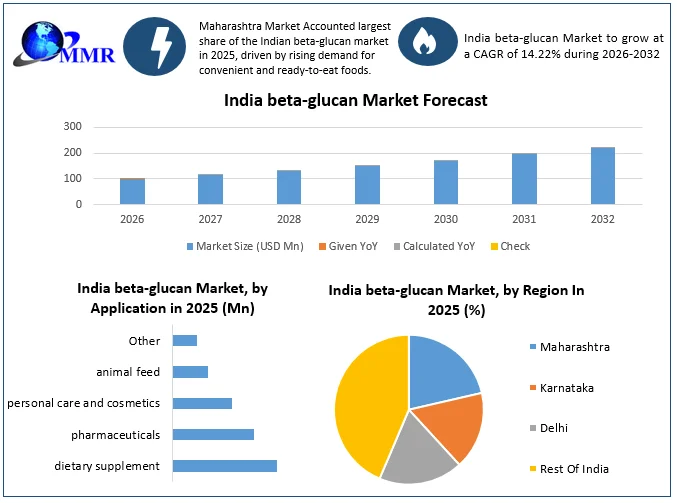
The India Beta-Glucan Market is emerging as a high-growth segment within the country's functional food, nutraceutical, pharmaceutical, personal care, and animal nutrition industries. Beta-glucan is a naturally occurring polysaccharide found in sources such as yeast, oats, barley, mushrooms, and seaweed. Its recognized functional properties, including support for immune health, cardiovascular wellness, cholesterol management, digestive health, and blood sugar management, are increasing its attractiveness among Indian manufacturers and consumers. According to Maximize Market Research, the India Beta-Glucan Market was valued at approximately USD 86.4 million in 2025 and is projected to reach USD 218.7 million by 2032, expanding at a CAGR of 14.22% during 2026–2032. The rapid expansion of India's nutraceutical sector, increasing awareness of preventive healthcare, rising disposable incomes, and the growing availability of health-oriented products through online channels are expected to support market development throughout the forecast period.
𝐃𝐨𝐰𝐧𝐥𝐨𝐚𝐝 𝐅𝐫𝐞𝐞 𝐏𝐃𝐅 𝐁𝐫𝐨𝐜𝐡𝐮𝐫𝐞 @https://www.maximizemarketresearch.com/request-sample/317049/
India Beta-Glucan Market Segmentation
The India Beta-Glucan Market can be segmented by source, application, purity level, form, functionality, and distribution channel. By source, the market includes yeast-based beta-glucan, oat-based beta-glucan, barley-based beta-glucan, mushroom-based beta-glucan, seaweed-based beta-glucan, and other sources. Yeast beta-glucan currently represents the leading source category, accounting for around 34.2% of the market, supported by its cost competitiveness, functional properties, and applications in dietary supplements and animal nutrition. Mushroom beta-glucan is expected to record comparatively rapid growth as consumers increasingly associate mushrooms with natural wellness, immunity, and functional nutrition.
By application, the market is divided into food and beverages, dietary supplements, pharmaceuticals, animal feed, cosmetics and personal care, and other applications. Dietary supplements represent the largest application segment, accounting for approximately 38.4% of the Indian market, as consumers increasingly seek convenient products for immune support, cardiovascular health, digestive wellness, and preventive nutrition. Food and beverages are another major application area, with beta-glucan being incorporated into cereals, bakery products, functional beverages, dairy products, snacks, and other fortified products. Globally, food and beverage applications remain an important demand centre because beta-glucan can be incorporated into functional products while adding nutritional and fibre-related value.
The pharmaceutical segment also offers considerable potential because beta-glucan is being investigated and utilized for immunomodulatory and cholesterol-management applications. Meanwhile, cosmetics and personal care manufacturers are exploring beta-glucan for formulations associated with skin barrier support, soothing, hydration, and anti-ageing positioning. The animal feed segment is gaining attention because beta-glucan can be used in poultry and aquaculture nutrition to support immune-related functions and reduce dependence on conventional approaches to animal health.
By form, the market is segmented into powder, liquid, capsules, tablets, and granules. Powder remains particularly attractive for ingredient manufacturers because of its versatility and compatibility with functional food, beverage, nutraceutical, and supplement formulations. Capsules and tablets are especially relevant to dietary supplement brands because they provide convenient dosage formats, while liquid beta-glucan can be incorporated into beverages and liquid nutritional products. By functionality, applications include immune support, cholesterol reduction, digestive health, blood sugar management, cardiovascular health support, and other benefits.
Distribution channels comprise supermarkets and hypermarkets, pharmacies and drug stores, online retail, specialty stores, and direct sales. Online retail is a particularly important growth channel in India and accounts for approximately 52.6% of distribution, according to Maximize Market Research. The growth of e-commerce, digital health platforms, online pharmacies, direct-to-consumer brands, and quick delivery services is improving access to specialized nutritional products beyond traditional metropolitan markets.
Rising Demand for Preventive Healthcare
One of the strongest growth drivers for the India Beta-Glucan Market is the growing focus on preventive healthcare and wellness. Indian consumers are increasingly moving beyond treatment-oriented healthcare toward nutrition and lifestyle practices intended to support long-term health. Beta-glucan benefits align with several of these priorities, particularly immune health, heart health, digestive wellness, and cholesterol management.
The country's expanding middle class is also increasing expenditure on health foods, dietary supplements, functional beverages, and premium nutritional products. Urban consumers, particularly younger working-age groups, are increasingly interested in convenient products that combine nutrition with everyday consumption. This is creating opportunities for beta-glucan to move beyond specialist supplements and into mainstream foods, beverages, snacks, and nutritional products.
Expansion of the Nutraceutical Industry
The rapid development of India's nutraceutical and functional food industry is another significant driver. Manufacturers are introducing products designed around immunity, gut health, cardiovascular wellness, sports nutrition, and general vitality. Beta-glucan provides an opportunity for brands to differentiate products through scientifically supported functional ingredients.
The growth of organized retail and e-commerce is simultaneously making these products more accessible. Online platforms allow consumers to compare formulations, ingredient lists, product claims, prices, and customer reviews before purchasing. This is particularly useful for relatively unfamiliar ingredients such as beta-glucan, as digital channels can also support educational marketing and explain the nutritional benefits of the ingredient. Research also indicates that India's expanding e-retail ecosystem, rising smartphone usage, and increasing purchasing power in Tier-2 and Tier-3 cities are creating additional opportunities for functional ingredients and health products.
Growing Interest in Natural and Plant-Based Ingredients
Consumer preference for natural, plant-derived, and clean-label ingredients is further supporting the market. Oat, barley, mushroom, and yeast-based beta-glucans can be positioned within broader trends toward naturally sourced functional ingredients. Indian consumers are increasingly examining ingredient transparency and seeking products perceived as more natural and less processed.
Mushroom-based beta-glucan has particular potential because mushrooms are already associated with traditional wellness practices and functional nutrition. The growing popularity of mushroom-based supplements and functional foods could therefore help manufacturers introduce beta-glucan through familiar wellness narratives. At the same time, cereal-based beta-glucans can benefit from India's expanding interest in dietary fibre and whole-grain nutrition.
Demand from Animal Nutrition
India's large poultry and aquaculture industries are creating another important opportunity for beta-glucan manufacturers. Yeast-derived beta-glucans are being explored and used in animal nutrition because of their immune-related functional properties. As producers seek alternatives and complementary strategies to conventional animal-health products, functional feed additives can gain importance.
The animal feed opportunity is particularly relevant because beta-glucan can potentially be incorporated into feed formulations for poultry and aquatic species. Growth in India's animal protein consumption, commercial poultry production, and aquaculture industry is therefore expected to create additional demand for functional feed ingredients.
Regulatory Environment and Market Challenges
Despite its strong growth potential, the Indian beta-glucan industry faces several challenges. Regulatory compliance, consumer awareness, price sensitivity, and raw-material availability remain important considerations. Beta-glucan products used in functional foods and nutraceuticals must comply with India's food safety and labelling requirements, while health claims require appropriate scientific substantiation. The regulatory framework administered by the Food Safety and Standards Authority of India (FSSAI) is therefore an important factor influencing product development and commercialization.
Another challenge is that awareness of beta-glucan specifically remains lower than awareness of broader categories such as fibre, probiotics, vitamins, and herbal supplements. Manufacturers must therefore invest in consumer education and evidence-based marketing. Price sensitivity can also restrict adoption, particularly outside affluent urban consumer groups. In addition, India's limited domestic oat cultivation creates challenges for manufacturers relying heavily on imported oat-derived beta-glucan.
𝐃𝐨𝐰𝐧𝐥𝐨𝐚𝐝 𝐅𝐫𝐞𝐞 𝐏𝐃𝐅 𝐁𝐫𝐨𝐜𝐡𝐮𝐫𝐞 @https://www.maximizemarketresearch.com/request-sample/317049/
Recent Developments and Innovation Trends
Recent developments indicate that innovation is becoming increasingly important in the Indian beta-glucan industry. Manufacturers and ingredient suppliers are focusing on higher-purity extracts, improved extraction technologies, specialized delivery systems, and new functional food formats. Research and development efforts are exploring enzymatic and other advanced extraction methods designed to improve yield, purity, and formulation performance.
The development of convenient delivery formats is another important trend. Beta-glucan is increasingly being considered for powders, capsules, tablets, functional beverages, fortified snacks, cereal products, and other convenient formats. This allows manufacturers to target different consumer groups ranging from traditional supplement users to consumers who prefer functional foods.
The broader Indian market is also seeing increased interest in sustainable sourcing and utilization of agricultural by-products. The development of extraction processes that can recover functional ingredients from cereal-processing streams could reduce waste while improving the economics of beta-glucan production. Such approaches align with the growing emphasis on sustainable food manufacturing and circular-economy principles.
Digitalization is additionally changing product development and marketing. Online retail and direct-to-consumer models allow smaller brands to enter the functional nutrition category without relying exclusively on conventional retail networks. Personalized nutrition, subscription-based supplement purchasing, influencer-led health education, and digital product discovery are expected to support the commercialization of beta-glucan products.
Regional Outlook
Regionally, the market includes Maharashtra, Karnataka, Delhi-NCR, and the rest of India, including Tier-2 and Tier-3 cities. Maharashtra represents a major market because of its large consumer base, developed healthcare ecosystem, strong pharmaceutical and food-processing industries, and high concentration of premium consumers. Karnataka, particularly Bengaluru, benefits from a young, digitally connected population and a strong technology-driven consumer ecosystem. Delhi-NCR provides opportunities through high-income consumers and established organized retail and healthcare infrastructure.
The Tier-2 and Tier-3 city markets represent an important long-term opportunity. Rising disposable income, improving digital connectivity, expanding e-commerce logistics, and growing health awareness are allowing functional nutrition brands to reach consumers outside India's largest metropolitan areas.
Competitive Landscape
The competitive landscape includes Tata Consumer Products, Himalaya Wellness, Dabur India, Patanjali Ayurved, Amway India, Nestlé India, Abbott India, Herbalife India, Kerry Group, DSM-Firmenich, Kemin Industries, Cargill, ADM, Ingredion, BASF, Roquette, Angel Yeast, Lesaffre, and other domestic and international participants. Competition is centred on ingredient quality, purity, scientific validation, formulation capabilities, distribution reach, pricing, and brand credibility. International suppliers generally compete through specialized ingredient technologies and research capabilities, while domestic companies can benefit from local market knowledge, cost advantages, and established distribution networks.
For full access to the comprehensive strategic report, visit:https://www.maximizemarketresearch.com/market-report/india-beta-glucan-market/317049/
Future Outlook
Overall, the India Beta-Glucan Market is positioned for rapid expansion, with its value expected to increase from USD 86.4 million in 2025 to USD 218.7 million by 2032 at a 14.22% CAGR. The convergence of preventive healthcare, nutraceutical adoption, functional foods, e-commerce, natural ingredients, and animal nutrition is creating multiple avenues for market expansion. Future growth will depend on manufacturers' ability to combine scientific validation with affordable formulations, regulatory compliance, consumer education, and innovative delivery formats. As Indian consumers become increasingly proactive about health and nutrition, beta-glucan is likely to transition from a specialized functional ingredient into a more mainstream component of dietary supplements, fortified foods, functional beverages, pharmaceuticals, cosmetics, and animal nutrition products.


 English
 Arabic
 French
 Spanish
 Portuguese
 Deutsch
 Turkish
 Dutch
Dutch
 Russian
 Romaian
 Portuguese (Brazil)
 Greek
Greek
