
Managing the Disconnect Between Energy Costs and Industrial Demand
Industrial energy procurement once revolved around fixed utility tariffs, predictable pipeline spreads, and steady seasonal consumption patterns. However, the convergence of upstream crude swings, regional natural gas bottlenecks, maritime transit diversions, and stringent carbon mandates has severed primary energy pricing from legacy seasonal models. Today, sudden fuel surges ripple through enterprise cost structures far more quickly than standard procurement agreements can adjust to, transforming energy management into a high-stakes financial risk.
Succeeding in this landscape requires abandoning delayed price indices and spot-market speculation. Year-on-year metrics reveal significant divergence across fuel types. Within the U.S. market alone, crude oil benchmarks climbed by 23.8% while natural gas prices plunged by 12.1% over the exact same period. Navigating these opposing cost pressures demands constant market transparency. Operating as a SaaS-based commodity price intelligence platform, Grand View Signal equips procurement and executive leadership with the continuous clarity required to spot regional price gaps, mitigate feedstock exposure, and protect operating margins before supply shocks occur.
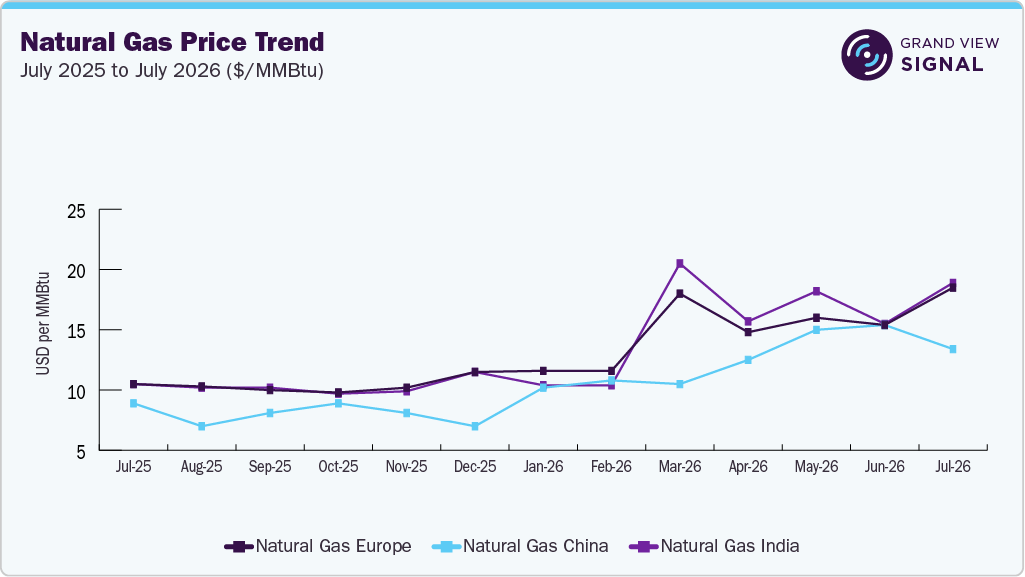
An analysis of the five core market forces altering global energy dynamics today highlights where decision-makers must focus their strategy.
1. Upstream Crude Shifts & Transit Corridor Bottlenecks
Geopolitical friction across critical maritime trade lanes directly threatens downstream fuel stability. When vessel transit routes around vital ocean corridors encounter security threats, shippers are forced to execute extended detours around regional capes. These extended sea routes add up to two weeks to cargo transit times while driving up bunker fuel surcharges and ocean freight rates.
Market Impact: Industrial consumers and power generation plants experience immediate margin compression as underlying crude and refined-product benchmark settlements fluctuate month over month. Rallies in primary crude benchmarks directly lift production expenditures for downstream refiners, driving regional feedstock spreads to multi-month highs.
The financial strain manifests differently depending on supply exposure:
- Import-Reliant Energy Consumers: Entities dependent on sea-borne crude shipments or foreign LNG cargoes endure compound cost increases from elevated freight tariffs paired with high physical spot quotes.
- Domestic Basin Operations: Facilities linked directly to low-cost onshore extraction sites maintain a distinct cost shield, keeping global energy prices heavily fragmented by geography.
Schedule a free demo of Grand View Signal to get real-time preview of price fluctuations in the Energy Sector
2. Regional Gas Disruption & Infrastructure Strain
Local natural gas supplies frequently experience unexpected contraction due to scheduled pipeline overhauls, liquefaction terminal maintenance, or rapid inventory drawdowns across regional distribution networks.
When primary gas hubs experience capacity constraints, industrial end-users, ranging from chemical processing plants to heavy manufacturing facilities, face immediate availability challenges. The resulting disconnects between continuous thermal demand and restricted physical inventory triggers sharp rallies across core energy indices.
Market Impact: Commercial end-users operating under fixed-rate utility tariffs or rigid customer contracts face immediate margin squeeze, as sudden fuel spikes cannot be passed downstream, directly exposing operating profits to severe contraction.
3. Evolving Environmental Policy & Carbon Tariffs
Government regulations, carbon compliance schemes, and sustainability directives are actively reshaping the economics of primary fuels. Legislative bodies worldwide continue to enforce stringent environmental controls that alter fuel trade flows and processing overhead. For instance, the European Union’s Carbon Border Adjustment Mechanism (CBAM), which fully transitioned into its financial compliance phase in 2026. Under this mandate, importers of carbon-intensive commodities, including hydrogen, electricity, steel, and fertilizers, must purchase carbon certificates linked directly to EU Emissions Trading System (ETS) allowance prices to offset embedded emissions. Overseas suppliers failing to document low-carbon production face immediate financial penalties, forcing procurement teams to re-evaluate regional energy sourcing strategies to prevent non-compliance tariffs from eroding profit margins.
Market Impact: Regulatory penalties and compliance pricing fundamentally change raw fuel economics, forcing energy procurement teams to evaluate carbon-neutral and low-emission fuels alongside baseline market prices to avoid non-compliance surcharges.
Key regulatory pressures altering procurement include:
- Emissions Compliance & Carbon Markets: Stricter carbon offset mechanisms compel heavy fuel buyers to integrate carbon allowance pricing directly into their thermal fuel sourcing budgets.
- Renewable Fuel Mandates: Enforced targets for sustainable aviation fuel (SAF), renewable diesel, and green hydrogen integration require procurement teams to continually rebalance fuel blends to avoid noncompliance penalties.
- Export Duty Adjustments: Tactical policy changes to national energy export duties allow governments to safeguard domestic supply, shifting global trade flows for thermal coal, crude, and refined products overnight.
Get historical, current, and forecast energy price assessments. Request Free Access to Grand View Signal
4. Asymmetric Industrial Demand & Cost Pass-Through Friction
Even as upstream crude and natural gas benchmarks experience volatility, industrial purchasing across major manufacturing centers remains cautious and selective. Energy-intensive sectors, such as primary metals, automotive manufacturing, commercial real estate, and consumer packaging, are maintaining conservative procurement stances.
Market Impact: Because end-user demand remains soft, manufacturers are unable to fully pass through energy surcharges, resulting in margin compression for facilities using physically constrained fuel lines.
5. Transition to Localized Power & Dynamic Fuel-Switching
To protect operational continuity from global shipping delays and volatile international fuel prices, major industrial zones are investing heavily in regional power infrastructure and localized renewable generation. A prime example unfolded across South and East Asia following transit frictions in the Middle East, where acute natural gas import shortfalls forced widespread industrial rationing. While single-fuel gas consumers across fertilizer and garment processing hubs faced severe output curbs and plant shutdowns, energy-intensive manufacturing complexes in India that had proactively integrated dual-fuel capacity (alternating between PNG, LPG, and fuel oil) and localized rooftop solar generation bypassed grid curtailments, maintained baseline production, and protected operating margins.
Market Impact: Companies adopting dynamic sourcing and dual-fuel infrastructure gain immediate cost advantages by capturing price arbitrage during fossil fuel price spikes while hedging long-term exposure to grid volatility.
Simultaneously, enterprise purchasing teams are redesigning their energy sourcing models to defend profit margins:
- Dual-Fuel Flexibility: Industrial facilities are upgrading thermal generation assets with multi-fuel burners, enabling them to switch among natural gas, LPG, and fuel oil based on real-time price differentials.
- Corporate PPA Execution: Large commercial enterprises are increasingly securing long-term Power Purchase Agreements (PPAs) with renewable energy developers to insulate baseline budgets from fossil fuel swings.
- Multi-Hub Sourcing Networks: Procurement leaders are diversifying away from reliance on single-pipeline routes, establishing multi-region supply contracts to mitigate localized network outages.
Access commodity-wise monthly forecast datasets for the next 6 months. Request Free Access to Grand View Signal
How Grand View Signal Helps Mitigate Commodity Price Risks
Managing energy purchasing in an era of sudden price spikes, transit disruptions, and carbon policy shifts demands moving past reactive decision-making. Enterprise leaders can no longer depend on outdated market reports or informal trade rumors.
As a dedicated SaaS-based technology solution, Grand View Signal transforms complex energy market data into actionable intelligence:
- Mitigating Fuel Price Swings: When upstream oil and gas benchmarks fluctuate, Signal delivers real-time price assessments across major global energy commodities, including crude oil, natural gas, LNG, refined fuels, and coal. Its analytics cover monthly, quarterly, annual, and multi-year timeframes to help risk management teams protect margins.
- Predicting Supply Outages: Instead of being caught unprepared by refinery turnarounds, pipeline maintenance, or LNG export disruptions, Signal combines historical trend analysis with forward-looking forecast models. This enables procurement leaders to anticipate energy cost spikes before power bills and thermal costs erode corporate margins.
- Navigating Regulatory and Policy Shifts: As nations introduce carbon taxes, alter fuel tariffs, or update clean energy requirements, Signal tracks policy developments and regional risk metrics. Subscribing organizations can benchmark alternative fuel sources and align sourcing strategies with emerging regulatory standards.
- Defending Operating Margins: To manage the disconnect between elevated energy costs and cautious industrial demand, Signal offers granular cost-structure decomposition and predictive risk modeling. This empowers commercial and purchasing teams to negotiate better utility contracts, execute data-backed hedging strategies, and defend operating margins.
Managing energy market volatility requires continuous foresight. Grand View Signal addresses this complexity by combining live market updates, historical pricing trends, and forward-looking forecast models across global energy markets. By tracking shifting feedstock pricing, carbon policies, and regional cost spreads, Signal empowers procurement and finance leaders to shift from reactive purchasing to a strategic, margin-defending sourcing approach.
Read our latest articles on

 Arabic
 French
 Spanish
 Portuguese
 Deutsch
 Turkish
 Dutch
Dutch
 Italiano
 Russian
 Romaian
 Portuguese (Brazil)
 Greek
Greek
