
Algae Polymer Bottles Market Expected to Reach USD 722 Million by 2036
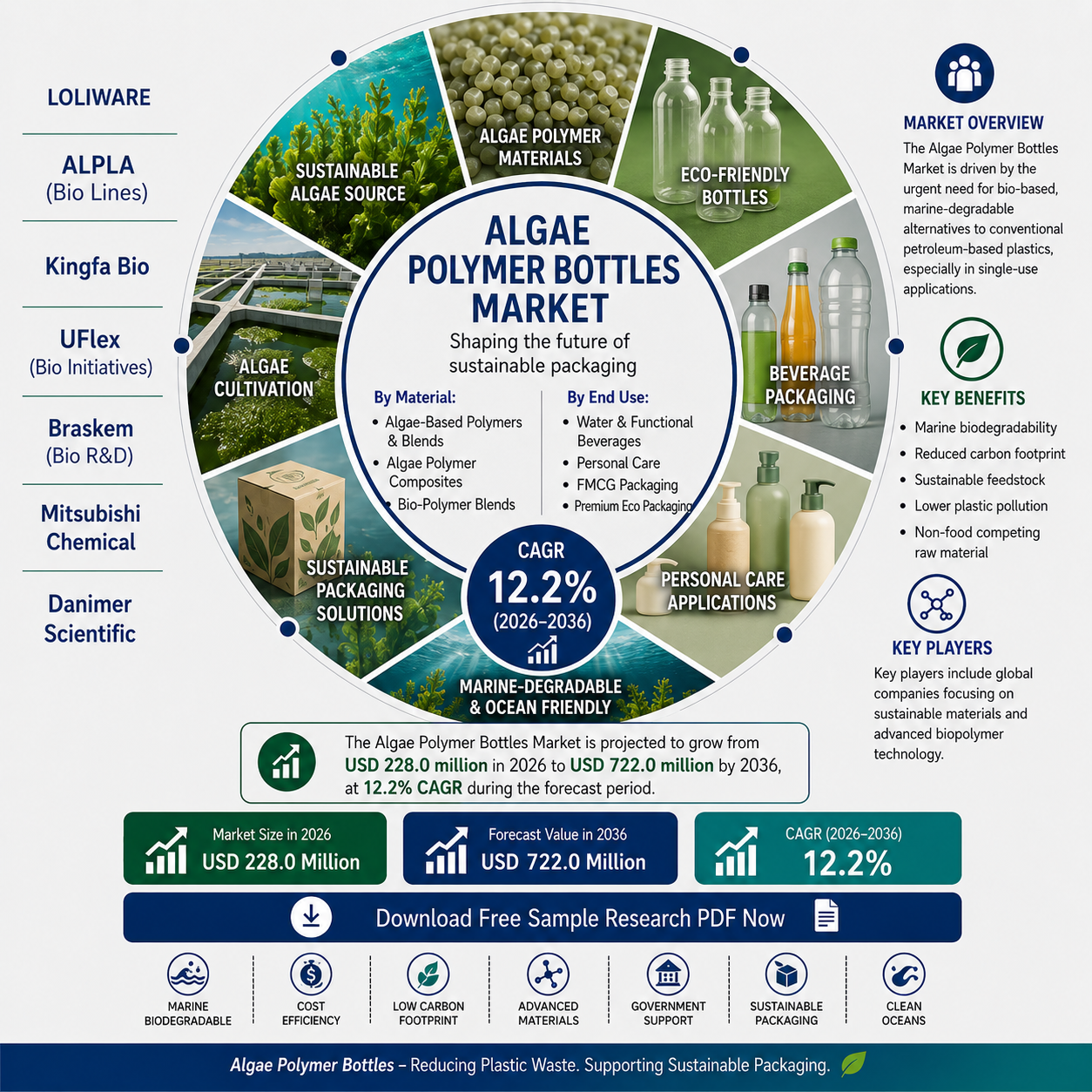
The global algae polymer bottles market is projected to reach USD 722.00 million by 2036, up from USD 228.00 million in 2026, expanding at a CAGR of 12.2% during 2026–2036, according to Fact.MR. The market is responding to demand for bio-based and marine-degradable alternatives to conventional petroleum-based plastics, especially in single-use packaging applications.
The market is expected to add USD 494.00 million in absolute opportunity over the forecast period and expand by approximately 3.17 times in value. This answers a key question for packaging manufacturers and brand owners: why now? Regulatory pressure, plastic pollution concerns, and demand for lower-carbon packaging are pushing companies to explore alternative feedstocks and materials.
Get detailed market forecasts, competitive benchmarking, and pricing trends: https://www.factmr.com/connectus/sample?flag=S&rep_id=13542
The algae polymer bottles market is a sustainable packaging category that uses algae-derived polymers and blends to develop alternatives to conventional petroleum-based plastic bottles.
Algae-derived polymers are emerging as next-generation materials because they address plastic pollution and carbon footprint concerns without competing with food-based feedstocks such as corn or sugarcane. According to the supplied market analysis, algae can be cultivated on non-arable land using saltwater, creating an alternative raw material pathway for packaging production.
The strongest commercial signal is already visible in the material segment. Algae-based polymers and blends hold a 52.3% share in 2026, making them the leading material category. Pure algae polymers may require blending with other bio-based or compatible biodegradable polymers to achieve the mechanical strength, processability, and barrier performance required for bottle applications.
That practical blending approach is an important insider-level detail from the market analysis. Commercial development is not limited to using pure algae polymer. Instead, algae can serve as a primary component within formulations designed to meet manufacturing and product performance requirements.
“The market is moving toward practical formulations that can meet commercial bottle requirements,” said “That matters because material performance and processability will determine how quickly algae-derived packaging moves beyond prototypes.”
Technology will also shape the pace of market development. Bio-polymer extrusion and blow moulding account for 51.3% of the technology segment in 2026. The technology is critical because established high-speed manufacturing processes must be adapted to the thermal and rheological properties of algae-based resins.
Manufacturers also face technical challenges involving moisture sensitivity and consistent melt flow. According to the supplied analysis, these factors affect the ability to produce bottles with required clarity, barrier properties, and dimensional stability at commercial speeds.
Water and functional beverages represent the largest end-use segment, accounting for 38.0% of market share in 2026. This makes beverage packaging a major early application for algae-derived bottle materials. Brands in this consumer-facing category face pressure to address plastic waste and are exploring packaging that can support environmental positioning.
Packaging format data shows a similar trend. Bottles and jars account for 42.8% of the packaging format segment in 2026, reflecting their role as the primary format for market adoption.
“It is still a cost-sensitive market,” said. “But the pressure around packaging materials is real, and brands are looking beyond the options they already know.”
India is expected to record the fastest growth among the countries listed in the analysis, with a 13.1% CAGR from 2026 to 2036. China follows at 12.2%, while the USA is projected to grow at 10.0%. Germany is forecast at 8.2%, Brazil at 8.1%, and Japan at 5.7%.
India's growth outlook is linked in the supplied analysis to the scale of its FMCG packaging sector and the potential integration of algae cultivation with wastewater treatment or coastal aquaculture. The long-term focus is on developing affordable sustainable materials for a large consumer base.
The competitive landscape includes material startups and established chemical and packaging companies. Key companies identified in the supplied content include Loliware, ALPLA, Kingfa Bio, UFlex, Braskem, Mitsubishi Chemical, and Danimer Scientific.
The market analysis describes a collaborative competitive environment in which startups and larger companies may work through joint development agreements and supply partnerships. Competition is also focused on efficient algae processing, intellectual property, and relationships with global brand owners.
Several broader industry factors are influencing market development. Plastic taxes and extended producer responsibility fee structures can improve the relative economics of alternatives to virgin fossil-based plastics. Corporate net-zero and Scope 3 emission goals are also increasing interest in packaging materials with lower carbon footprints.
The algae polymer bottles market also faces a clear restraint: high production costs compared with PET and established bioplastics. This can limit adoption in price-sensitive applications. At the same time, opportunities include potential integration with carbon credit and blue economy frameworks for algae cultivation, according to the supplied analysis.
The long-term market opportunity depends on scaling material production while maintaining bottle performance and commercial economics. Bio-polymer extrusion and blow moulding, material blending, and high-volume processing are therefore central to the industry's development.
With market revenue projected to rise from USD 228.00 million in 2026 to USD 722.00 million by 2036, the algae polymer bottles market is positioned as a developing area within sustainable packaging. The transition will depend on manufacturing scalability, material performance, regulatory requirements, and brand demand for alternatives to conventional petroleum-based plastics.
To View Top Reports
https://net-pals.com/blogs/27481/3D-Printing-Powder-Market-Set-to-Reach-USD-7-8
https://uddokta64.com/blogs/6039/3D-Printing-Powder-Market-Projected-to-Hit-USD-7-8
https://acmingle.com/blogs/15720/3D-Printing-Powder-Market-Expected-to-Reach-USD-7-8
About Fact.MR
Fact.MR provides market research and analysis across industries and business sectors. The algae polymer bottles market analysis cited in this release covers market value, growth outlook, technology, materials, packaging formats, end-use segments, key countries, and competitive developments.

 English
 Arabic
 French
 Spanish
 Deutsch
 Turkish
 Dutch
Dutch
 Italiano
 Russian
 Romaian
 Portuguese (Brazil)
 Greek
Greek
