
Intranet Services New York: 10 Key Trends Shaping Digital Workplaces in 2026
New York's business landscape moves fast. Finance firms on Wall Street, media companies in Midtown, and healthcare networks across the boroughs all share one challenge: keeping employees connected across offices, boroughs, and time zones. That is why demand for intranet services New York organizations can rely on has grown sharply this year.
A modern intranet is no longer a static bulletin board. It has become the digital front door of a company, a place where employees find documents, connect with colleagues, and get work done without friction. As hybrid work becomes permanent, businesses are investing in digital workplace solutions that keep teams aligned, informed, and productive.
Below, ten trends are outlined that are reshaping how companies in New York build and manage their intranets in 2026. Whether a business is upgrading an outdated system or launching a platform for the first time, these trends offer a clear roadmap for what matters most this year.
Each trend reflects a broader shift in how people expect to work. Employees now compare their internal tools to the consumer apps they use every day, and they expect the same speed, clarity, and personal relevance. Companies that ignore this shift risk losing engagement, while those that embrace it are turning their intranet into a genuine competitive advantage.
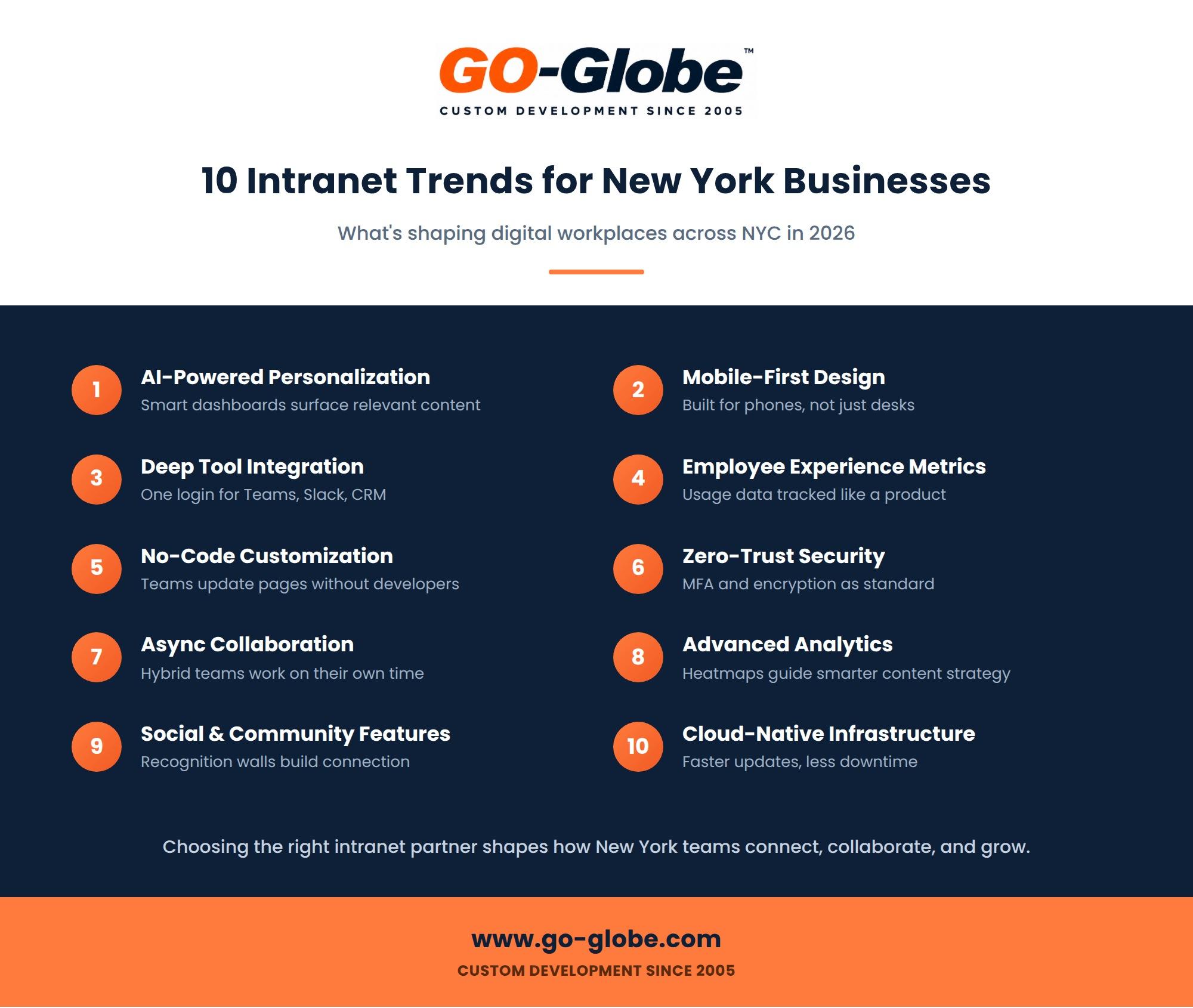
1. AI-Powered Personalization Takes Center Stage
Generic homepages are being replaced by personalized dashboards. AI now studies an employee's role, location, and past activity, then surfaces the documents, news, and tasks that matter most to that person. A finance associate in Lower Manhattan sees compliance updates first, while a marketing coordinator in Brooklyn sees campaign assets.
This shift matters because employees waste less time searching. Studies consistently show that workers spend hours each week hunting for information buried in shared drives. AI-driven personalization solves this by bringing relevant content forward automatically, which is a major reason intranet services New York firms request most often include some form of machine-learning search.
Chatbots are also being added to answer routine HR and IT questions instantly. Instead of filing a ticket and waiting a day for a reply, an employee can ask the intranet assistant directly and receive an accurate answer within seconds. This reduces pressure on support teams and speeds up everyday tasks across the organization.
2. Mobile-First Design Becomes Non-Negotiable
New York's workforce is rarely tied to a desk. Retail associates, field technicians, healthcare staff, and construction crews all need intranet access from a phone. As a result, mobile-first design has moved from a nice-to-have to a baseline requirement.
A mobile-first intranet is built for small screens first, then scaled up for desktop, rather than the reverse. Buttons are larger, navigation is simplified, and push notifications keep deskless employees informed about shift changes, safety alerts, and company news in real time.
Offline access is also being prioritized. Subway commutes and job sites with limited signal are common across the five boroughs, so forward-thinking platforms cache key content locally. This way, an employee can still review a schedule or policy document even when a connection drops.
3. Deep Integration With Everyday Work Tools
Employees do not want another separate application to check. Instead, intranets are being woven directly into Microsoft Teams, Slack, Google Workspace, and CRM systems. A single sign-on lets staff move between email, chat, and the intranet without repeated logins.
This integration trend is being driven by a simple goal: reduce app fatigue. When the intranet pulls calendar events, task lists, and approvals into one dashboard, employees stop bouncing between ten browser tabs and start working from a single, unified hub.
API-first architecture is what makes this possible. Rather than building rigid, one-off connections, modern platforms are designed with open APIs so new tools can be plugged in as a company grows. This approach protects the investment, since the intranet can adapt as software needs change over time.
4. Employee Experience Is Measured Like a Product
Companies are treating their intranet the way a product team treats an app, complete with usage analytics, satisfaction surveys, and iterative updates. Metrics such as page engagement, search success rate, and time-to-find are tracked monthly rather than reviewed once a year.
This data-first mindset is helping HR and IT teams justify budget for ongoing improvements. When leadership can see that a redesigned search bar cut support tickets by a meaningful margin, further investment becomes an easier conversation.
Feedback loops are being built directly into the platform as well. Short in-app surveys and comment threads let employees flag confusing pages immediately, so problems are caught within days rather than surfacing months later in an annual engagement survey.
5. No-Code and Low-Code Customization
Not every company has a large development team on staff, yet every company wants an intranet that reflects its own branding and workflows. No-code and low-code platforms are closing that gap. Marketing teams can update banners, HR can launch a new onboarding page, and department leads can build simple approval workflows, all without writing a line of code.
This flexibility is particularly valuable for mid-sized New York businesses that need enterprise-level functionality but cannot justify a full-time development team dedicated solely to intranet maintenance.
Template libraries are speeding up rollout too. A department can select a pre-built layout for a project hub or a knowledge base, then adjust colors and fields to match its needs, cutting weeks off a typical build timeline.
6. Zero-Trust Security Becomes Standard Practice
New York is home to some of the most heavily regulated industries in the country, including finance, healthcare, and legal services. As a result, security has been pushed to the top of every intranet project brief. Zero-trust architecture, where no user or device is automatically trusted, is being adopted widely.
Multi-factor authentication, role-based permissions, and encrypted document storage are now considered baseline features rather than premium add-ons. Compliance with regulations such as HIPAA and SEC guidelines is being built into the platform from day one, not bolted on afterward.
Regular penetration testing and audit trails are also being requested more frequently. Because a data breach can damage both finances and reputation, security has shifted from a background concern to a headline feature discussed openly in vendor proposals.
7. Hybrid Work Support Through Asynchronous Collaboration
Hybrid schedules mean fewer moments when an entire team is online at once. Intranets are adapting by supporting asynchronous collaboration: recorded video updates, threaded discussions, and shared documents that can be edited on different schedules.
This trend reduces the pressure to schedule yet another meeting. A project update can be posted once, viewed by teammates whenever they log in, and discussed through comments rather than a calendar invite that half the team cannot attend.
Shared status boards are being used to replace some daily stand-up meetings entirely. Team members update their own progress whenever it fits their schedule, and managers get a clear picture of project momentum without pulling everyone into a call.
8. Advanced Analytics Guide Content Strategy
Intranet administrators are using detailed analytics dashboards to understand what content employees actually read. Heatmaps show which sections of the homepage get attention, while search logs reveal what employees are struggling to find.
These insights are shaping smarter content strategy. Instead of guessing what employees want, communications teams can see exactly which announcements are being ignored and adjust their approach, whether that means shorter posts, clearer subject lines, or better placement on the homepage.
Predictive analytics are being explored by larger organizations as well. By reviewing historical engagement patterns, some platforms can now suggest the best day and time to publish an announcement so it reaches the widest possible audience.
9. Social Features Build a Sense of Community
Remote and hybrid work can leave employees feeling isolated, especially in a city as large as New York where colleagues may never share the same physical office. To counter this, intranets are adding social features: employee recognition walls, interest-based groups, and company-wide discussion boards.
These features are not just for fun. Research has shown that employees who feel connected to colleagues report higher engagement and stay with a company longer. A well-designed intranet is being used as a tool to rebuild the social fabric of the workplace, one post and comment at a time.
Milestone celebrations, from work anniversaries to project wins, are being automated so no achievement slips through the cracks. Small gestures like these are proving surprisingly effective at keeping morale high across dispersed teams.
10. Cloud-Native, Sustainable Infrastructure
Finally, intranet platforms are shifting toward cloud-native infrastructure that scales automatically and reduces the environmental footprint of on-premise servers. This shift also supports faster deployment of updates, since new features are rolled out centrally rather than installed office by office.
For New York businesses managing multiple locations across the metro area, cloud-native intranets mean every office receives the same version of the platform at the same time. Downtime is minimized, and IT teams spend less time on manual maintenance.
Energy-efficient hosting is becoming a talking point in vendor selection too. As more companies publish sustainability goals, the infrastructure behind everyday tools, including the intranet, is being scrutinized as part of that broader commitment.
Choosing the Right Intranet Partner in New York
With so many trends converging at once, selecting a provider can feel overwhelming. The strongest approach is to look for a partner with proven experience across the specific mix of trends that matter most to a business, rather than a one-size-fits-all template.
A good starting point is asking clear questions during vendor evaluation. How is personalization handled? What security certifications does the platform carry? Can the system integrate with the tools already in use? Providers who answer these questions with specific, concrete detail, rather than vague marketing language, tend to deliver stronger results once the project moves into development.
It is also worth prioritizing a partner who offers ongoing support after launch. An intranet is not a one-time project; it needs regular updates, security patches, and content refreshes to stay useful. Businesses that plan for this from the outset avoid the common trap of a platform that looks great at launch but grows stale within a year.
What This Means for New York Businesses
These ten trends point toward one conclusion: the intranet has evolved from a simple document repository into the operational backbone of the modern digital workplace. Companies that invest in personalization, mobile access, integration, and security today will be better positioned to retain talent and improve productivity tomorrow.
Choosing the right intranet services New York provider is therefore not just an IT decision. It is a strategic one that touches HR, communications, security, and company culture all at once. Businesses that approach this choice with a clear understanding of these trends will be equipped to build a platform employees genuinely want to use, rather than one they are forced to tolerate.
Looking ahead, the gap between companies that modernize their digital workplace and those that delay is likely to widen. Talent in a competitive market like New York gravitates toward employers who make everyday work simple, and an outdated intranet sends the opposite signal on day one. Investing now, while these trends are still forming best practices, gives a business the chance to shape its digital workplace rather than scramble to catch up later.

 English
 French
 Spanish
 Portuguese
 Deutsch
 Turkish
 Dutch
Dutch
 Italiano
 Russian
 Romaian
 Portuguese (Brazil)
 Greek
Greek
