
Building Codes Fuel Growth in the Fire Alarm Systems Market
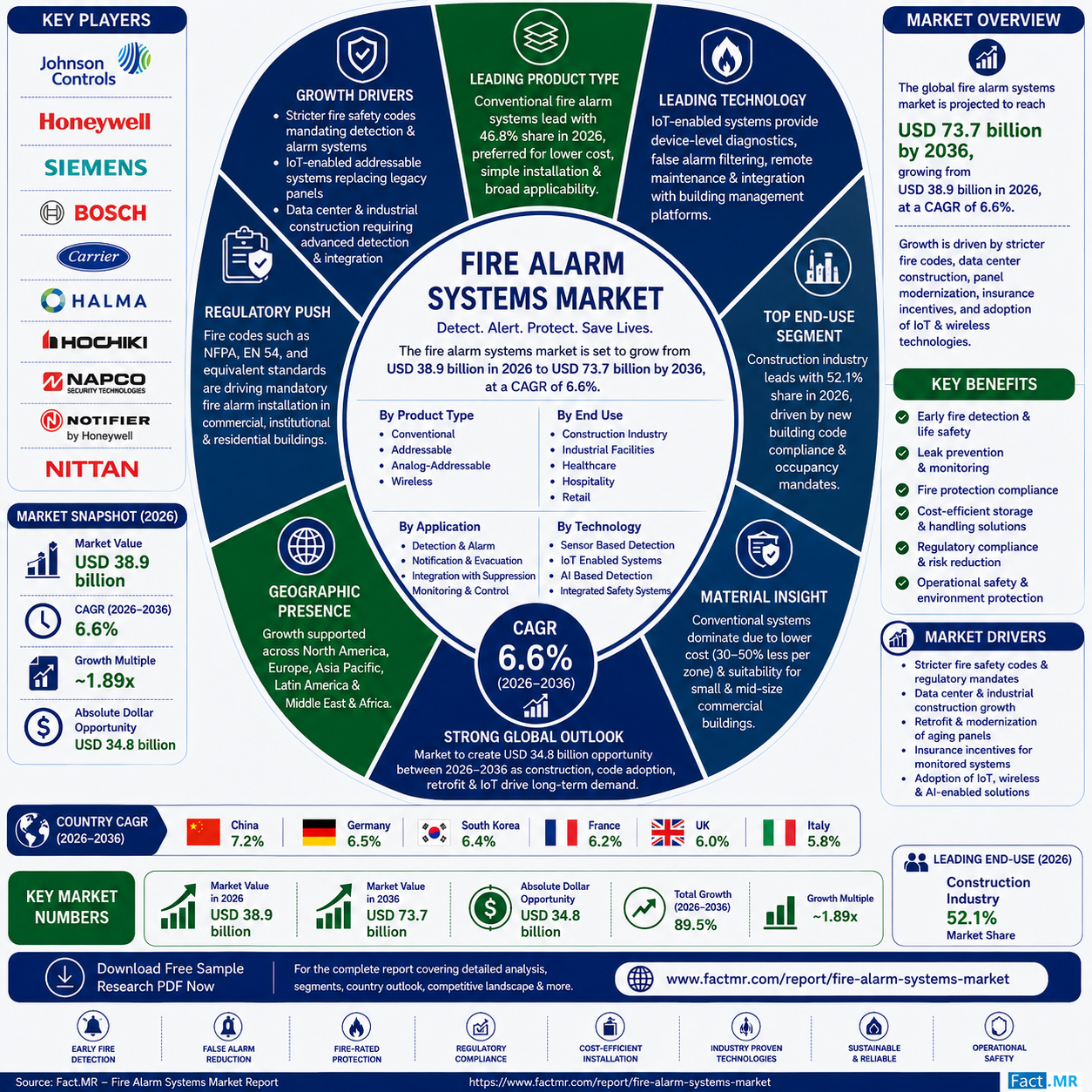
SubHead : Market rises from USD 38.9 billion in 2026; 6.6% CAGR; construction holds 52.1% share
August 29, 2026 — The global Fire Alarm Systems Market is valued at USD 38.9 billion in 2026 and is projected to reach USD 73.7 billion by 2036, expanding at a 6.6% CAGR, according to Fact.MR. The market is expected to create an absolute dollar opportunity of USD 34.8 billion between 2026 and 2036.
Demand is rising as fire safety rules become stricter across major markets. New and existing commercial, institutional, and multi-family buildings face stronger fire detection requirements. Data center construction is also creating demand for early warning systems. Building owners are replacing aging panels as legacy systems reach the end of their service life. Insurance incentives for monitored fire alarm systems also support upgrades.
IoT and connected technology are changing how buyers assess fire alarm systems. Addressable systems can provide device-level status reporting, fault detection, false alarm analytics, and remote maintenance scheduling. Wireless systems can reduce installation cost and time by 40% to 60%, according to Fact.MR. These features are supporting retrofit projects, including applications in heritage buildings and existing facilities.
Get detailed market forecasts, competitive benchmarking, and pricing trends: https://www.factmr.com/connectus/sample?flag=S&rep_id=600
Market Proof and Industry Standards
The supplied Fact.MR page identifies NFPA and EN 54 standards documentation, building code databases, and company product catalogs among its research references. It also states that its methodology uses secondary research, primary interviews, forecast modelling, trade-flow validation, pricing analysis, and code adoption tracking.
However, the supplied page does not provide 2–3 dated third-party statistics with publication dates and numerical values. Therefore, no external proof statistics have been added to avoid introducing data that is not present on the source page.
Key Numbers
|
Market Indicator |
Fact.MR Data |
|
Market value, 2025 |
USD 36.5 billion |
|
Market value, 2026 |
USD 38.9 billion |
|
Forecast value, 2036 |
USD 73.7 billion |
|
CAGR, 2026–2036 |
6.6% |
|
Absolute dollar opportunity |
USD 34.8 billion |
|
Conventional systems share, 2026 |
46.8% |
|
Construction industry share, 2026 |
52.1% |
|
China CAGR |
7.2% |
|
Germany CAGR |
6.5% |
|
South Korea CAGR |
6.4% |
|
France CAGR |
6.2% |
|
UK CAGR |
6.0% |
Source: Fact.MR analysis from the supplied Fire Alarm Systems Market page.
Segment Breakdown
Product type: Conventional fire alarm systems account for 46.8% of the product type segment in 2026. Fact.MR links this position to lower cost, simpler installation, and broad use in small and mid-size commercial buildings. Conventional panels are stated to cost 30% to 50% less per protected zone than addressable alternatives.
Addressable systems: Addressable systems are growing faster in percentage terms as large buildings and connected technology increase demand. The transition is linked to building size, code requirements, and IoT integration.
End use: The construction industry accounts for 52.1% of end-use demand in 2026. Commercial buildings, institutional facilities, and multi-family residential buildings are key installation channels.
Technology: Demand is expanding for IoT-enabled systems, AI-based detection, cloud monitoring, multi-sensor detection, and aspirating smoke detection. Data centers and clean rooms require systems capable of identifying conditions before visible smoke or flame develops.
Applications: Fire alarm systems support detection and alarm, notification and evacuation, suppression integration, and monitoring and control.
Country CAGR Outlook
|
Country |
CAGR, 2026–2036 |
|
China |
7.2% |
|
Germany |
6.5% |
|
South Korea |
6.4% |
|
France |
6.2% |
|
UK |
6.0% |
|
Italy |
5.8% |
|
Japan |
5.6% |
Source: Fact.MR analysis based on its proprietary forecasting model and primary research.
China records the fastest growth among the listed countries at 7.2% CAGR. Building code expansion, commercial construction, industrial development, and data center projects support demand.
Germany follows at 6.5% CAGR. EN 54 compliance, commercial building modernization, data center investment, and institutional upgrades support the market.
South Korea records 6.4% CAGR, supported by semiconductor and display manufacturing, cleanroom requirements, safety regulations, and smart building adoption.
France and the UK record CAGRs of 6.2% and 6.0%, respectively. Heritage building retrofits, national fire safety rules, commercial modernization, and post-Grenfell regulatory changes support demand.
Competitive Landscape
Johnson Controls holds approximately 27.4% market share, according to Fact.MR. Its position is supported by its fire alarm, suppression, building management, OpenBlue IoT, installation, and service capabilities.
Honeywell International, Siemens, and Robert Bosch compete through fire detection portfolios, building automation integration, and multinational distribution.
Carrier Global and Halma PLC maintain positions through specialized fire and security operations and detector technology portfolios.
Other companies named by Fact.MR include Hochiki Corporation, Napco Security Technologies, Notifier (Honeywell), and Nittan.
Recent developments cited on the supplied page include Halma's acquisition of Zettler Group in January 2025, Johnson Controls' OpenBlue fire safety platform expansion in 2025, and Honeywell's fire safety integration into the Doha Metro automated rail system in 2025.
Analyst Commentary
Shambhu Nath Jha, Principal Consultant at Fact.MR, said: “The fire alarm systems market is transitioning from basic code compliance to integrated life safety and building intelligence.”
He added that IoT-enabled addressable panels with device-level diagnostics, false alarm filtering, and building management integration are gaining specification share from conventional panels. The commentary also points to cloud monitoring, analytics, and maintenance scheduling as areas that can support recurring service revenue.
Frequently Asked Questions
What is the current size of the fire alarm systems market?
Fact.MR estimates the global market at USD 38.9 billion in 2026.
What will the fire alarm systems market be worth in 2036?
The market is projected to reach USD 73.7 billion by 2036, according to Fact.MR.
What is the CAGR of the fire alarm systems market?
Fact.MR forecasts a 6.6% CAGR from 2026 to 2036.
Which fire alarm product type has the largest share?
Conventional fire alarm systems hold 46.8% of the product type segment in 2026.
Which end-use segment leads the market?
The construction industry accounts for 52.1% of the end-use segment in 2026.
About Fact.MR
Fact.MR is a market research and consulting firm providing market intelligence, forecasts, competitive analysis, and industry research across global markets. The supplied Fire Alarm Systems Market study uses secondary research, primary interviews, forecast modelling, trade-flow validation, pricing analysis, and code adoption tracking.

 English
 Arabic
 French
 Spanish
 Portuguese
 Deutsch
 Turkish
 Italiano
 Russian
 Romaian
 Portuguese (Brazil)
 Greek
Greek
