
Total Retail Software Market 2026–2034: Trends, Growth and Forecast
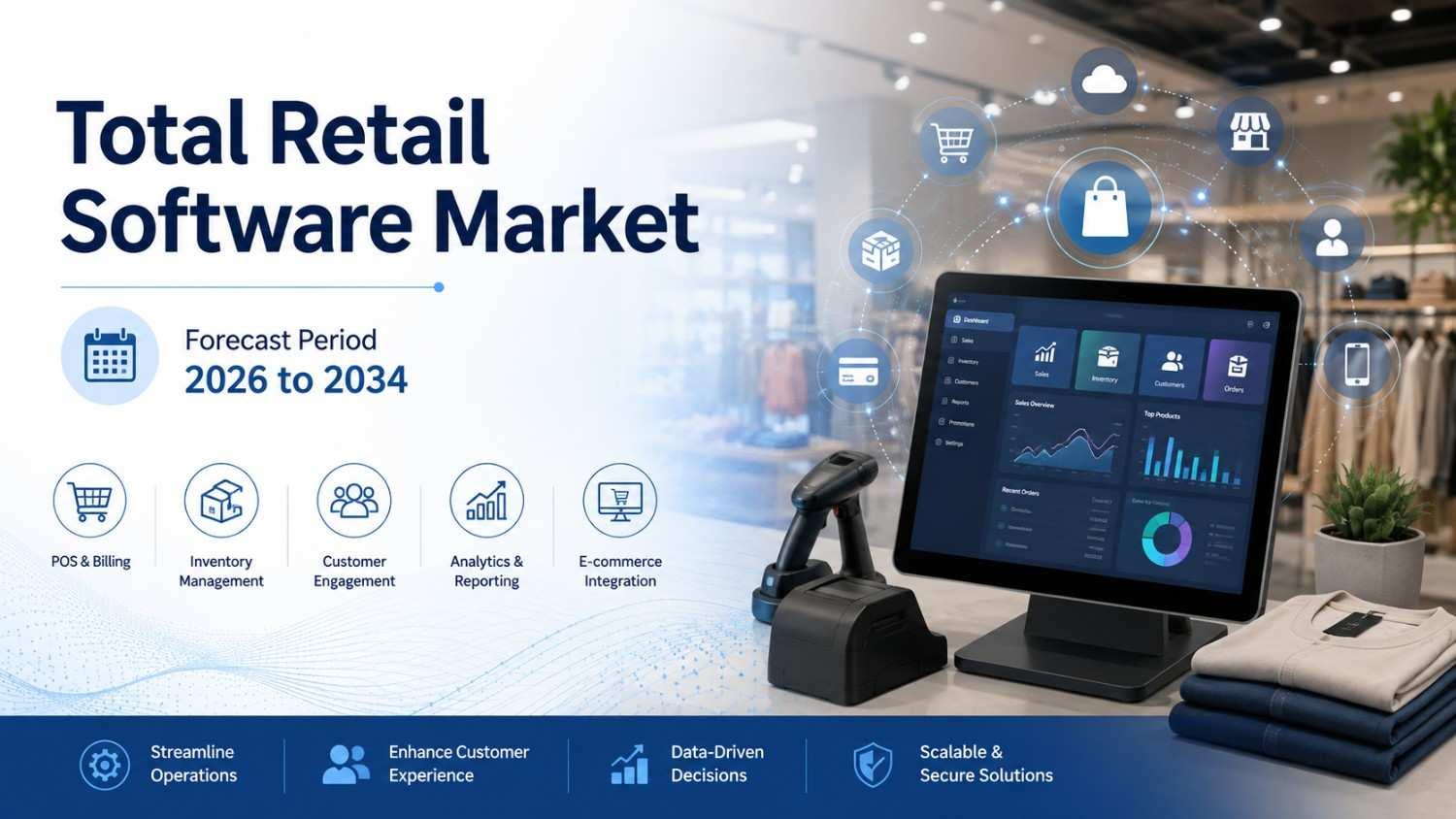
The global total retail software market is experiencing a transformative phase driven by rapid digital transformation, changing consumer expectations, and the necessity for seamless unified commerce. Retail software encompasses a comprehensive suite of digital solutions, including Point of Sale (POS) systems, Inventory Management, Customer Relationship Management (CRM), Supply Chain Management (SCM), Retail Analytics, and E-commerce platforms.
The global total retail software market size is projected to reach US$ 78.38 billion by 2034 from US$ 24.6 billion in 2025. The market is anticipated to register a CAGR of 13.74% during the forecast period 2026-2034.
Key Market Drivers
- Rise of Unified Commerce and Omnichannel Retailing: Modern consumers expect a cohesive shopping experience across online channels, mobile apps, and physical brick-and-mortar stores. Total retail software allows merchants to sync inventory, process unified payments, and manage fulfillment options like Buy Online, Pick Up In-Store (BOPIS) efficiently.
- Rapid Integration of Artificial Intelligence and Machine Learning: Retailers are increasingly leveraging generative AI and machine learning algorithms within their software stack for predictive demand forecasting, personalized product recommendations, real-time dynamic pricing, and automated inventory replenishment.
- Migration Toward Cloud-Based SaaS Solutions: Cloud software deployment allows retail enterprises and small-to-medium businesses (SMEs) to lower upfront infrastructure costs, access real-time data from any location, scale operational capacity seamlessly, and maintain robust data security standards.
- Automation of Back-Office Operations: Modern retail software suites reduce manual errors, automate complex financial reconciliations, lower labour overheads, and streamline task management across large store chains.
Growth Opportunities
- Adoption of Hyper-Personalization Tools: Customer engagement platforms with advanced analytics present massive expansion opportunities. Retailers can utilize customer data platforms (CDPs) to deliver tailored promotions, targeted loyalty programs, and curated product discovery journeys.
- Emergence of Multimodal and Visual Commerce: The integration of voice-assisted shopping, visual search, and computer vision shelf scanners opens new avenues for software vendors to build intelligent, context-aware retail applications.
- Expansion of SMEs in Emerging Markets: Developing economies across Asia-Pacific and Latin America are undergoing rapid digitalization. Scalable, budget-friendly Software-as-a-Service (SaaS) platforms offer immense growth opportunities as local retailers shift away from legacy manual accounting and point-of-sale setups.
Market Segmentation
The global total retail software market can be categorized into key segments:
By Software Type
- Point of Sale (POS) Software
- Inventory & Warehouse Management Software
- Retail Analytics & Intelligence Systems
- Customer Relationship Management (CRM) & Loyalty Systems
- Supply Chain Management (SCM) Solutions
- E-commerce & Unified Commerce Platforms
By Deployment Model
- Cloud-Based / SaaS Deployment
- On-Premise Deployment
By Organization Size
- Small and Medium Enterprises (SMEs)
- Large Enterprises
By End-User Application
- Fashion & Apparel
- Grocery & Supermarkets
- Consumer Electronics
- Health & Beauty
- Home Goods & Furniture
- Specialty Stores
Market News and Recent Developments
- AI-Powered Predictive Inventory Solutions: Leading software providers have recently introduced predictive analytics modules that leverage regional weather patterns, localized shopping trends, and social media sentiment to forecast inventory demand spikes.
- Strategic Ecosystem Mergers & Acquisitions: Industry pioneers continue acquiring niche tech startups specializing in computer vision, automated barcode scanning, and real-time loss prevention to broaden their end-to-end enterprise capabilities.
- Headless Commerce Integrations: Major e-commerce and retail platform vendors are expanding APIs to enable "headless" architectures, allowing merchants to decouple front-end user interfaces from back-end transactional engines for maximum flexibility.
Competitive Landscape and Market Analysis
The global total retail software market exhibits a highly competitive, dynamic structure featuring established global tech conglomerates alongside specialized, fast-growing software vendors. Industry leaders continuously invest heavily in research and development to update their product portfolios, secure enterprise multi-year contracts, and expand strategic partner ecosystems.
Dominant market players maintain their competitive edge through product innovation, strategic partnerships with payment gateways and logistics firms, and targeted acquisitions of regional solutions providers. Furthermore, vendor competition is increasingly shifting from raw feature count to platform interoperability, security compliance, data integration flexibility, and ease of deployment.
Top Market Players
- SAP SE
- Oracle Corporation
- Salesforce, Inc.
- Microsoft Corporation
- Adobe Inc.
- Shopify Inc.
- IBM Corporation
- Infor
- NCR Voyix Corporation
- Manhattan Associates
Market Future Outlook
Looking toward 2034, the total retail software sector is poised to function as the core technological backbone of global trade. The market trajectory indicates a clear transition toward autonomous retail infrastructure, where edge computing, autonomous inventory tracking, and embedded financial technology (Embedded Fintech) operate in unison.
As digital public infrastructure and cloud connectivity expand globally, retail operations will become increasingly automated and data-driven. Enterprise software buyers will prioritize modular, microservices-based platforms (MACH architecture) that facilitate agile technological adoption. Software providers that successfully combine real-time operational visibility, high cybersecurity standards, and intuitive AI-driven decision tools will lead market growth over the next decade.
The Insight Partners provides comprehensive syndicated and tailored market research services in the healthcare, technology, and industrial domains. Renowned for delivering strategic intelligence and practical insights, the firm empowers businesses to remain competitive in ever-evolving global markets.
• Email: sales@theinsightpartners.com
• Website: theinsightpartners.com
• Phone: +1-646-491-9876

 English
 Arabic
 French
 Spanish
 Portuguese
 Deutsch
 Turkish
 Dutch
 Italiano
 Romaian
 Portuguese (Brazil)
 Greek
