
Healthcare Middleware Market 2031: Segmentation, Trends and Competitive Landscape
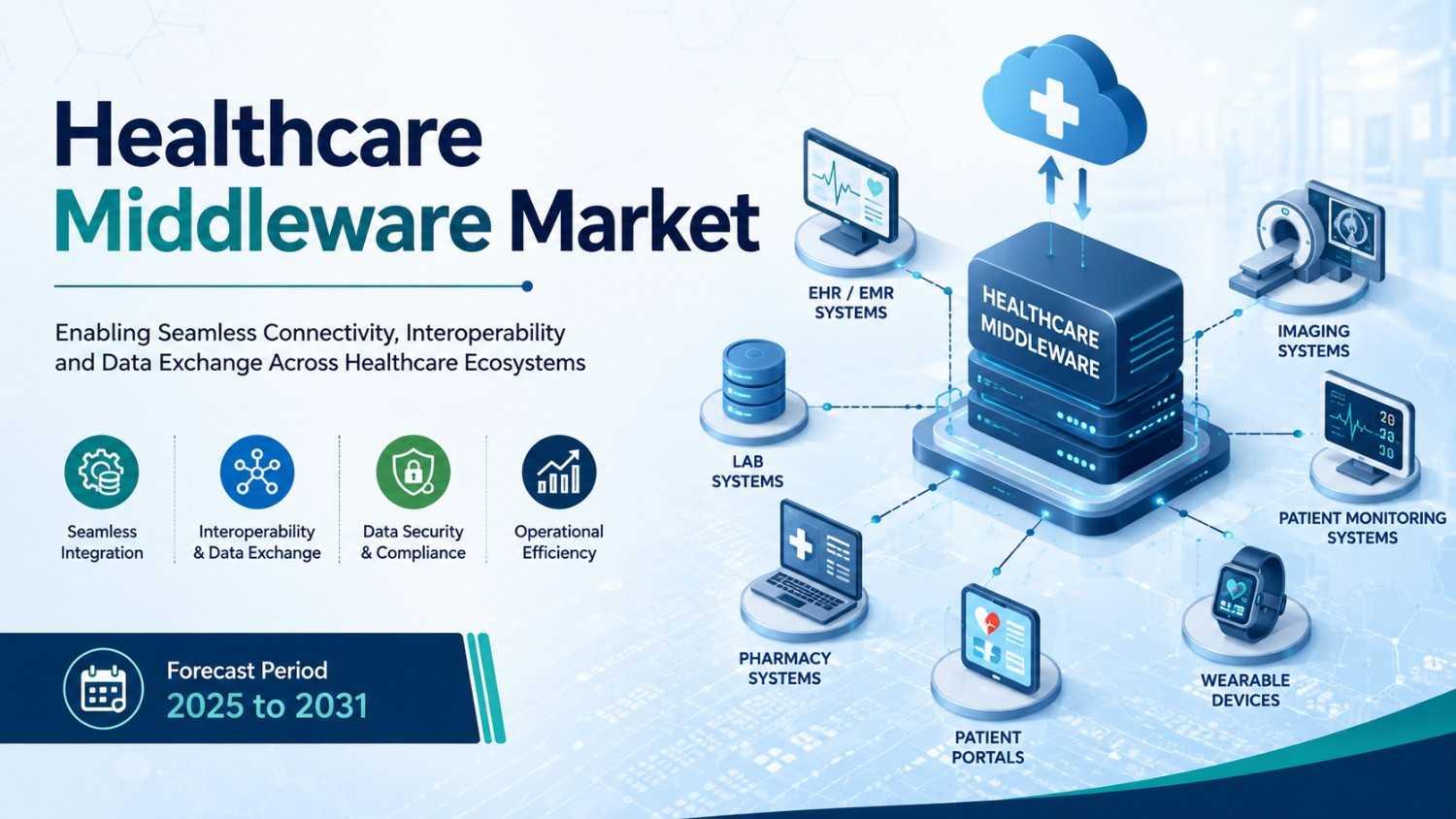
Healthcare IT ecosystems are notoriously fragmented, often relying on legacy systems that store patient data in isolated silos. Middleware serves as the underlying layer that harmonizes these diverse systems, standardizing communication protocols such as HL7, Fast Healthcare Interoperability Resources (FHIR), and DICOM.
The Healthcare Middleware Market size is expected to reach US$ 7.55 Billion by 2031. The market is anticipated to register a CAGR of 8.2% during 2025-2031.
Key Drivers
Need for Healthcare Data Interoperability
The primary catalyst driving market expansion is the demand for unified data exchange. Healthcare networks utilize multiple platforms across various departments. Middleware translates complex data schemas across these software platforms, eliminating data silos and enabling clinicians to access real-time patient history at the point of care.
Regulatory Mandates and Standardization
Government bodies worldwide are enforcing strict data sharing and security standards. Standards such as the U.S. ONC interoperability rules and Europe's GDPR necessitate secure, standardized data transfers. Middleware provides built-in encryption, audit logging, and compliance protocols that allow organizations to maintain strict security compliance without disrupting clinical workflows.
Surge in Telehealth and Remote Patient Monitoring
The expansion of remote healthcare services, continuous health monitoring, and wearable health tech generates high volumes of continuous patient data. Healthcare middleware provides the essential connectivity required to ingest data from mobile apps and IoMT devices directly into clinical records.
Market Opportunities
Integration of Artificial Intelligence and Machine Learning
The convergence of artificial intelligence with middleware offers substantial growth potential. AI-enabled middleware platforms can perform real-time predictive analytics on streaming patient data, alerting care teams to early signs of patient deterioration, optimizing bed management, and automating routine administrative tasks.
Expansion in Emerging Economies
Developing regions across Asia Pacific, Latin America, and the Middle East are investing heavily in modernizing digital health infrastructure. Government initiatives aiming to expand digital hospital networks and universal health coverage in countries like China, India, and Brazil create untapped opportunities for scalable, cloud-first middleware solutions.
Market Segmentation
By Type
- Communication Middleware: Facilitates messaging, data routing, and connection between application software.
- Integration Middleware: Connects disparate databases, EHR systems, and third-party software tools.
- Platform Middleware: Provides cloud-native runtime environments for developing and running customized digital health applications.
- Process Middleware: Automates administrative and clinical workflows across hospital enterprise systems.
By Application
- Clinical Systems: Represents the largest application segment, driven by the need to synchronize clinical data, EHR platforms, and physician order entry tools.
- Financial & Administrative Systems: Streamlines billing systems, revenue cycle management (RCM), and insurance claims processing.
- Laboratory Information Systems (LIS): Enables automated sample tracking, instrument integration, and real-time result distribution.
By Deployment Model
- Cloud-based / Software-as-a-Service (SaaS): Dominates market growth due to scalability, lower upfront costs, and rapid deployment capabilities.
- On-Premise: Preferred by institutions requiring direct control over physical data infrastructure for strict security compliance.
By End User
- Hospitals & Healthcare Systems: Primary consumers utilizing middleware for enterprise-wide integration.
- Clinical Laboratories: Leverage middleware for point-of-care testing management and device connectivity.
- Ambulatory Surgical Centers & Clinics: Utilize cloud solutions to connect with regional health information exchanges (HIEs).
Market News and Recent Developments
- Cloud-Native Platform Launches: Major vendors have launched next-generation FHIR-native healthcare data engines, simplifying the process of ingesting structured and unstructured clinical data into big-data analytics environments.
- Strategic Partnerships: Healthcare IT providers continue to form alliances with cloud service giants to integrate advanced AI models into integration platforms, optimizing clinical workflows and diagnostic analytics.
- Point-of-Care Digital Connectivity: Emerging developments focus on specialized middleware designed to manage point-of-care diagnostic devices remotely, ensuring seamless synchronization between bedside testing tools and hospital records.
Market Analysis and Competitive Landscape
The global healthcare middleware market is moderately fragmented, characterized by intense competition among global technology providers, specialized healthcare IT firms, and emerging cloud software companies. Innovation, strategic acquisitions, and adherence to evolving global interoperability standards form the core competitive strategy.
Top Industry Players
- IBM Corporation
- Oracle Corporation
- Microsoft Corporation
- Rhapsody (Lyniate)
- InterSystems Corporation
- Epic Systems Corporation
- Cerner Corporation (Oracle Health)
- Fujitsu Limited
- Orion Health Group
- Ascom Holding AG
Market leaders are consistently reinvesting in cloud capabilities, zero-trust cybersecurity features, and microservices architectures to maintain market leadership and capture enterprise healthcare contracts.
Future Outlook
Looking toward 2031, the healthcare middleware market is positioned to move beyond basic data connectivity into a period of intelligent orchestration. Middleware will increasingly incorporate generative AI, automated workflow engines, and real-time predictive analytics directly into the integration layer. As edge computing and IoMT devices expand across home care environments, middleware platforms will play a central role in powering decentralized care models. Providers prioritizing open API ecosystems, hybrid-cloud adaptability, and zero-trust data protection will define the market trajectory heading into 2031.
The Insight Partners provides comprehensive syndicated and tailored market research services in the healthcare, technology, and industrial domains. Renowned for delivering strategic intelligence and practical insights, the firm empowers businesses to remain competitive in ever-evolving global markets.
• Email: sales@theinsightpartners.com
• Website: theinsightpartners.com
• Phone: +1-646-491-9876

 English
 Arabic
 French
 Spanish
 Portuguese
 Deutsch
 Turkish
 Dutch
Dutch
 Russian
 Romaian
 Portuguese (Brazil)
 Greek
Greek
