
Colorant Market: Global Industry Trends, Growth Drivers, Segmentation, and Forecast 2032
Colorants Market
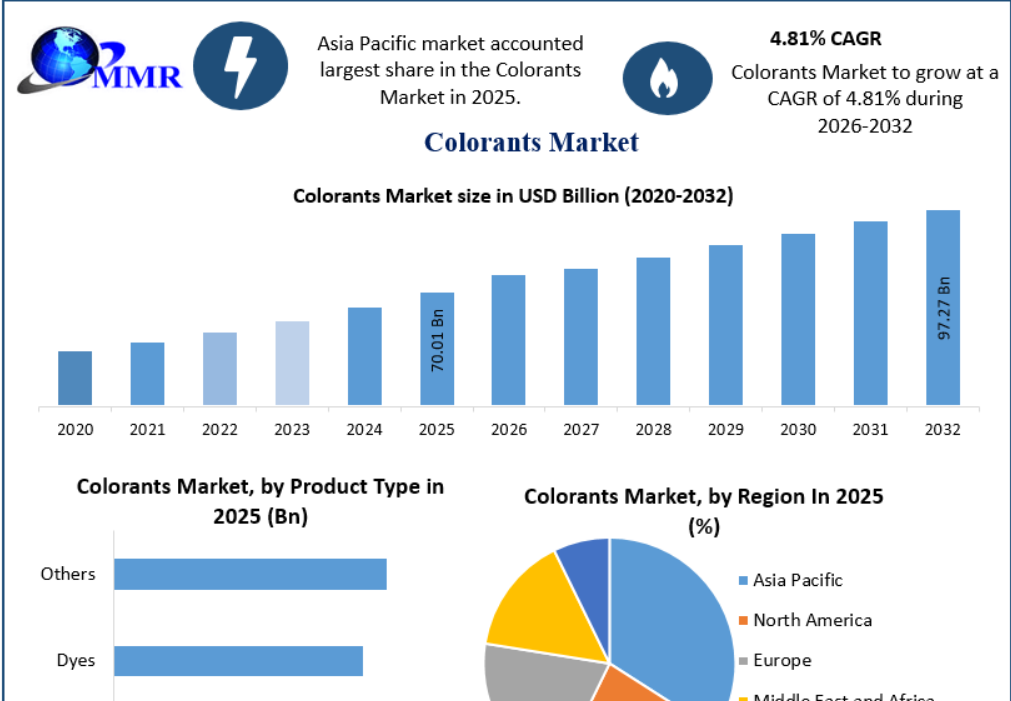
The global Colorants Market is an essential part of the specialty chemicals and materials industry, supplying dyes, pigments, and other coloring systems that provide visual appeal, product differentiation, and functional performance across a broad range of consumer and industrial products. Colorants are used in textiles, paints and coatings, plastics, packaging, food and beverages, cosmetics, paper and printing, automotive products, and other applications, making market demand closely connected with manufacturing activity, consumer preferences, construction, packaging consumption, and technological development. According to Maximize Market Research, the global Colorants Market was valued at USD 66.80 billion in 2025 and is expected to grow at a CAGR of 4.81% from 2026 to 2032, reaching nearly USD 97.27 billion by 2032. Colorants can broadly be differentiated into dyes, which are soluble and commonly used in applications such as textiles and selected food products, and pigments, which are insoluble particles used extensively in paints, plastics, printing inks, and coatings. The industry is undergoing a notable transformation as manufacturers increasingly balance color performance with environmental requirements, regulatory compliance, raw-material availability, and sustainability objectives. Growing demand for bio-based and natural colorants, high-performance pigments, digital printing inks, smart pigments, and application-specific formulations is creating new opportunities for producers. At the same time, manufacturers face challenges from raw-material price volatility, stringent regulations governing certain synthetic colorants, production costs, and supply-chain disruptions. Asia Pacific remains the dominant regional market, accounting for more than 45% of the global market in 2024, supported by large textile, plastics, packaging, pigment, and manufacturing industries in countries such as China and India. The increasing emphasis on sustainable chemistry is gradually changing the competitive landscape, encouraging companies to develop colorants that provide the required shade, stability, durability, and functionality while reducing environmental impact.
𝐃𝐨𝐰𝐧𝐥𝐨𝐚𝐝 𝐅𝐫𝐞𝐞 𝐏𝐃𝐅 𝐁𝐫𝐨𝐜𝐡𝐮𝐫𝐞 @https://www.maximizemarketresearch.com/request-sample/4033/
Colorants Market Segmentation
The Colorants Market is segmented by product type, source, end use, and region, with each segment reflecting different technical requirements and consumption patterns. By product type, the market is divided into pigments, dyes, and others. Dyes are widely utilized where color needs to be incorporated into materials through dissolution or chemical interaction, particularly across textile processing and selected consumer applications. Pigments, in contrast, remain important for applications requiring opacity, lightfastness, heat resistance, chemical stability, and surface coloration, including paints, coatings, plastics, printing inks, and construction materials. The distinction between dyes and pigments is increasingly important because customers are demanding colorants that combine visual quality with performance characteristics such as migration resistance, weatherability, dispersion, and regulatory compliance.
By source, the market is categorized into synthetic and natural colorants. Synthetic colorants continue to have a strong industrial position because they provide consistent shades, broad color ranges, predictable performance, and cost-effective large-scale production. However, the natural colorant segment is gaining momentum as consumers and manufacturers increasingly seek plant-based, microbial-based, mineral-derived, and other naturally sourced alternatives. Natural colorants derived from sources such as plants, algae, and microorganisms are attracting attention in food, beverages, cosmetics, textiles, and other applications where clean-label and environmentally conscious positioning is important. Recent industry research indicates that natural and bio-based colorants are expected to expand faster than conventional synthetic alternatives as sustainability and regulatory considerations increasingly influence product development.
Based on end use, the market includes paint and coatings, packaging, food and beverages, textiles, paper and printing, and others. The textile industry remains a major consumer of dyes because of the enormous global volume of apparel, home furnishings, technical textiles, and industrial fabrics. Colorants are essential for achieving specific shades, color consistency, wash resistance, and durability across different textile fibers. Paints and coatings represent another major application, with pigments used to provide color while also contributing to opacity, UV resistance, weather resistance, and other performance characteristics. In the packaging industry, colorants serve both aesthetic and branding functions, helping companies create recognizable product identities and attractive retail presentation. Increasing demand for flexible packaging, recyclable plastics, and premium packaging designs is creating opportunities for advanced color concentrates and pigment systems.
The food and beverage industry uses approved colorants to enhance visual appeal and maintain consistent product appearance, while the growing preference for clean-label products is encouraging manufacturers to investigate natural alternatives. Paper and printing applications rely on colorants for packaging graphics, publications, labels, commercial printing, and specialty products. Digital printing is creating an additional opportunity because modern printing systems require highly controlled colorants capable of delivering accurate shades and consistent performance.
Growth Drivers of the Colorants Market
One of the primary growth drivers for the Colorants Market is the continuing expansion of the textile, packaging, plastics, and paints and coatings industries. Increasing urbanization, consumer spending, infrastructure development, and industrial production are creating demand for colored materials across both developed and emerging economies. In particular, the expansion of packaging consumption is increasing the requirement for pigments, dyes, masterbatches, and color concentrates used to create visually attractive and brand-specific packaging. The growing use of plastics in consumer products, automotive components, construction materials, and packaging further strengthens demand for high-performance colorants.
The increasing consumer preference for natural and sustainable products represents another major growth factor. Consumers are paying greater attention to ingredient sources, environmental impacts, and product safety, particularly in food, beverages, cosmetics, and personal care. This is encouraging manufacturers to replace or supplement certain synthetic colorants with plant-based, algae-derived, microbial, and other naturally sourced alternatives. Recent research indicates that the global natural dyes and pigments market is growing as industries seek safer and more environmentally friendly coloring solutions. The development of improved extraction, stabilization, and formulation technologies is helping address some of the traditional limitations of natural colorants, including shade consistency, stability, and scalability.
Regulatory developments are also influencing innovation across the industry. Increasing scrutiny of certain synthetic chemicals and stricter environmental and safety requirements are encouraging manufacturers to reformulate products and invest in alternative chemistries. Regulations in major markets can increase compliance requirements and encourage companies to develop colorants with improved environmental and toxicological profiles. Rather than simply restricting market growth, these requirements are also creating opportunities for companies capable of developing compliant, sustainable, and high-performance alternatives.
Another important growth driver is the expansion of digital printing and advanced manufacturing technologies. Digital textile printing, digital packaging, 3D printing, and other digitally controlled processes require specialized colorants capable of producing precise shades and consistent results. The growth of short-run customized packaging and personalized consumer products is particularly favorable for digital printing technologies. Advanced coatings and engineered plastics are similarly creating demand for colorants that provide both appearance and additional functional properties.
Emerging Trends and Opportunities
A significant trend in the Colorants Market is the transition from conventional coloring agents toward multifunctional and smart colorants. Thermochromic and photochromic pigments can change appearance in response to temperature or light, creating applications in packaging, security printing, automotive products, and consumer goods. Functional colorants can also contribute to properties such as UV protection, antimicrobial performance, heat reflection, or improved durability. These developments are expanding the role of colorants from purely decorative additives to performance-oriented material components.
The growth of bio-based colorants is another defining trend. Manufacturers are investigating plant-derived pigments, microbial fermentation, algae-based colorants, and waste-derived raw materials to create more sustainable products. Innovations in biotechnology are particularly promising because microorganisms can potentially produce specific pigments under controlled conditions, providing an alternative to conventional chemical synthesis. Although scalability, cost, color range, and stability remain challenges, continued research and investment could improve the commercial viability of these alternatives.
Regional Outlook
Asia Pacific is the leading regional market for colorants, supported by its extensive textile manufacturing base, expanding plastics industry, packaging production, construction activity, and growing consumer markets. China and India are particularly significant because of their large-scale textile and pigment manufacturing capabilities. According to Maximize Market Research, Asia Pacific accounted for more than 45% of the global Colorants Market in 2024, demonstrating the region's importance to global production and consumption.
North America represents an important market due to its advanced manufacturing infrastructure, strong packaging and automotive industries, sophisticated coatings sector, and increasing demand for sustainable and high-performance colorants. The region also provides opportunities for specialty pigments and natural colorants used in food, cosmetics, and personal care products. Europe is characterized by strict environmental and chemical regulations, encouraging manufacturers to develop safer, recyclable, low-impact, and bio-based colorant technologies. Meanwhile, Latin America and the Middle East & Africa offer emerging opportunities through industrial development, construction, packaging, textiles, and expanding consumer markets.
𝐃𝐨𝐰𝐧𝐥𝐨𝐚𝐝 𝐅𝐫𝐞𝐞 𝐏𝐃𝐅 𝐁𝐫𝐨𝐜𝐡𝐮𝐫𝐞 @https://www.maximizemarketresearch.com/request-sample/4033/
Recent Developments in the Colorants Market
Recent developments show that companies are increasingly focusing on sustainability, product portfolio expansion, capacity optimization, and strategic consolidation. A notable development highlighted by Maximize Market Research occurred in March 2022, when Colorants International AG, a joint venture between Heubach Group and SK Capital Partners, acquired a 3.36525% stake, increasing its holding in the company to 54.37%. Such transactions demonstrate the importance of strategic ownership and consolidation in a market where manufacturers are seeking broader product portfolios, stronger geographic reach, and improved production capabilities.
The industry is also experiencing developments in bio-based pigment technology, circular-economy solutions, and sustainable formulations. Leading manufacturers are investing in alternative raw materials and production processes that can reduce environmental impacts while maintaining color quality and performance. In parallel, manufacturers are developing high-performance pigments for plastics, coatings, printing inks, and specialty applications that require improved heat stability, durability, dispersion, and resistance characteristics.
Another important development is the growing adoption of digital printing and specialty effect pigments. Demand for customized packaging, short production runs, digitally printed textiles, and premium consumer products is encouraging colorant suppliers to develop more precise and application-specific formulations. Smart colorants that respond to environmental conditions are also opening new possibilities in security printing, interactive packaging, and advanced automotive applications.
Competitive Landscape and Future Outlook
The competitive landscape of the Colorants Market includes major specialty chemical companies, pigment manufacturers, dye producers, printing-ink suppliers, and regional colorant specialists. Key companies identified by Maximize Market Research include BASF SE, Huntsman Corporation, Sensient Technologies, Sun Chemical, PPG Industries, Sherwin-Williams, Dow Chemical Company, LANXESS AG, Archroma, AkzoNobel, DIC Corporation, Sudarshan Chemical Industries, Kiri Industries, and Atul Ltd., among others. Competition is increasingly based on color consistency, product performance, regulatory compliance, sustainability, raw-material efficiency, application expertise, innovation, and supply reliability.
For full access to the comprehensive strategic report, visit:https://www.maximizemarketresearch.com/market-report/global-colorants-market/4033/
Future Outlook
The future of the Colorants Market will be shaped by the intersection of sustainability, digitalization, advanced materials, and changing consumer expectations. According to Maximize Market Research, the market is projected to increase from USD 66.80 billion in 2025 to nearly USD 97.27 billion by 2032, representing a 4.81% CAGR from 2026 to 2032. While raw-material price volatility, regulatory requirements, manufacturing costs, and the technical limitations of some natural alternatives remain challenges, the long-term outlook remains positive. Companies that successfully combine high-performance synthetic technologies with bio-based alternatives, smart pigments, sustainable production methods, and application-specific solutions are likely to strengthen their market positions. As color continues to serve not only an aesthetic purpose but also a role in product identification, branding, functionality, safety, and material performance, colorants are expected to remain an important enabling technology across global consumer and industrial markets.
About Maximize Market Research
Maximize Market Research is a multifaceted market research and consulting company with professionals from several industries. Some of the industries we cover include medical devices, pharmaceutical manufacturers, science and engineering, electronic components, industrial equipment, technology and communication, cars and automobiles, chemical products and substances, general merchandise, beverages, personal care, and automated systems. To mention a few, we provide market-verified industry estimations, technical trend analysis, crucial market research, strategic advice, competition analysis, production and demand analysis, and client impact studies.
Contact Maximize Market Research
3rd Floor, Navale IT Park, Phase 2
Pune Bangalore Highway, Narhe,
Pune, Maharashtra 411041, India
sales@maximizemarketresearch.com
+91 96071 95908, +91 9607365656

 English
 Arabic
 French
 Spanish
 Portuguese
 Deutsch
 Turkish
 Italiano
 Russian
 Romaian
 Portuguese (Brazil)
 Greek
Greek
