
Military Sensors Market Expansion Supported by IoT and MEMS Technologies
Market Overview
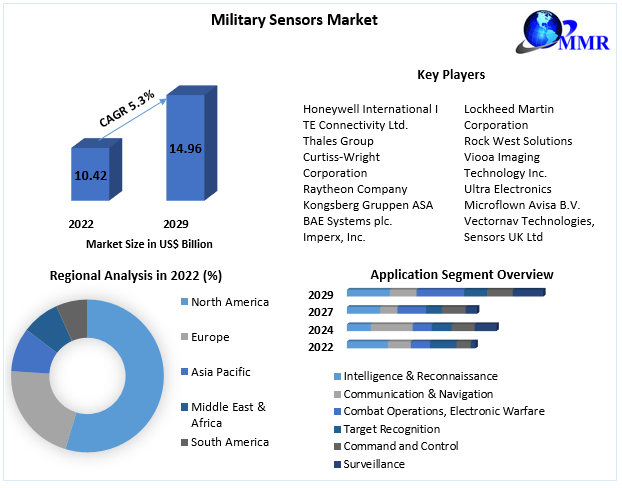
The Military Sensors Market is witnessing steady expansion as armed forces increasingly deploy advanced sensing technologies for surveillance, reconnaissance, navigation, electronic warfare, target recognition, command and control, and missile defense. According to Maximize Market Research, the market was valued at USD 10.42 billion in 2022 and is projected to reach USD 14.96 billion by 2029, registering a CAGR of 5.3% during 2023–2029. North America held the leading regional position in 2022, supported by substantial military modernization programs, particularly in the United States.
The market is being driven by increasing defense expenditure, modernization of military aircraft and armored vehicles, rising demand for unmanned systems, and the growing requirement for real-time battlefield intelligence. Modern military platforms require sensors capable of detecting, identifying, tracking, and classifying threats under challenging operating conditions. The increasing adoption of smaller, smarter, lower-power, and more affordable sensors is another important growth factor. MEMS-based devices, electro-optical systems, infrared sensors, radar technologies, vibration sensors, navigation sensors, and advanced electronic warfare sensors are becoming increasingly important to next-generation defense platforms.
Significant opportunities are emerging from sensor fusion, artificial intelligence, edge computing, autonomous platforms, space-based surveillance, hypersonic threat detection, and GPS-independent navigation. The integration of multiple sensor inputs into a unified operational picture can improve decision-making and shorten response times. Opportunities are also increasing as governments seek flexible, networked military systems capable of operating across land, air, sea, space, and cyber domains.
United States Market Trends and Investment in 2025
The United States remained one of the most important growth centers for military sensor technologies in 2025, supported by rising defense modernization requirements and increased attention to missile defense, hypersonic threats, autonomous systems, and advanced battlefield awareness. In June 2025, the U.S. Department of Defense outlined a proposed FY2026 national defense budget of USD 1.01 trillion, representing a 13.4% increase from FY2025. The proposal emphasized homeland security, Indo-Pacific deterrence, shipbuilding, missile defense, munitions production, and strengthening the defense industrial base.
Corporate investment also demonstrated strong demand for advanced sensors. Raytheon, an RTX business, received a USD 646 million U.S. Navy contract in June 2025 for continued production and sustainment of the SPY-6 radar family, which is designed to improve maritime detection and defense capabilities. In April 2025, Raytheon's LTAMDS air and missile defense sensor transitioned from prototype to production after completing U.S. Army flight testing and achieving Milestone C. Lockheed Martin also delivered the first TPY-4 radar to the U.S. Air Force in April 2025, featuring a software-defined sensor architecture designed to adapt to emerging threats.These developments indicate that investments in radar, infrared sensing, electronic warfare, and autonomous sensing technologies will remain central to U.S. defense modernization.
Request To Free Sample of This Strategic Report ➤ https://www.maximizemarketresearch.com/request-sample/33143/
Military Sensors Market Segmentation
-
By Component
-
Hardware
-
Software
-
-
By Platform
-
Land
-
Naval
-
Airborne
-
Space
-
-
By Application
-
Intelligence and Surveillance
-
Communication
-
Navigation
-
Electronic Warfare
-
Target Recognition
-
Command and Control
-
-
By Sensor Type
-
Radar Sensors
-
Infrared Sensors
-
Electro Optical Sensors
-
Pressure Sensors
-
Temperature Sensors
-
Proximity Sensors
-
Position Sensors
-
Vibration Sensors
-
Image Sensors
-
Motion Sensors
-
Other Sensors
-
-
By Geography
-
North America
-
Europe
-
Asia Pacific
-
Latin America
-
Middle East and Africa
-
Competitive Analysis
The military sensors industry is competitive, with established defense and technology companies focusing on radar, infrared, electro-optical, navigation, electronic warfare, and integrated sensing capabilities. Among the prominent companies identified in the market landscape are Honeywell International Inc., TE Connectivity Ltd., Thales Group, Raytheon Company, and Lockheed Martin Corporation, alongside BAE Systems, Curtiss-Wright, Kongsberg Gruppen, Esterline Technologies, and other specialized sensor manufacturers.
RTX Raytheon is strengthening its position through investments in next-generation radar and sensor technologies. In 2025, its LTAMDS program advanced into production, while its SPY-6 radar received additional U.S. Navy funding. Raytheon also delivered an AN/TPY-2 radar incorporating a complete Gallium Nitride array, with GaN providing increased sensitivity and surveillance capability for missile defense.
Lockheed Martin is expanding advanced sensing through radar, infrared, and quantum technologies. In 2025, the company received a U.S. government contract to prototype a quantum-enabled inertial navigation system using quantum sensing for GPS-independent positioning.Its IRST21 infrared sensor also achieved initial operational capability for the F/A-18 Super Hornet, supporting long-range passive detection of airborne targets.
BAE Systems continues investing in electronic warfare, autonomy, electro-optical sensors, navigation, precision guidance, and space technologies. Its 2025 activities included development of technologies that connect sensors and automate intelligence gathering, including AI-based enhancements for combat management systems.
TE Connectivity maintains a broad portfolio of aerospace and defense sensors, including temperature, pressure, vibration, position, force, tilt, and ultrasonic technologies. Its MEMS-based solutions are increasingly relevant to compact, lightweight, power-efficient military applications.
Thales Group remains an important defense electronics and sensing provider, supported by its capabilities across radar, surveillance, avionics, and mission systems. Its broad defense technology portfolio positions the company to benefit from increasing demand for integrated sensing and situational awareness.
Regional Analysis
United States: The U.S. is expected to remain a major military sensor market because of high defense spending, advanced military platforms, missile defense programs, and strong investment in radar and electronic warfare. The 2025 defense budget proposal and multiple sensor-related contracts demonstrate continued government demand.
United Kingdom: The UK market is benefiting from modernization of air and defense capabilities. In June 2025, the UK Government committed £204.6 million toward production and integration of the advanced ECRS Mk2 radar for Royal Air Force Eurofighter Typhoon aircraft. The radar is designed to detect, identify, and track multiple targets while providing advanced electronic warfare capabilities.
Germany: Germany represents an important European opportunity as defense modernization and NATO capability requirements increase. Demand for advanced radar, surveillance, navigation, and electronic warfare systems is expected to support sensor adoption.
France: France's focus on sovereign defense technologies, advanced aircraft, naval platforms, and integrated surveillance systems creates opportunities for sophisticated military sensing technologies.
Japan: Japan's military modernization programs, regional security requirements, and investment in advanced air, missile, naval, and space capabilities are supporting demand for advanced sensors. Maximize Market Research identifies Japan's continuing modernization efforts as a contributor to Asia Pacific military sensor growth.
China: China's increasing defense procurement and military modernization are major contributors to Asia Pacific market growth. The report identifies increased procurement in China as one of the factors supporting regional expansion.
Request To Free Sample of This Strategic Report ➤ https://www.maximizemarketresearch.com/request-sample/33143/
Key Players
-
Honeywell International Inc.
-
TE Connectivity Ltd.
-
Thales Group
-
Curtiss-Wright Corporation
-
Raytheon Company
-
BAE Systems plc
-
Lockheed Martin Corporation
-
Kongsberg Gruppen ASA
-
Esterline Technologies Corporation
-
Imperx Inc.
-
Ultra Electronics
-
Chemring Sensors and Electronic Systems Inc.
-
AMETEK Sensors and Fluid Management Systems
-
VectorNav Technologies LLC
-
Microflown Avisa B.V.
Conclusion
The global Military Sensors Market is positioned for sustained growth as defense organizations transition toward connected, autonomous, multi-domain military operations. The projected increase from USD 10.42 billion in 2022 to USD 14.96 billion by 2029 reflects the growing strategic importance of high-performance sensing technologies.
In our view, the strongest opportunities will arise from AI-enabled sensor fusion, Gallium Nitride radar, MEMS miniaturization, infrared sensing, quantum navigation, autonomous platforms, and advanced missile and hypersonic detection. Companies that combine sensing hardware with intelligent software, secure communications, and real-time data processing will be well positioned to capture future demand. Continued defense modernization and government investment, particularly in the United States and other major military powers, are expected to remain the primary catalysts for market expansion.
About Maximize Market Research
Maximize Market Research Pvt. Ltd. (MMR) is a global market research and consulting company that provides reliable, data-focused, and practical business insights. The firm serves a wide range of industries, including healthcare, pharmaceuticals, technology, automotive, electronics, chemicals, personal care, and consumer goods. Through market forecasts, competitive analysis, strategic consulting, and industry impact assessments, MMR helps organizations understand changing market conditions, identify growth opportunities, and make informed business decisions for long-term success.
Contact Us
Maximize Market Research Pvt. Ltd.
2nd Floor, Navale IT Park Phase 3
Pune Bangalore Highway, Narhe
Pune, Maharashtra 411041, India
Phone: +91 9607365656
Email: sales@maximizemarketresearch.com

 English
 Arabic
 French
 Spanish
 Portuguese
 Deutsch
 Turkish
 Dutch
Dutch
 Italiano
 Russian
 Portuguese (Brazil)
 Greek
Greek
