
Gold Minting Services: How Refined Gold Becomes Finished Bullion Products
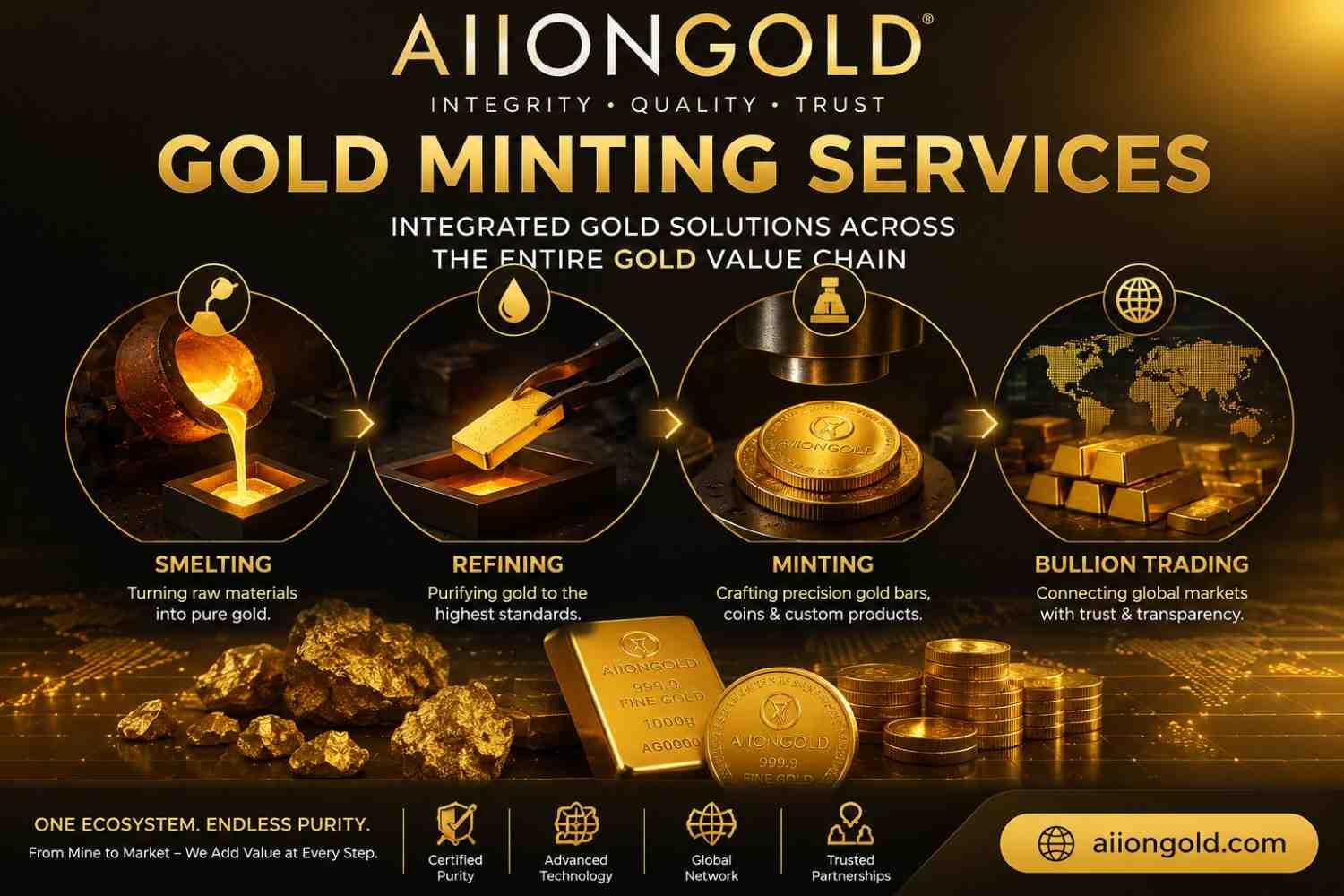
Gold has a long journey before it reaches the hands of a buyer, investor, manufacturer, or bullion trader. Behind every finished gold bar, coin, or minted product are several carefully managed stages, including sourcing, smelting, refining, manufacturing, quality control, and distribution. Gold Minting Services represent an important stage in this value chain because they transform refined precious metal into finished physical gold products with defined specifications.
For businesses exploring the physical gold industry, understanding how minting works can provide useful insight into product quality, manufacturing standards, responsible sourcing, and bullion-market requirements.
What Are Gold Minting Services?
Gold Minting Services are specialized manufacturing services used to convert refined gold into finished products such as gold bars, coins, rounds, medals, and customized precious-metal products.
Depending on the product, the process may involve melting, casting, forming, pressing, engraving, polishing, inspection, and packaging. The objective is to produce gold products with consistent characteristics such as weight, dimensions, design, appearance, and required purity.
Minting is therefore different from refining. Refining primarily focuses on purification, while minting focuses on converting refined gold into a finished physical product.
How Does the Gold Minting Process Work?
Although the exact process varies according to the product, the gold value chain can generally be understood through several connected stages.
1. Gold Sourcing and Initial Processing
The journey begins with gold-bearing material obtained through appropriate supply channels. Depending on its form and composition, the material may undergo smelting or other processing before it reaches the refining stage.
Responsible sourcing has become an important consideration throughout the precious-metals industry. LBMA's Responsible Gold Guidance uses a risk-based due-diligence framework for applicable Good Delivery refiners, covering areas such as supply-chain risks, management systems, independent assurance, and reporting.
2. Gold Refining
Refining removes unwanted materials and impurities to produce gold at the required level of purity. Accurate testing and documentation are important because the characteristics of refined gold influence its subsequent manufacturing and commercial use.
Once the refined metal meets the required specifications, it can be prepared for manufacturing.
3. Melting and Forming
Refined gold may be melted and prepared according to the requirements of the intended product. Bars, coins, rounds, and specialty products can require different manufacturing approaches.
Controlled processing helps maintain consistency in dimensions, weight, surface finish, and overall product characteristics.
4. Precision Minting
This is where Gold Minting Services become particularly important. Precision manufacturing can give the product its final shape, markings, design, and finish.
For example, a minted gold coin may require carefully controlled dimensions, design details, edge characteristics, and weight. A gold bar may require specific markings, serial identification, weight information, and finishing depending on its intended market.
5. Quality Control and Distribution
After manufacturing, finished products can be inspected and verified before packaging, storage, distribution, or bullion trading.
Quality control can include checking weight, dimensions, appearance, markings, and other applicable specifications. Strong documentation and traceability can also support confidence throughout the physical gold supply chain.
Why Are Gold Minting Services Important?
Professional Gold Minting Services help bridge the gap between refined gold and finished physical products. Without a controlled manufacturing stage, refined metal cannot simply be assumed to be a standardized bullion product.
For businesses evaluating a minting partner, useful considerations include:
-
Manufacturing and production capabilities
-
Gold testing and quality-control procedures
-
Weight and dimensional accuracy
-
Product finishing and marking
-
Documentation and traceability
-
Secure handling and storage
-
Responsible sourcing policies
-
Experience with physical gold products
International bullion markets also emphasize quality and responsible sourcing. LBMA manages Good Delivery standards for gold and silver and requires Good Delivery List refiners to follow its Responsible Sourcing Programme, including annual independent assurance.
How Do Gold Minting Services Connect With Bullion Trading?
Minting is not an isolated activity. It is part of a wider physical gold ecosystem:
Sourcing → Smelting → Refining → Melting → Minting → Quality Control → Storage → Bullion Trading
Each stage has a different purpose. Smelting helps process gold-bearing materials, refining focuses on purity, minting creates finished products, and bullion trading connects physical gold products with commercial markets.
This integrated view is particularly useful for organizations involved in smelting, refining, minting, and bullion trading, because quality and traceability can influence the value chain from beginning to end.
Frequently Asked Questions About Gold Minting Services
What are Gold Minting Services?
Gold Minting Services involve manufacturing refined gold into finished products such as bars, coins, rounds, medals, and other physical gold products according to defined specifications.
What is the difference between gold refining and gold minting?
Gold refining focuses on removing impurities and achieving the required purity. Gold minting focuses on manufacturing the refined metal into a finished product with specific physical characteristics.
Can refined gold be used to make coins and bars?
Yes. Refined gold can be manufactured into coins, bars, rounds, and other products, depending on the required specifications and production process.
Why is quality control important in gold minting?
Quality control helps verify important characteristics such as weight, dimensions, appearance, markings, and applicable product specifications.
Are Gold Minting Services connected to bullion trading?
Yes. Minting can prepare refined gold for finished physical products that may subsequently enter storage, distribution, or bullion-trading channels.
Why does responsible sourcing matter?
Responsible sourcing helps businesses identify and manage risks within the gold supply chain. International frameworks such as LBMA's Responsible Gold Guidance emphasize due diligence and responsible supply-chain practices for applicable refiners.
Conclusion
Gold Minting Services are an essential link between refined precious metals and finished physical gold products. From sourcing and smelting to refining, precision manufacturing, quality control, storage, and bullion trading, every stage contributes to the integrity of the final product.
For businesses researching the gold industry, the most important considerations go beyond appearance. Purity, accurate weight, manufacturing consistency, documentation, traceability, responsible sourcing, and quality-control practices all contribute to a reliable physical gold ecosystem.
AIIONGOLD's focus on the broader gold value chain—including smelting, refining, minting, and bullion trading—reflects the importance of viewing gold as a complete lifecycle rather than simply a finished commodity.
For AEO and GEO, the strongest content approach is to answer genuine user questions clearly, provide useful original context, and demonstrate expertise rather than repeating keywords. Google has specifically stated that its guidance for generative AI search features continues to emphasize established SEO fundamentals and helpful, non-commodity content.

 English
 French
 Spanish
 Portuguese
 Deutsch
 Turkish
 Dutch
Dutch
 Italiano
 Russian
 Romaian
 Portuguese (Brazil)
 Greek
Greek
