Mountain Bike Market: Growth, Segmentation, Trends and Recent Developments
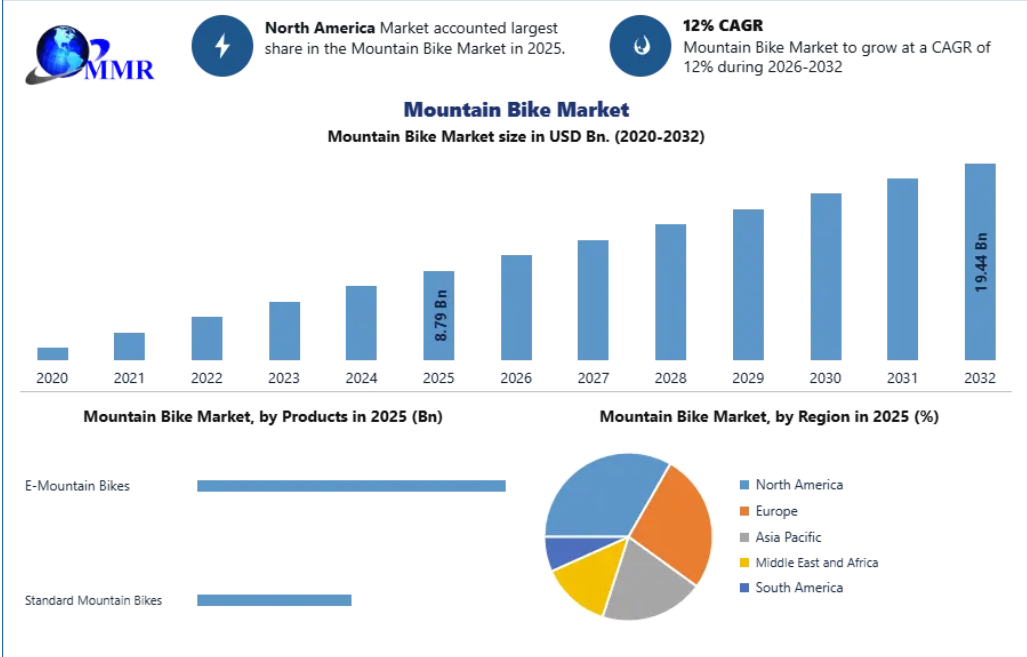
The Mountain Bike Market is witnessing strong expansion as recreational cycling, adventure tourism, competitive mountain biking, outdoor fitness, and sustainable transportation gain popularity across global markets. Mountain bikes are specifically designed for off-road environments and are engineered to provide durability, stability, traction, and control across challenging surfaces such as rocky trails, loose dirt, muddy paths, grassy tracks, and steep slopes. The growing popularity of outdoor recreational activities and increasing awareness of cycling as a healthy and environmentally friendly activity are encouraging more consumers to participate in mountain biking. According to Maximize Market Research, the global Mountain Bike Market was valued at USD 8.79 billion in 2025 and is expected to reach USD 19.44 billion by 2032, growing at a CAGR of 12% during 2026–2032. The market is also benefiting from the development of mountain biking tourism, organized competitions, cycling events, improved trail infrastructure, and increasing participation among recreational riders. At the same time, manufacturers are focusing on lightweight frames, advanced suspension systems, improved braking technologies, electronic components, and electric mountain bikes to address changing consumer preferences. The increasing availability of technologically advanced products is expanding the market beyond traditional sporting applications and attracting consumers interested in adventure, fitness, leisure, and sustainable outdoor mobility.
𝐃𝐨𝐰𝐧𝐥𝐨𝐚𝐝 𝐅𝐫𝐞𝐞 𝐏𝐃𝐅 𝐁𝐫𝐨𝐜𝐡𝐮𝐫𝐞 @https://www.maximizemarketresearch.com/request-sample/56758/
Mountain Bike Market Segmentation
The Mountain Bike Market can be segmented based on type, product, application, distribution channel, and region. Based on type, the market includes cross-country bikes, all-mountain bikes, downhill bikes, freeride bikes, dirt jumping bikes, and others. Among these categories, cross-country bikes held the largest market share and are expected to maintain their leading position during the forecast period. These bicycles are designed for long-duration riding across forests, nature trails, and varied outdoor landscapes. Their emphasis on endurance, efficient handling, and controlled performance makes them suitable for riders who cover longer distances rather than focusing exclusively on extreme downhill activities.
All-mountain bikes are designed for demanding mountainous terrain and rough trails, requiring durable components capable of handling forces from different directions. Their versatility makes them attractive to riders who want a single bicycle capable of handling climbs, descents, technical sections, and uneven surfaces. Downhill bikes are optimized for steep descents and high-speed technical riding, while freeride bikes provide greater flexibility for riders performing jumps, technical maneuvers, and aggressive trail activities. Dirt jumping bikes are designed for jumps, tricks, and specially constructed dirt tracks. The diversity of bike types allows manufacturers to target riders according to terrain, riding style, technical ability, and recreational preferences.
By product, the market is divided into E-Mountain Bikes and Standard Mountain Bikes. Standard mountain bikes continue to represent an important part of the market because they are widely used for recreational riding, fitness, competition, and outdoor adventure. However, E-Mountain Bikes are becoming an increasingly important growth area as electric assistance makes challenging trails and longer-distance rides more accessible. E-MTBs combine traditional mountain-bike designs with electric motors and batteries, allowing riders to receive additional assistance while climbing or navigating difficult terrain. Their growing popularity is attracting both experienced riders and consumers who may otherwise find demanding mountain trails physically challenging.
The expansion of the e-mountain-bike category is also encouraging innovation in battery capacity, motor efficiency, charging systems, frame integration, and electronic controls. The development of rapid-charging battery systems and improved electric-drive technologies is making E-MTBs increasingly suitable for adventure tourism and recreational applications. Recent developments demonstrate that manufacturers are increasingly positioning electric mountain bikes as technologically advanced products rather than simply conventional bicycles with electric assistance.
Based on application, the market is segmented into racing and leisure. Racing represents an important application because mountain-bike competitions provide manufacturers with opportunities to demonstrate product performance, suspension technology, frame design, braking systems, and rider-control technologies. Competitive events also contribute to greater visibility for mountain biking and encourage new participants to enter the sport. The increasing organization of mountain-bike competitions and the growing popularity of cycling events are therefore supporting market demand.
Leisure represents a broader application segment encompassing recreational riders, outdoor enthusiasts, tourists, fitness-conscious consumers, and individuals seeking adventure activities. Mountain biking provides a combination of physical exercise, outdoor exploration, and recreation, making it attractive to consumers seeking alternatives to conventional indoor fitness activities. The expansion of mountain biking destinations and tourism infrastructure is further strengthening this segment.
By distribution channel, the market includes offline and online channels. Offline sales remain important because consumers often want to physically inspect a bicycle, assess its frame size, test riding characteristics, and obtain advice from specialized retailers before purchasing. Bicycle dealers and specialty stores can also provide maintenance, repairs, component replacement, and customization services, strengthening their role throughout the product lifecycle.
At the same time, online distribution is gaining importance as e-commerce platforms enable consumers to compare models, specifications, prices, components, and customer reviews. Digital channels allow manufacturers and retailers to reach consumers beyond traditional geographic markets. The availability of detailed product information and online purchasing options is making premium and specialized mountain-bike models more accessible to a broader customer base.
Growth Drivers of the Mountain Bike Market
One of the major factors supporting market expansion is the increasing popularity of outdoor recreational activities and adventure sports. Consumers are becoming more interested in experiences that combine exercise, nature, and recreation. Mountain biking provides an opportunity to explore natural landscapes while engaging in physically demanding activity, supporting demand among fitness-conscious and adventure-oriented consumers.
Mountain biking tourism is another significant growth driver. The development of mountain trails and cycling destinations can generate economic activity for local communities by attracting tourists, riders, accommodation providers, restaurants, equipment rental businesses, and other service providers. Maximize Market Research highlights mountain-bike tourism as a catalyst for economic development in several emerging markets.
Growing awareness of the health benefits of cycling is also encouraging participation. Mountain biking provides cardiovascular exercise and can contribute to physical fitness while allowing participants to spend time outdoors. Increasing awareness of active lifestyles and recreational fitness is therefore creating a favorable environment for market growth.
Another important driver is the growing interest in sustainable and non-polluting transportation. Mountain biking is primarily associated with recreation, but bicycles more broadly represent an environmentally friendly transportation option. Increasing environmental awareness and interest in sustainable mobility are strengthening the broader cycling ecosystem and supporting investment in bicycle infrastructure and related products.
The market is also being influenced by technological advancement. Manufacturers are incorporating lightweight materials, advanced suspension systems, improved braking technologies, sophisticated drivetrains, and electronic components into mountain bikes. These improvements can enhance rider control, comfort, durability, and performance. Electronic suspension systems and electric-assistance technologies are particularly important emerging areas.
Technology Trends and Innovation
The mountain-bike industry is increasingly focused on lightweight and high-performance frame technologies. Aluminum and carbon-fiber frames enable manufacturers to balance strength and weight according to the intended riding application. However, fluctuations in raw-material costs and supply-chain conditions can influence manufacturing expenses and product pricing. Maximize Market Research specifically identifies the impact of supply-chain disruptions and changing costs associated with aluminum-frame sourcing and carbon-fiber production.
Another important trend is the integration of electronic suspension technology. Advanced suspension systems can automatically adjust characteristics according to terrain and riding conditions, potentially improving efficiency and control. In January 2025, SCOTT Sports SA introduced its SCOTT Spark 2025 lineup with the automated RockShox Flight Attendant electronic suspension system, representing a notable development in electronic suspension technology for cross-country riding.
The increasing adoption of electric mountain bikes is another defining trend. Improvements in batteries, motors, charging technology, and electronic controls are expanding the capabilities of E-MTBs. These developments are particularly relevant for riders interested in longer-distance routes, challenging climbs, and adventure tourism.
Recent Developments in the Mountain Bike Market
Recent industry developments demonstrate the increasing focus on electric mobility, advanced suspension, competitive cycling, and adventure tourism. In February 2026, Tata Group subsidiary Stryder Cycle launched the Voltic X and Voltic GO e-mountain bikes, featuring 48V splash-proof batteries and rapid three-hour charging. The development strengthens the company's position in the growing E-MTB segment and targets consumers seeking technologically advanced products.
In March 2026, Pace Cycles officially released the Pace RC629, a hardtail mountain bike designed around progressive trail geometry. The product addresses renewed interest in hardtail bikes among riders seeking simplicity and performance on technical terrain.
Another notable development occurred in May 2025, when Škoda Auto secured a two-year agreement as the Official Partner of the 2025 and 2026 UCI Mountain Bike World Championships. The partnership includes the use of electric and hybrid support vehicles, connecting the sport with broader sustainable transportation initiatives.
These developments indicate that the mountain-bike industry is increasingly connected with electric mobility, digital technology, sustainability, competitive sports, and adventure tourism. Product innovation is consequently becoming an important method for manufacturers to differentiate themselves in an increasingly competitive market.
𝐃𝐨𝐰𝐧𝐥𝐨𝐚𝐝 𝐅𝐫𝐞𝐞 𝐏𝐃𝐅 𝐁𝐫𝐨𝐜𝐡𝐮𝐫𝐞 @https://www.maximizemarketresearch.com/request-sample/56758/
Regional Outlook
North America is expected to account for the largest share of the global Mountain Bike Market, supported by the strong popularity of mountain biking as an adventure sport, high consumer purchasing power, organized cycling bodies, competitions, media exposure, tourism, and growing awareness of cycling's health benefits.
Europe represents the second-largest regional market, with countries such as Germany and France contributing significantly to demand. The region benefits from an established cycling culture, outdoor recreation, organized sporting events, and growing interest in sustainable transportation.
Asia Pacific is expected to generate the fastest growth during the forecast period. China and India are identified as important markets, supported by rising disposable incomes, increasing participation in recreational sports, expanding cycling infrastructure, and growing awareness of health and fitness. The expansion of e-commerce is also helping manufacturers reach consumers across emerging markets.
The Middle East and Africa are expected to experience moderate growth, with opportunities particularly concentrated in Gulf economies such as Saudi Arabia and the UAE, where investment in tourism, outdoor recreation, and adventure infrastructure is creating new opportunities for mountain biking.
Competitive Landscape
The competitive landscape includes established bicycle manufacturers, component suppliers, and emerging electric-bike companies. Key players identified by Maximize Market Research include Trek Bicycle Corporation, Giant Bicycles, Specialized Bicycle Components, Santa Cruz Bicycles, Cannondale, Scott Sports SA, Merida Industry, Canyon Bicycles, Dorel Sports, Shimano Inc., Bosch, XDS Bikes, BH Bikes, Pivot Cycles, Yeti Cycles, Marin Bikes, Kona Bicycle Company, Diamondback Bicycles, Rocky Mountain Bicycles, GT Bicycles, Orbea, Cube Bikes, Norco Bicycles, Transition Bikes, and Commencal.
Companies are increasingly concentrating on product innovation, lightweight construction, electronic suspension, electric propulsion, improved battery systems, competition-oriented designs, online distribution, and expansion into emerging markets. Manufacturers are also using professional competitions and sponsorships to demonstrate product capabilities and strengthen brand visibility.
For full access to the comprehensive strategic report, visit:https://www.maximizemarketresearch.com/market-report/global-mountain-bike-market/56758/
Conclusion
The Mountain Bike Market is entering a strong growth phase as outdoor recreation, adventure tourism, cycling competitions, health consciousness, sustainable mobility, and technological innovation converge. The market was valued at USD 8.79 billion in 2025 and is projected to reach USD 19.44 billion by 2032 at a CAGR of 12% during 2026–2032. Cross-country bikes continue to represent a major type segment, while E-Mountain Bikes are creating an important new avenue for technological and commercial growth. Racing and leisure applications are both contributing to demand, while online channels are expanding consumer access to specialized products. Going forward, advances in electronic suspension, lightweight materials, electric propulsion, battery technology, and connected cycling systems are expected to reshape the competitive landscape. The combination of performance, recreation, health, sustainability, and adventure is likely to keep mountain biking attractive to both established enthusiasts and new participants worldwide.


 English
 Arabic
 French
 Spanish
 Portuguese
 Deutsch
 Turkish
 Dutch
Dutch
 Italiano
 Romaian
 Portuguese (Brazil)
 Greek
Greek
